



Seventeen years in health policy. Fifteen in the Senate, two and a half in the Trump White House. Preventive services fights, coverage mandates, hearings and litigation about what your health plan owes you for free.
Men’s fertility and vitality never came up. Not that I remember anyway.
For a long time I assumed that was because there was nothing to sell. No drug, no sales force, no lobbyist, no earthly reason for a Senate staffer to learn the word spermatogenesis.
But I had it backwards. There’s plenty to sell, and I’m not sayin’ but I’m just sayin’ that maybe that’s related to the problem.
Can’t get an erection? There’s a little blue pill, a rep in every urology waiting room in America, and a Super Bowl ad with a couple inexplicably rowing a boat across a lake. Big Pharma doesn’t need to know why you can’t get an erection. The pill works either way, and never fixing the root cause is better for the business model.
If your sperm is wrecked, that’s where the real money is.
And then there’s my favorite evil empire: Big Fertility. IVF runs at least $12,000 a round, and the technology at the heart of it was built for exactly this moment. Intracytoplasmic sperm injection (ICSI) is a technician picking up one single sperm with a needle and injecting it straight into an egg. The clinical literature describes its advantage as being independent of sperm count and morphology. (Never mind that this bypasses and passes on any genetic issues that caused that sperm to be inept to the next generation, cool-cool-cool).
Independent of sperm count. That’s the pitch. The entire procedure is engineered to make a man’s number stop mattering.
And what was a last resort became the default. ICSI went from 11 percent of American IVF cycles in 1995 to 57.5 percent by 2004, while the share of patients diagnosed with male-factor infertility held steady. In cycles with no male factor at all, ICSI use climbed from 15.4 percent to 66.9 percent between 1996 and 2012, and the research verdict on that is no improvement in fertilization or live birth rates. One large center reports 56,855 cycles over three decades, 91.6 percent of them ICSI.
So the industry’s answer to a fifty-year collapse in male fertility is a needle, billed per cycle, that routes around the problem without anybody having to ask what caused it. Every step of that needle has a billing code. Asking why his count collapsed has none.
And both industries know exactly what they’ve got. The blue pill and the needle earn their living off male reproductive failure, and both earn more the longer that failure goes unexplained.
High Confidence is as High as It Gets
HHS ordered up a review of glyphosate and male reproductive health, and the scientists at NIEHS went and did their jobs. Fifty-five animal studies. They searched the Chinese databases American reviews skip. They split pure glyphosate from the Roundup-style formulations on purpose, in advance, written right into the protocol, so nobody at Bayer could come back later and pin it all on the surfactants. Then they graded what they found.
“High confidence” that glyphosate and the commercial formulations cut sperm abundance and overall sperm health. High confidence that the formulations wreck motility and sperm shape. Moderate confidence that both knock down testosterone.
High is the top of their scale. There’s no “extremely high,” no “super-duper high.”
The paper came out November 13th in Environment International and was largely met with silence. And then the next week, the same institute dropped a glyphosate cancer finding and every reporter and activist got distracted by that. I don’t blame them. Cancer is what we think about when we think of glyphosate, in no small part because of the plaintiffs in lawsuits at the Supreme Court and the skyrocketing rates in farm states.
Meanwhile, our species is careening toward extinction.
Some Scary-@ss Math
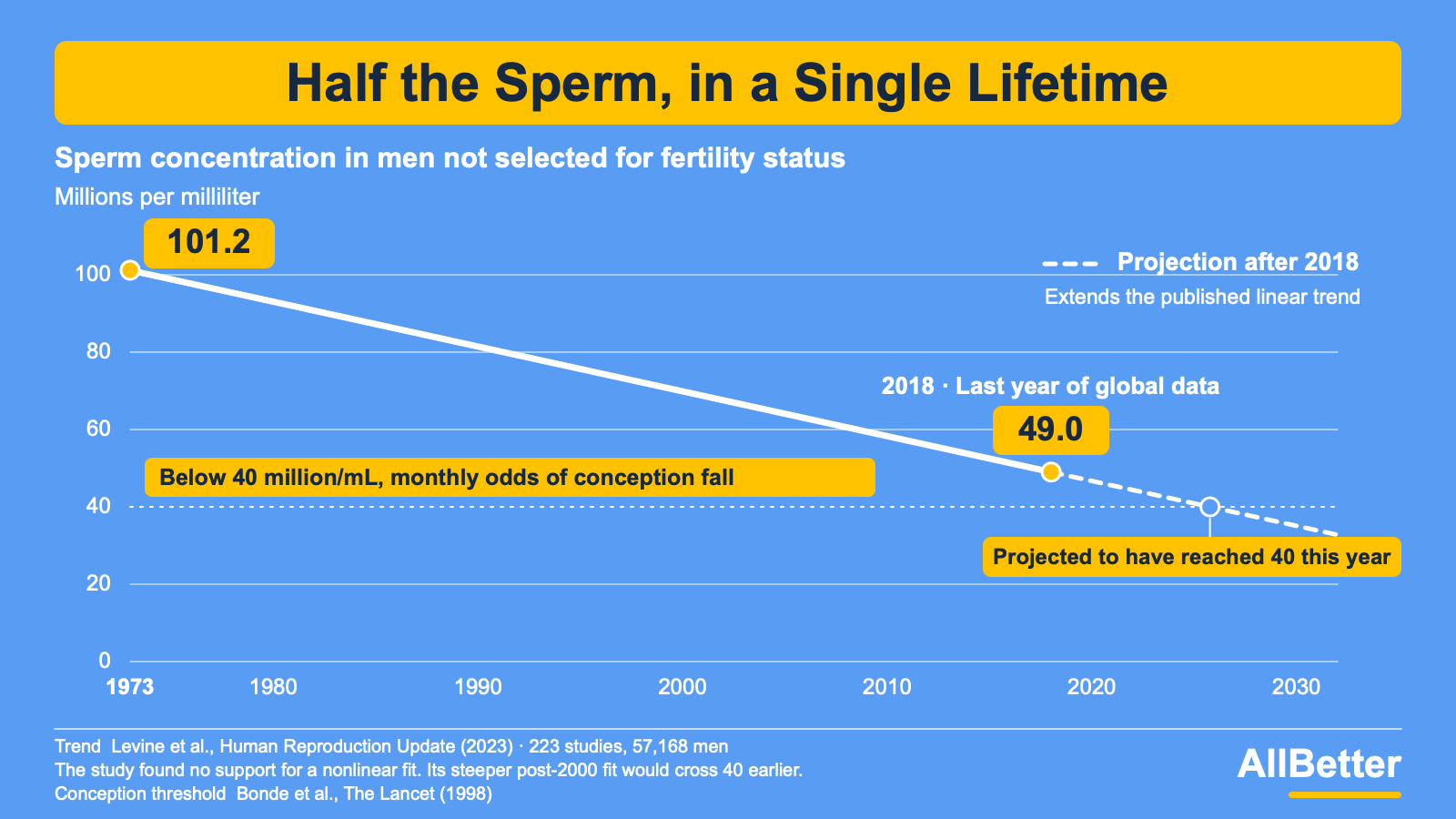
In 2023 Hagai Levine’s team at Hebrew University published the biggest analysis anybody’s done on this, a systematic review and meta-regression in Human Reproduction Update. 223 studies, 57,168 men, semen collected for 45 years from 1973 to 2018.
Sperm concentration in men not known to be infertile fell 51.6 percent, from 101.2 million per milliliter to 49 million. Total count fell 62.3 percent. The decline showed up on every continent they could get data from.
And it’s speeding up.
The annual rate of decline more than doubled after 2000, going from 1.16 percent a year to 2.64.
Forty million sperm per milliliter is an important threshold. A prospective study of 430 couples who stopped using contraception found the odds of conceiving climbing steadily with sperm concentration up to 40 million/ml, then flattening out above it. Below 40, the odds start falling. Levine’s own paper calls the share of Western men under that line “particularly concerning.”
The global average was 49 million/ml as of 2018, the last year in Levine’s data. Carry his own measured rate of decline forward and the average man crosses under 40 million right about now. The post-2000 slope, which is steeper, puts it earlier than that.
Nobody can tell you whether it’s happened, because there’s been no global accounting since 2018.
Sperm Count Also Predicts Mortality
A Danish study followed 78,284 men for up to 50 years, adjusted for age, birth cohort, smoking, education and BMI, and found worse semen quality tracking with higher all-cause mortality across every parameter they measured. Men under 15 million/ml had 50 percent more hospitalizations of any kind and 40 percent more cardiovascular disease than men above 40 million. The gap held in men with children and men without, which rules out the easy explanation that infertile men were simply sicker to begin with.
A semen analysis is more than a conception diagnostic, it’s a whole-body health test. But we only order it for the tiny percentage of men asking for help at a fertility clinic.
People v. Poison
I was on the sidewalk in front of the Supreme Court on April 27th with a few hundred other people and a lot of homemade signs. “The People vs the Poison.” The weather was gorgeous, the crowd was small but all the cool kids were there.

Inside, the Court was hearing the case of John Durnell, a Missouri man who got non-Hodgkin lymphoma after years of spraying Roundup.
Then word went through the crowd that the United States was in the courtroom, arguing for Monsanto.
The legal fight is narrow, and it decides everything. Federal pesticide law says a state can’t impose labeling requirements “in addition to or different from” the federal ones. Monsanto’s argument was that, because EPA approved the Roundup label, and that label carries no cancer warning, no state jury anywhere can punish the company for leaving one off. The Court bought it, seven to two. The majority held that federal law preempts the failure-to-warn claim - and that means that the EPA’s label trumps any state law trying to protect consumers. Two justices dissented, writing that the ruling leaves Durnell without a remedy for the harms he suffered.
Did the Dog Eat EPA’s Homework?
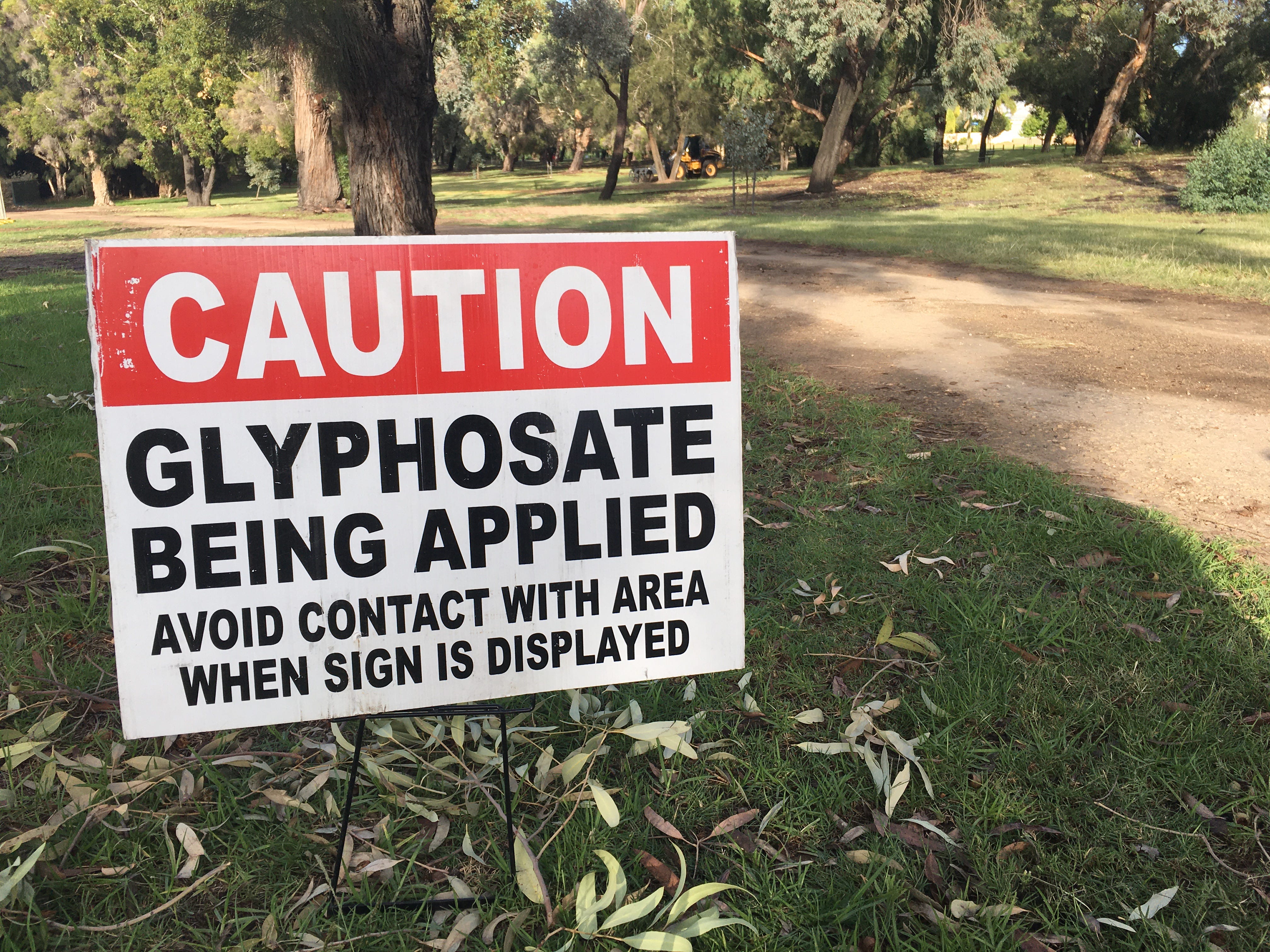
Go to EPA’s glyphosate page today and you’ll still find words like “still reviewing” and “did not identify risks of concern” and “not likely to be carcinogenic.”
Federal law requires EPA to review pesticide registrations at least once every fifteen years. EPA opened its glyphosate review in 2009. The original deadline was October 2022. That December, the pesticide industry’s trade group and more than thirty other groups paid bullied Congress to pass the bill that gave EPA four more years. Congress did. Because, of course they did.
EPA missed that deadline, too.
For the math-challenged: seventeen years in, and EPA’s still working on it.
In 2020, when EPA started this “not likely to be carcinogenic” theater, farmworker and environmental groups sued. In June 2022, the Ninth Circuit threw out the human-health half of that decision, finding that EPA’s errors in assessing human-health risk were “serious” and that the agency’s conclusion couldn’t withstand scrutiny under EPA’s own framework. EPA withdrew the “not likely” decision that September.
And Then There’s the “Academic” Fraud
In April 2000, three authors published the review that became the standard citation for glyphosate’s safety, relied on by regulators around the world for a quarter century and cited more than 1,300 times. Internal Monsanto documents surfaced in 2017 litigation showing company employees had ghostwritten it. The journal finally retracted it this year, noting that its conclusions rested solely on unpublished Monsanto studies. Eight years from exposure to retraction, and twenty-five years of regulatory decisions built on it in the meantime.
EPA has never replaced it. The human-health portion of the glyphosate review has been unfinished since 2022.
So the EPA label that now shields Bayer from every failure-to-warn claim in America rests on a cancer assessment that a federal court vacated four years ago and that EPA never redid. The Supreme Court handed the whole question to an agency two years past its statutory deadline on the one document that decides it.
And your government and mine went into that courtroom to help Bayer.
Yes, Bayer, the the aspirin people, who now own Monsanto. Also, the Nazi death camp people, which tracks.
The Solicitor General asked the Court for argument time as a “friend of the court” supporting Monsanto, and on April 17th the Court said yes. Monsanto started with thirty minutes and handed ten of them over at the Solicitor General’s request, keeping twenty for itself. That same day, the Court denied the identical request from the lawyers court-appointed to lead the Roundup litigation for tens of thousands of cancer patients.
Asking for divided argument time takes paperwork, sign-off, and somebody up the chain at DOJ and the White House deciding it’s worth a government lawyer’s shoe leather. Somebody wanted to be in that room. Calley Means has reported that the leader of that effort was White House staffer Heidi Overton, whose nomination for FDA Commissioner was just pulled by the new sheriffs in the West Wing.
So yeah, I went home that day from the Supreme Court furious and demoralized. This, along with the Executive Order declaring glyphosate to be a national security priority and insinuating that vaccine-style liability protection for Monsanto might be coming, was the biggest betrayal by the president of the MAHA movement to date.
Meanwhile, Back at the CDC
The Agency for Toxic Substances and Disease Registry is a federal public health agency, part of HHS, and its job is to publish authoritative profiles of what toxic chemicals do to people. In 2020, it published a Toxicological Profile for glyphosate and flagged reproductive and endocrine toxicity as endpoints of concern, citing sperm abnormalities, reduced testosterone, testicular damage and decreased sperm counts in exposed animals.
That’s the same year that EPA was telling the public glyphosate was “not likely to be carcinogenic to humans.” That ATSDR report is the one NIEHS cites as the reason it finally went looking. Six years later, we have a much better answer about what happens to sperm… in animals.
So, When Do We Get to the Humans?
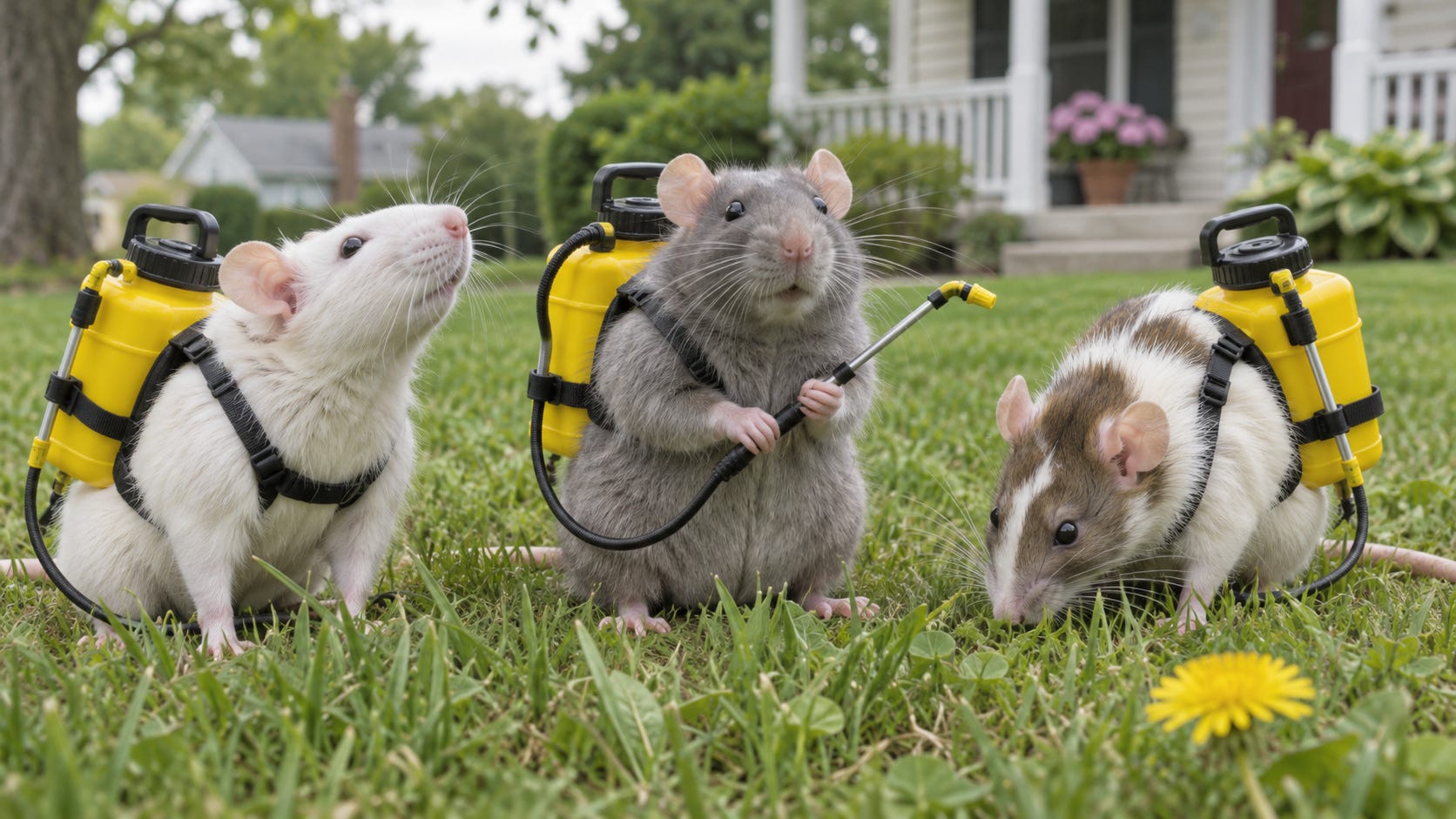
Last week’s published review is explicitly phase 1 of 2, focused on animal studies showing biological likelihood that glyphosate is wrecking male reproduction. Human epidemiology and mechanistic data got pushed to “later with no date.”
Now hold that up next to the cancer review the same institute posted a week later, which is built entirely on human epidemiology. Same institute. Same HHS request.
Why did cancer get people and fertility get rats?
Because cancer registries exist, where tumors get counted. The Agricultural Health Study followed tens of thousands of pesticide applicators for decades and wrote down every malignancy. There’s a human evidence base sitting there to review.
There’s none for sperm. We screen men for cholesterol, blood pressure, colon cancer, prostate cancer, diabetes and depression. We have never screened the organ system ensuring that, you know, humanity continues.
And we stopped measuring the chemical, too. Most of us are carrying it: CDC’s biomonitoring found detectable glyphosate in the urine of 70 to 81.7 percent of Americans, depending on the survey cycle. That data runs from 2013 to 2018, which is the last time anyone checked.
And glyphosate isn’t the only villain here, as the aspirin people will be quick to point out. NIH’s own LIFE Study has separately tied human semen quality to phthalates, forever chemicals like PFAS and heavy metals. Glyphosate’s one exposure in a stack of them.
Got it. Stipulated. None of it argues for waiting. When you’ve got a global species collapse, you don’t sort out a dozen suspects by continuing to measure none of them.
Though who am I kidding? FDA has had the data on heavy metals in baby food for decades. Kennedy’s FDA finally moved in October, the first update to formula standards in nearly thirty years, and it covered nutrients. But on enforceable limits for the metals, FDA is still “working to establish action levels.” Sigh.
Folks, your government isn’t coming to save you, your babies, or your sperm from deadly chemicals.
They Came In Tired and Sick. I Ran Some Labs.
The overwhelming majority of men who come to see me for some chronic issue also have low testosterone. They also test high for urinary glyphosate. I ran it on myself and my result came back past the top of the reportable range, which I didn’t expect and didn’t enjoy.

Yes, my little practice is anecdotal. But I’m seeing a lot of it, men who showed up about fatigue, or weight, or depression, metabolic disorder or a gut that stopped working. They didn’t come to me about their fertility or their glyphosate levels.
But it seems plausible that they’re all related.
When Do We Get to the Actionable Intel?
Now, some might argue that there’s no point testing men for something you can’t fix. But that’s wrong.
Exercise moves the sperm numbers and the hormones both. A network meta-analysis of randomized trials found that exercise significantly improved total testosterone, sperm DNA fragmentation, and semen parameters including motility and morphology, along with BMI, waist circumference and fasting glucose. In one 24-week trial, 397 healthy men got randomized across moderate-intensity training, high-intensity training, interval training, and nothing. Every exercise group beat the control on semen quality, and the best results came from the moderate group. Moderate - not CrossFit martyrdom.
On the exposure side - glyphosate and other endocrine disruptors - diet moves the needle, and fast. In a 2020 intervention study, four families ate completely conventional for five days, then completely organic for five days. Urinary glyphosate fell about 71 percent and AMPA, the compound glyphosate breaks down into, fell about 77 percent, hitting baseline inside three days. That study was small, sixteen people. A larger randomized trial found a more modest 25 percent drop, and almost no effect at all for people living next to farmland.
So how much it helps depends on where you live and what you were eating to begin with. But food is the main exposure route for most people, and it responds in days, not years.

That’s the bridge from a number on a page to a reorganized food supply. Men with bad numbers on metrics they care deeply about very well could start to buy differently. Equally if not more powerfully - the women who love them - could start to buy differently too. Demand like that moves the markets behind Big Agriculture faster than any rule EPA ever will write.
I already told you about the clients of my naturopathic practice. My other business, building health plans for employers, has clients too, and they’re caught in the middle of this right now. Self-funded employers are being pushed hard to add IVF coverage, and Congress is working on making it mandatory - the idea being, I guess, that we should force employers to spend twelve thousand dollars a round on a needle that bypasses a man’s sperm count rather than incentivizing the test once a year to measure it. Medicare pays about $12 for the analysis, employers should be able to negotiate a cash price of $20-30. Add on an androgen panel, and you’re looking at under $200. No vendor’s selling them this, because it’s not nearly as lucrative as IVF or Cialis demand for life.
Nobody has run the trial that closes the loop: screen men, intervene with diet, exercise and other lifestyle adjustments, show better outcomes in fertility and chronic illness. That evidence doesn’t exist. But look at the circle of convenient gaslighting. The societies say there’s not enough evidence that measuring men helps them, and the research to produce that evidence never got funded at anything like the scale the question deserves.
The Gross Little Room At the Lab
So about that semen collection… standard collection means masturbation in a room at the clinic. And fertility clinics have historically stocked pornography in those rooms, which makes the American health care system a paying customer of an industry built on coercion, trafficking, and the exploitation of women and children. We’re subsidizing that in the name of men’s health. Whatever you think about the morality of masturbation, there’s a human rights problem in that room with him.
For observant Catholics the door is shut on different grounds, and it stays shut even when the purpose is medical diagnosis. The licit route is a perforated seminal collection device used during intercourse, essentially a condom verified not to harm sperm, with two or three pinholes so nothing’s contracepted. It’s standard in NaProTechnology practice, and Catholic moral theologians have been chewing on the question since the 1940s. Craig Turczynski, a NaPro clinician who writes about collection methods, puts it this way: controlling measurement variables matters, but expecting a man to go into a room at the lab with a cup and a magazine isn’t dignified. Even the patent filings for collection devices concede that hospital collection makes a man overcome “a variety of psychological barriers.”
Orthodox Jews, observant Muslims and plenty of evangelicals hit versions of the same wall. But this isn’t just a conscience problem - it raises epidemiological bias as well.
If you run national semen surveillance through fertility clinic rooms or any other porn den, you’ll systematically under-sample observant Catholics, Orthodox Jews, Muslims and conservative evangelicals. Religious observance tracks with marriage rates, family size, alcohol use, diet, and rural and agricultural residence. Agricultural residence is a glyphosate exposure variable. So the collection method would correlate with the exposure and the outcome both, which makes it a biasing confounder rather than a coverage gap.
A program built around that little room risks giving us biased national numbers and missing the men most likely to be hurt.
At-home mail-in collection already exists and researchers are using it. Validation’s still open, since the same work documents significant variability among at-home kit users. So there’s work to be done here: a validated at-home system, compatible with a licit collection device for the men who need one, analyzed at a reference lab, priced for volume. There has been little demand because measurement isn’t routine in clinical practice, nor has large-scale surveillance research been ordered up by public health authorities.
My employer clients buy at-home colorectal kits by the pallet for exactly this reason. Participation plummets the second you ask people to go somewhere and do something undignified.
Speaking of Actionable…
Here are the next steps the government owes you, me, and a hypothetical next generation I’d like to see born:
National semen quality data, anonymized, NHANES-style, same as we track blood lead. Single samples work fine for population estimates even though they’re unreliable for diagnosing an individual, there’s no overdiagnosis risk and no treatment cascade, and it would’ve handed us the trend line thirty years ago.
A clinical standard that puts semen analysis in the chronic-disease workup, not only the infertility workup. Today a man gets a semen analysis when a couple can’t conceive. Given that semen quality predicts all-cause mortality, cardiovascular hospitalization and diabetes, it belongs in the workup for any man showing up with chronic illness, metabolic trouble, fatigue, or depression, mental or physical. Two samples per WHO protocol, standardized labs. And any man who wants the test should be able to get it without producing a wife and a year of failed attempts first.
Incentivize the research and the product development for validated at-home and moral collection. Grant funding, an NIH prize, FDA breakthrough designation, whatever actually moves a diagnostic or collection device to market. The target is a validated at-home collection and analysis system that works with a perforated collection device, so the test reaches every man instead of the subset willing to use the clinic room.
Add semen analysis to the military’s periodic health assessment and follow the cohort over time. The Department of War already runs testosterone labs on every man 30 years and older. This is fantastic new policy. A JAMA analysis in October estimated 25.7 percent of active-duty Army men, roughly 100,691 soldiers, would come in under 300 ng/dL (deemed “deficient” by the urologist association, but that number is derived from men over 45, so it’s probably far too low a threshold for young soldiers).
Not good.
Troops who screen low can be offered testosterone replacement. However, irony alert: testosterone replacement suppresses sperm production, as any endocrinologist will tell you. Now, for frisky, unmarried men, that might be a contraceptive feature, not a bug. But men should be given full informed consent, and they can’t really do that without information about their baseline sperm quality.
Add the semen measure to the same visit, keep the data longitudinally, and inside five years the United States would have the first real population surveillance of male reproductive health anywhere in the world. The infrastructure is already built.
A public start date and a public completion-and-publication deadline for phase 2, the human and mechanistic review NIEHS has already committed to in print. Not “planned.” Committed, with a date certain for completion.
Finish the EPA glyphosate review. Like, yesterday. Seventeen years into a review federal law said should take fifteen. Two years past the statutory deadline. The human-health half vacated by a federal court in 2022, which found EPA’s errors “serious,” and never replaced in the four years since.
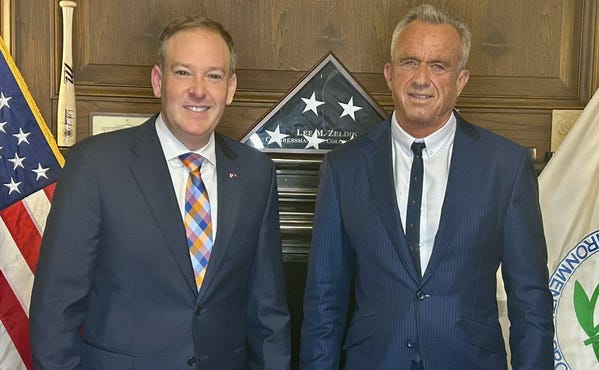
Administrator Zeldin, The Balls Are in Your Court
In April you stood next to Secretary Kennedy and announced what your own press office called “landmark, coordinated actions” on microplastics, describing it as one of the most urgent and growing public health challenges facing America. You put the MAHA label on it yourself. Good.
I’m hopeful that you and Secretary Kennedy were working together to get the scientific declarations that will make it politically and legally easier for you to override the pro-chemical forces within EPA. Now NIH has handed you a high-confidence finding that the most heavily used herbicide on earth damages sperm, and a cancer review alongside it, both ordered by that same Secretary Kennedy, both already in your docket. Most Americans are carrying this chemical in their urine right now. And the Supreme Court has, perversely, just made your label the only protection any of them has left.
You have everything you need. Isn’t it time to stop your agency’s war on America’s health?
Black Seed oil increases Sperm Count and Volume!
Katy, what a great dive into this topic.