



My name is Katy, and I’m a Diet Coke addict. (Hi Katy).
True confessions time. I’m a naturopathic doctor. People ask me for health advice, and they’re not expecting the kind they get from an MD — the kind that says, “well, it’s zero calories so it’s better than regular soda.” From me, they expect something more along the lines of, “if your great-greats didn’t drink it, then it’s not fit for humans.”
And to be honest, I DO say that. Even about Diet Coke. Especially about Diet Coke.
After all, it messes with your gut, your brain and probably your metabolism in ways I tell other people to avoid.
Like a big fat hypocrite, I coach people to stay off the stuff the way a grizzled, toothless meth-head threatens to shoot his dealer in the head if he tries to sell to his sister.
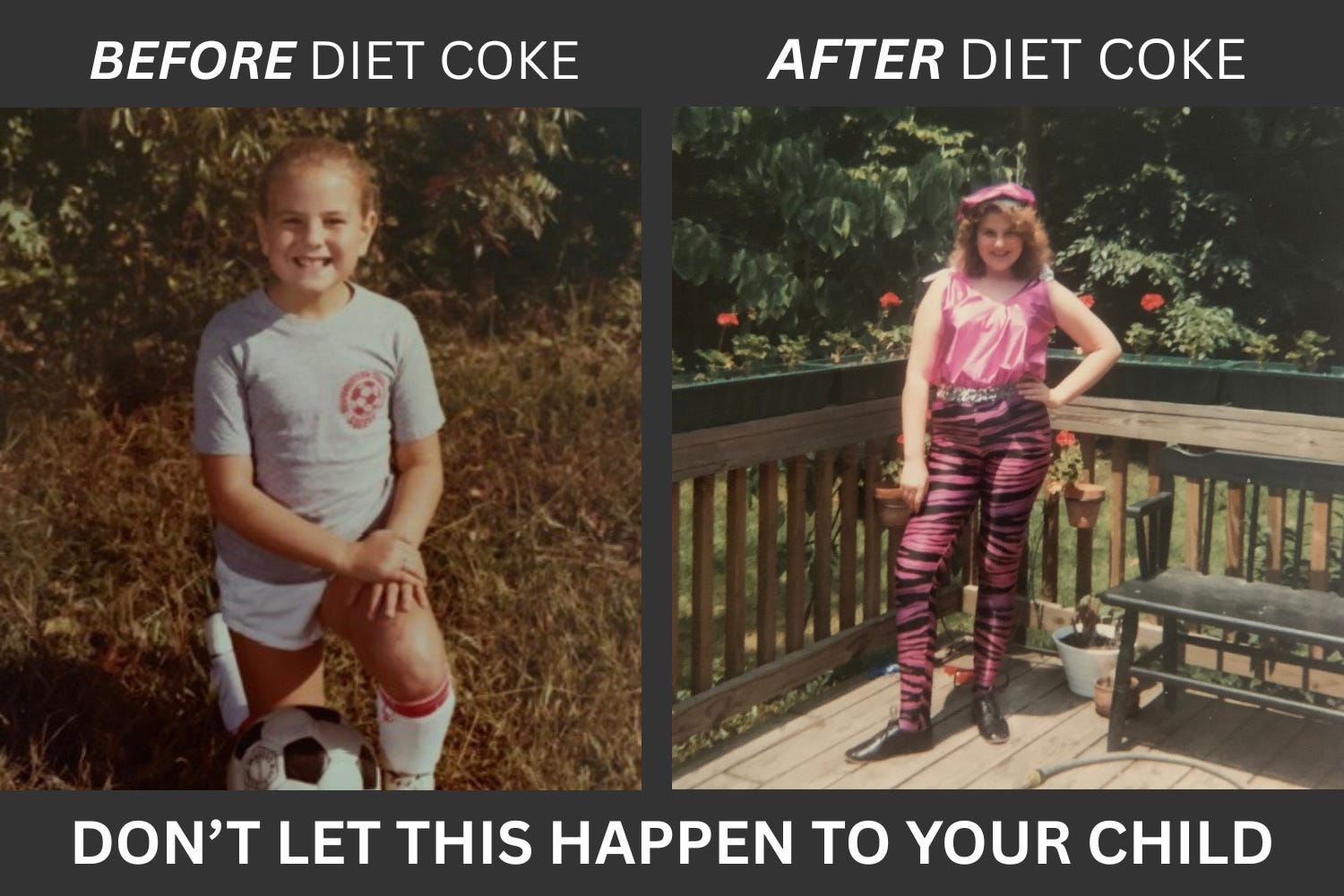
For me, it started young.
Origin Story: A Generational Curse

My grandmother, all 4 foot 10 inches of her, was surgically attached to her glass bottles of Coca-Cola.
Her addiction transmitted seamlessly to my dad. With his heart condition and his waistline battleground, doctors gave him the business in his mid-40s or so.
His solution was to swap out the fridge inventory with Diet Coca-Cola.
I was twelve.
In high school, once I started to drive, I’d stop at the 7-11 on the way to school and arrive with a 32-oz Big Gulp full of heaven every morning.
Ah Yes, the Trauma Bond
It wasn’t just the morning 7-11 stop, I learned to love it all day. The sound of the can opening, the fizzy pouring over ice, right before the battery acid burn down my throat — if the Balm of Gilead had a sound, that’s it.
They say that the first step is admitting you have a problem and you are powerless to stop.
Many times over the years, I’d give it up for Lent in a fit of penitential zeal, and would last a few weeks before I weakened. (My resolve was not helped by going hog-wild on Sundays when Lent is quasi-suspended.) Surely, Jesus wouldn’t ask for permanent surrender, right?
When my little sister died a gruesome, protracted death from colorectal cancer in 2019, I made a solemn vow: that sure as hell wasn’t gonna happen to me. And so began my health journey.
The sobering facts about aspartame and the desire to embrace a more Earth-Mama identity gave me the impetus to ditch the “fridge cigarettes” (as a friend calls Diet Coke in an attempt to shame me into quitting). And I did quit. Well, at least at home anyway.
The problem was, I was away from home quite a lot, and my permission structure made it a nice treat when I was out and about. Every day.
The point is, I never really went cold turkey.
And so I’d slide back into relapse. With a sheepish tone, I’d ask my long-suffering husband to grab a 35-can pallet at Costco. Or five.
I’d tell myself that I was gaining too much weight on the kombucha that I had used to replace the fizzy acid zest. Or that I would just have one or two a day. And other lies.
Before I knew it, I was going through a pallet in less than a week, drinking no other liquids, even at night. Even first thing in the morning, the way I had in college.
So this article is an intervention for myself and maybe for you or someone you love.
Friends don’t let friends get hooked on Diet Coke.
Here’s why.
Aspartame: Whispering Sweet Nothings
Let’s start with the obvious villain: aspartame.
It’s the king of all “non-nutritive” sweeteners, as they’re calling them these days. The human trials have fairly robustly failed to show that aspartame is going to kill us. They do however seem to suggest that it might kill animals, so that’s not great.
The obvious concern, cancer, seems to be intensely dose-dependent and overblown – for most people. The WHO only classifies aspartame as a Group 2B cancer risk, meaning that you have to hit twelve cans a day to approach the danger zone. (Granted, these are the same people who blamed COVID on eating bats.) But still, I’m just saying that certain heavy users (cough, not it, cough) maybe ought to be concerned.
So if it isn’t going to kill us, at least not that easily, what’s so bad about aspartame?
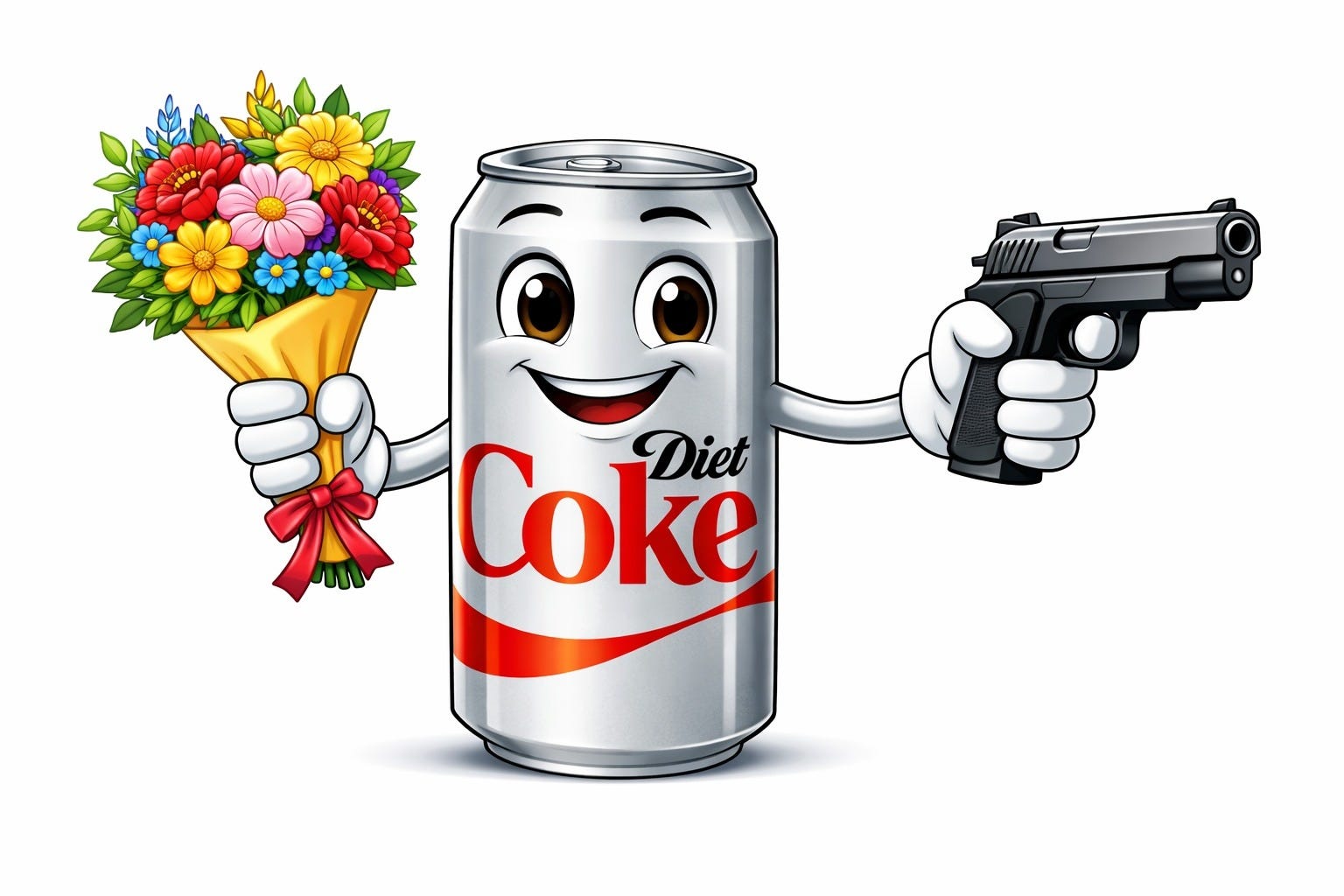
Aspartame acts as a domestic abuser showing up with flowers but depriving us of consistent support and nourishment.
Our brains evolved to associate sweetness with incoming energy (calories).
With aspartame, the sweetness arrives but the calories don’t, creating a reward-prediction mismatch in the brain. What was supposed to be the feature might actually be a bug.
In animal and mechanistic studies, decoupling sweet taste from calories can create a disconnect between the sensory signal and the expected energy procurement.
When that mismatch happens repeatedly, the neural systems involved in appetite regulation may adapt in ways that increase subsequent sweet-seeking. Bottom line: you end up craving, and therefore likely eating more sweet foods — taking in more calories, not fewer.
Musso et al. (2017) demonstrated a proof-of-concept version of this phenomenon in biology’s favorite lab rat: the fruit fly. They described a “caloric frustration” effect, where exposure to non-nutritive sweeteners altered mental learning about sweetness and increased motivation to seek sweet foods.
Broader reviews of sweet taste, reward pathways, and energy balance (e.g., Murray et al., 2016) suggest this mechanism is biologically plausible, even if the size and scope of the effect in humans remain uncertain.
This tracks for me.
Since my most recent relapse onto the all-Diet Coke hydration plan, I’ve noticed that my cravings for carby sweets have jacked up to eleven, with increasing intensity. It reminds me of a car’s seatbelt warning that starts gently, but turns into a screeching schoolmarm if your disobedience continues.
Your body is saying: “Listen honey, if you’re going to put out an amber alert for calories, I’m going to send the national guard to kick in doors until we find them.”

While randomized control trials tend not to show increased diabetes, obesity or other metabolic chaos among aspartame users, the observational studies do show an association. Back in epidemiology school, we learned to conclude from that sort of paradox that there’s usually a related third factor not being captured in the observational studies. This factor, called a confounder, is associated with both the outcome (obesity/diabetes) and the exposure (aspartame).
“Experts” (since COVID, I always put that word in quotes) have suggested that the people drinking aspartame are the same ones that are already at risk for metabolic problems because they are overweight or have some other risk factor.
My theory is that one confounding third factor could be the amber-alert-for-calories phenomenon that’s driving the apparent relationship between aspartame and metabolic risks.
Caffeine: Thirst that Lies
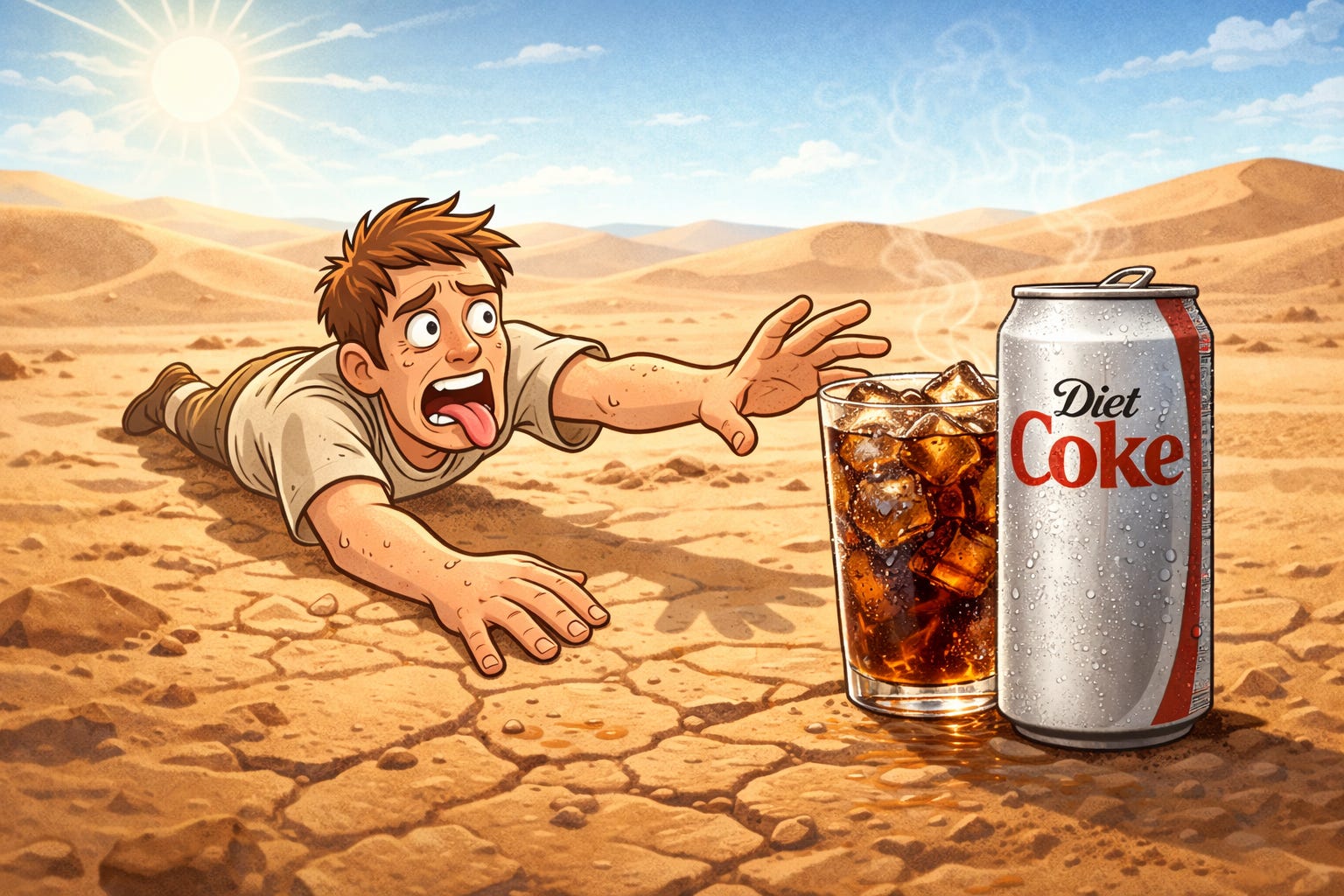
Caffeinated drinks, when they become your primary source of hydration, have a few subtle effects worth noting. In regular caffeine users, the classic diuretic effect is largely blunted — your kidneys adapt, and you’re not actually flushing out more fluid than you take in.
What does seem to happen, however, is that caffeine contributes to dry mouth and altered thirst perception. You can feel parched even when your body isn’t meaningfully dehydrated. In that sense, Diet Coke starts to behave like a self-licking ice cream cone: a drink that temporarily relieves dryness while nudging you to take another sip.
It’s almost as if Coca-Cola intended to create an addictive beverage that makes you think you need more when you don’t.
The Battery-Acid “Hit”

There’s something undeniably refreshing about that biting, acidic hit. You addicts know what I’m talking about.
Diet Coke is to my taste buds and brain what a good exfoliation is to my face: it wakes things up, makes me feel kind of amazing for a second, and distracts me from whatever stress, boredom, or anxiety might be driving the bus.
I notice I throw back the most cans in the middle of stressful, frenetic days - when I’m busy, keyed up, and don’t like the way frustration, overwhelm, or fear feel in my body.
In other words, for me, Diet Coke is medicating something.
Better medicine would probably be a few deep breaths, some sunshine, singing Copacabana out loud, or some other low-tech nervous-system hack.
But It’s 99% Water, Right?
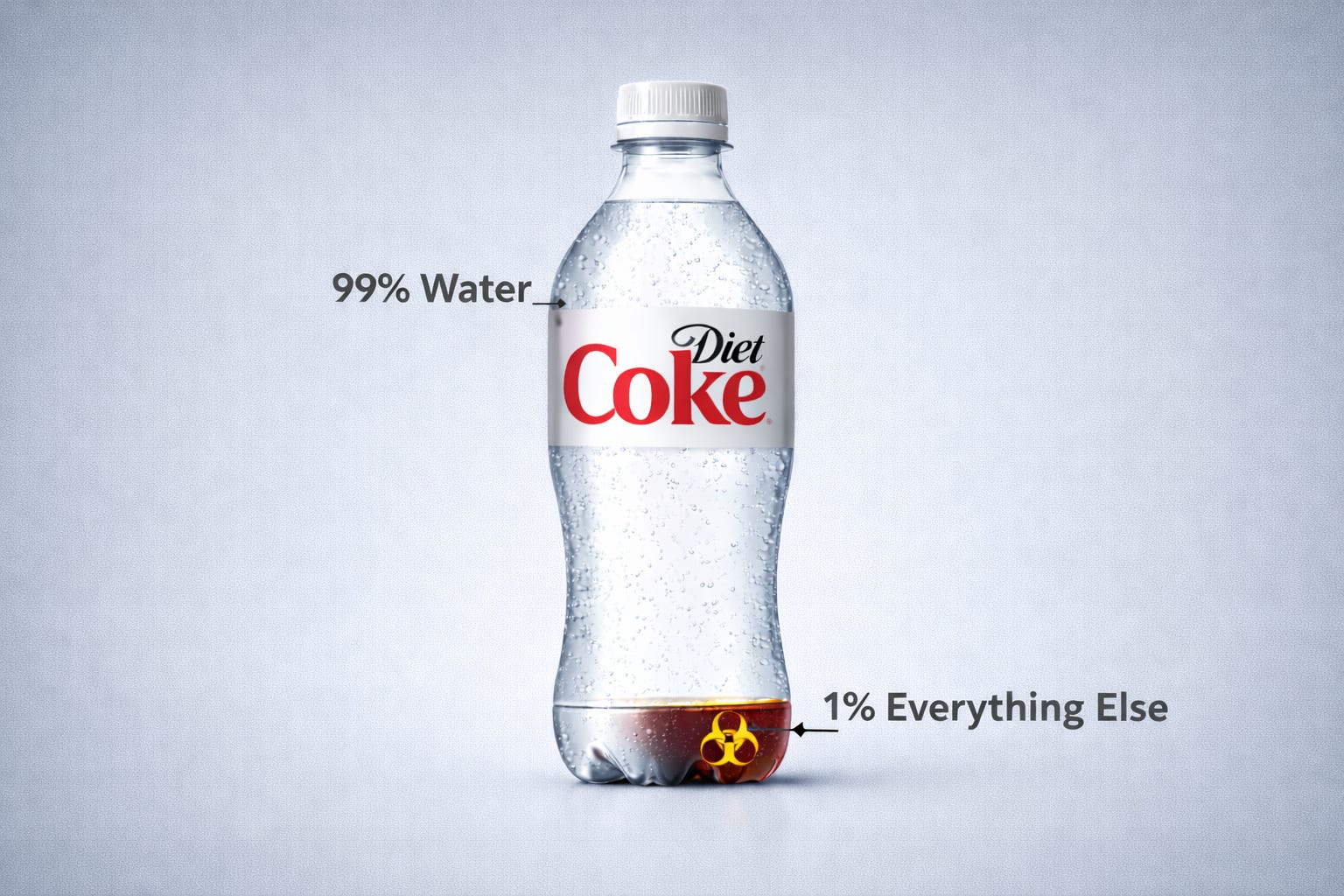
Coca-Cola’s manufacturing process for Diet Coke starts with heavily filtered municipal water, often using reverse-osmosis–style purification.
Minerals are then added back, not because Coke cares about your nutrition, but to stabilize the chemistry and ensure it tastes the same everywhere in the world.
That means that if Diet Coke becomes my primary — or sole — source of hydration, I’m opting out of whatever modest but real contribution mineral-rich water can make to electrolyte balance and acid buffering.
While most essential minerals come from food, water as our primary hydration still provides a steady background supply of minerals that support nerve, muscle, and acid–base balance. Replacing that with a highly acidic, essentially non-mineralized beverage may not cause outright deficiency, but it’s also not neutral.
This may be why I’ve developed leg cramps and accelerated dental erosion since my latest fall off the wagon.
The dental piece, at least, is not controversial: Diet Coke has a pH around 3, squarely in the range known to erode tooth enamel with repeated exposure – more acidic than most drinking water and comparable to vinegar or citrus juices.
At home, our drinking water comes from a nearby mountain spring (findaspring.org), filtered naturally through the Appalachians and picking up calcium, magnesium, potassium, silica, and other dissolved minerals along its path to my jug. Its pH is typically close to neutral.
I’m starting to think that swapping that out for an acid-washed soda all day long may be an exercise in lifelong low-grade demineralization.
Aluminum. Microplastics. Repeat.

I drink most of my Diet Coke from aluminum cans poured over ice.
Modern cans are lined with plastic to keep the aluminum from leaching into the drink. That lining is now marketed as “BPA-free,” which is comforting in roughly the same way “natural flavors” (like MSG) or “low tar” (still tar) once were.
But if you’re drinking a lot every day, especially an acidic beverage like Diet Coke, aluminum exposure isn’t zero.
Heavy consumption can creep toward a meaningful slice of what regulators call the “safe” weekly intake threshold. And that’s on top of the aluminum dosing we’re already getting everywhere — food additives, processed foods, deodorant, and the near-universal use of aluminum cookware. Each source looks trivial in isolation. Together, they form a low-grade, always-on exposure that never quite trips an alarm.
But aluminum isn’t inert filler.
At higher or chronic exposures it interferes with bone mineralization and nervous system function. Regulators will tell you this still falls within “safe” limits, but those limits are built for averages, not for outliers who stack exposures day after day, year after year, like life-long Diet Coke-heads.
BPAF is Still Plastic AF
So about that BPA-free lining of the can. “BPA-free” does not mean bisphenol-free. BPA is just one member of a larger chemical family, and Coca-Cola won’t say whether their cans are lined with BPA’s cousins — like BPF, BPS, or even BPAF (yes, that’s real).
As endocrine-active compounds, they’re up to the same estrogenic shenanigans as BPA. They can interact with hormone signaling — often weakly, inconsistently — which can be hard to suss out when we’re all already reeling from hormonal chaos from so many other sources. Add in the growing evidence that these cans shed microplastics, and what you’re left with isn’t a single obvious toxin but a background hum of chemical interference accumulating over time.
When regulators assure us that all of this falls “within safe limits,” it’s worth remembering how those limits are set. They’re rarely derived from independent, long-term human data on cumulative exposure. More often, they emerge from industry-funded studies, negotiated risk thresholds, and regulatory frameworks designed to answer a narrow question: Does this cause obvious harm quickly enough to justify restriction?
Regulatory capture doesn’t require bribery — it just requires that the bar for action be set high enough, and the definition of harm narrow enough for commercial expediency.
Now I like the current commissioner, but the FDA is not your mom. And all these approvals happened before his time anyway.

FDA exists to decide what companies are legally allowed to sell — not what you should be using as a hydration strategy.
None of this means a can of Diet Coke is poison, exactly. It means that when you turn it into a daily hydration plan, you’re enrolling yourself in a low-grade chemical experiment — one can at a time, for years.
So yeah, Diet Coke is terrible for you. And me.
Whaddya say we try to shake this thing?
The Case for Cold Turkey

Stick with me.
I tried super-tart kombucha to recreate that SHAZAM you get from the first few sips of Diet Coke. The SHAZAM, yes. The metabolic fix, nope.
Kombucha still has sugar (or fructose), still has caffeine, and still clocks in at 50–70 calories. Swapping a sweet, caffeinated drink for a slightly less-sweet, less-caffeinated drink doesn’t fix the metabolic signaling problem. It just puts a probiotic spin on it.
The keto and carnivore crowd are right about one thing (and many other things too): sugar needs its own 12-step program. Its grip reminds me of trying to extract our teenage son from the Dave payday loan app (how is that kind of predatory usury even legal?).
I’m increasingly convinced that Diet Coke is making it worse by keeping the sweetness craving roaring all day.
So here’s my plan:
Carbonate my mountain spring water with a SodaStream
Splash with lime juice at first, less over time
Lots of ice for the refreshing blast
If quitting a “zero-calorie” “diet” drink is the price of appetite mastery, I’ll pay it.
Goin’ cold turkey.
I’ll report back.

Thanks for this informative reminder, Katy, and for the laughs. I drank far too much diet coke in my teens and twenties. And I too switched it out for kombucha but found myself drinking far too much kombucha. 😫😆