


Last week I shared three moments that should have told me our 2017 Obamacare repeal-and-replace effort was doomed:
The Diet Coke button,
Jared Kushner’s “this is bullshit” moment, and
Panicky faces in the White House communications office.
[If you missed it catch it here.]
This week: what happened when we ignored all those warning signs.
So, once the bill had been introduced, Speaker Paul Ryan and the White House team were working hard to whip enough votes to pass it.
Democrats were slamming our guys with accusations of weakening protections for people with pre-existing conditions, including pregnant women. These assertions were somewhat unfair at best, and misleading demagoguery at worst, but I guess I would have done the same in their place.
We decided to buy the support of moderate Republicans - usually in unsafe, swing districts - by coughing up some sweeteners: $15 billion for people with pre-existing conditions, $45 billion to fight opioid addiction, and so forth.
When the fiscal conservatives – usually in safe, red districts – got wind of these inducements, they got jealous and insisted on some of their own priorities. These amendments made it into the bill as well and generally meant reducing requirements on ACA plans so as to make them more affordable.
And what happens when Republicans try to give America a big, fat federal program, but just a little less big and less fat than the Democrat version?
They lose elections, that’s what.
Which brings me to the last teaching moment from this dark episode of the first Trump term.
The Cabinet Room
Moderate Republicans were getting very nervous in advance of the House vote. Did I mention they were in unsafe, swingy districts?
Between the sweeteners thrown in for them, and the un-sweeteners thrown in for their conservative colleagues, the bill had become a Frankensteinian mess.
Our poor comms team was pretty much beside themselves.
So, the president did what only he can do. He summoned all the mods to the White House Cabinet Room and put the hard sell on.
He asked them politely for their vote. He didn’t try to sell them on the policy (how could he?).
He just used the power of the office to insist.
He went around the room, one by one, looking everyone in the eye and asking if they would be with him on the vote. My recollection is that every single one of them said some form of “you can count on me, Mr. President.”
Regardless of what they said that day, they all knew their districts well. The bill passed the House by only three votes, with 20 Republicans voting no.
The Rose Garden
After the vote, totally spontaneously, a bus was waiting outside the Capitol to shuttle a bunch of House Republicans over to the White House for a totally spontaneous victory lap — with totally spontaneous hors d’hoevres, and members of Congress lined up for exuberant one-on-one photos with the president to commemorate the occasion.
Then they all went out to the Rose Garden and staged a totally spontaneous public chest-beating, congratulating themselves on saving the American people from, well, a little more Obamacare than the Obamacare-lite in the bill.
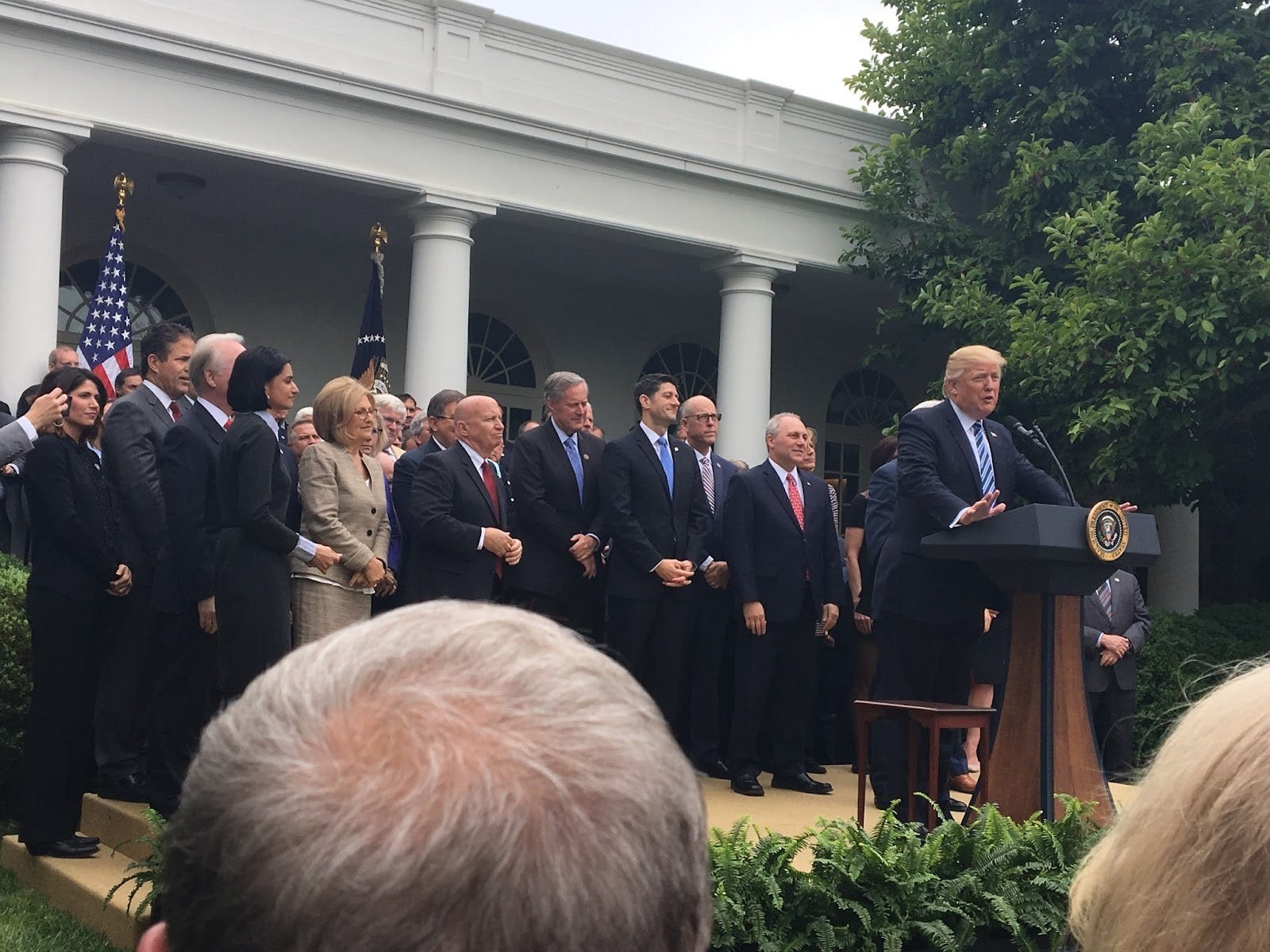
Sitting in the totally spontaneously-arranged second row of the Rose Garden, I too shared their relief, after a lot of nail-biting. While simultaneously worrying about the Senate.
Which turned out to be a reasonable concern.
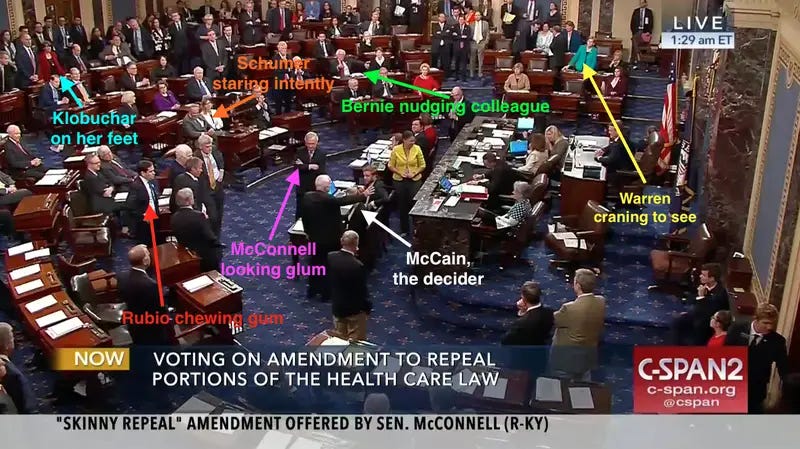
Still, I was surprised by Senator John McCain’s downturned thumb, the lethal third no vote in the Senate. There would actually end up being seven, but McCain gave permission to the subsequent four.
Frankenstein was taken out back and shot in the head.
I think I thought the power of the president’s personality and the momentum of House passage made Senate passage a surer thing that it geared up to be. It’s like I had forgotten every maddening lesson I’d ever learned about the upper chamber in my fifteen years, on-and-off, of working there.
Senators on both sides of the aisle are shrewd politicians who know their states. Even the Republicans in red states have to win in the face of viciously hostile local media, so they know what it takes.
Those seven no votes might just have saved the Senate majority.
The House wasn’t so lucky.
The Reckoning
The president demanded that House Republicans stick together and pass the bill. A year later, we lost the House in the mid-terms.
More than half of the 30 or so moderates who lost their seats had voted yes on the bill. More than half of all political ads that cycle were about health care. The party was so damaged reputationally that even moderates who voted no were bloodied up by the issue and lost anyway.
It didn’t help one bit that, right before the midterms, we doubled down on failure.
Texas was suing DOJ to bring down the pre-existing conditions protections in Obamacare, using a cute legal gimmick related to the tax package that had passed earlier in the year.
The question for the president was whether DOJ was going to defend the law in the case (which was their job, technically, but still awkward). The fiscal hawks – not the health team, notably – inside the administration argued that the conservative judge in the case was going to hand us a victory, and all we needed to do was nothing.
To be totally fair to this view – these were not evil people.
They wanted to take the mandates out of Obamacare plans that were making them unaffordable. They were just politically inept.
The sane caucus (which included my boss and DOJ) argued that the 5th Circuit would overturn the district judge and, if they didn’t, the Supreme Court would. The whole mess would extend the carnage we were already anticipating in the midterms into the 2024 re-elect, and we wouldn’t even get the policy in the end.
Which is exactly what happened when the fiscal hawks won the argument.
Why I’m Telling You This Now
If you’ve stuck with me this long, you’re either a devoted history buff, or you’ve got an inkling of where all this is going.
President Trump and Congressional Republicans are in danger of repeating the past.
I’m panicking a little as I watch Team GOP go off the same Obamacare cliff, now eight years later. There’s been a ton of staff churn on the Hill. I can’t think of a single GOP staffer who is there now who went through the first go-round.

Not everyone from the first Trump health team would agree with my recommendations below. After all, there were a good number of street-fights among us. But most of us had way more in common than not, and really wanted to make health care great again.
So in that spirit, I offer the following painfully-acquired learnings to the next generation in Congress and the administration tasked with the Obamacare redux:
Don’t scare the voters. Americans know their insurance is garbage. They’ll tell you so at every town hall. But that doesn’t mean they don’t want as much of it as they can get. Health care prices are so high that the idea of facing a medical crisis without even garbage insurance is understandably terrifying. Fear is a powerful political force. If you get painted as the face of that fear, you will lose.
Understand where the political risk really lies: When compromises are needed to get to a winning vote – and, with a two or three-vote majority in the House, there will be a LOT of compromise – it must be the conservatives in safe seats who sacrifice their priorities more than the moderates in swing seats. Those moderates are the ones who’ll lose their jobs if this goes sideways. And then you lose your majority anyway.
Remember Reagan’s maxim: The closest thing to eternal life on earth is a government program. Voters always pick Santa Claus over the Grinch. Don’t get in an arms race with Democrats over who gives away the most government cheese, by offering less cheese and then trying to say you didn’t. They’ll win.
Stop letting the 20-million-person Obamacare program suck up all the oxygen. Rather than trying to eat away at the margins of Obamacare, focus on what you can do for the long-forgotten 160 million Americans covered by the rest of the commercial market. If you can lower their premiums, you’ll help the 20 million in Obamacare too.
It’s the prices, not the premiums. Focus on driving down what gets charged by the sellers of care. Only then will less insurance be politically acceptable to the buyers of care.
Define the right villain. Republicans too often demonize the government program that voters view as their safety net. But there are better villains to focus on, like the big, bad Bond villains in the health care industry driving up everyone’s costs. The president has already intuited this with his social media rants about taking money away from the insurers and giving it to the people. Follow his lead.
If you can’t say it in one simple phrase, you can’t legislate it:
“End secret prices.”
“School choice for health care.”
“Cut out the middlemen.”
“No tax on health care.”
“Give the money to people, not Big Insurance.”
“Make tax-exempt hospitals charitable again.”
“Sell drugs cheap at TrumpRx.”
“End surprise out-of-network billing.”
“No more foreign free-riding on drug prices at America’s expense.”
A final note to my friends in the fiscal hawk community: Don’t take a dollar away from anyone who has that dollar now. Consider those dollars sunk costs of losing past elections. Instead, use them to buy the ROI of big policy reforms that lower costs for everyone.
And of course, never forget: If you’re explaining, you’re losing.
Thanks for the perspective Katy! As you know, there is a large force of people in the insurance business that benefit from the opaque misaligned incentives that would see their golf club memberships and income drop.Those agents and others benefiting will hang on to anything to lobby their customers to keep the gravy train going. There is one thing on the list that they will grab on to because of rampant TDS. They and others will use that to lobby against changes. All of the others are spot on and should bring votes from both sides. Instead of “cutting out the middlemen (PBMs and GPOs)“, how about repealing their safe harbors ? This brings transparency and competition back to the industry.
I was in the House when this entire sad saga unfolded. Healthcare was tackled first because Speaker Ryan was focused on Tax reform, and getting rid of the Obamacare taxes seemed to be the best way to free up space in the CBO estimates to maximize the opportunities for a major tax overhaul. So the relevant House committees undertook what became known as The American Health Care Act- or AHCA. This passed through the committees of jurisdiction(in the House) as well as the Rules Committee in March of 2017, and was on the floor in April. The opposition, in addition to every Democrat, was the House Freedom Caucus, as well as several right-leaning think tanks. The complaint was that it was not a complete repeal of the ACA. The Mandates-both individual and employer, the taxes, the medicaid expansion, prohibition on Physician Owned Hospitals, as well as funding for Planned Parenthood were all satisfactorily addressed, but the insurance provisions remained. So Speaker Ryan pulled the Bill. It was revived several weeks later, with the now infamous “pre-existing conditions” protections removed, and it finally passed in the House. Unfortunately during the delay Senator McCain became ill, and whether that affected his vote, we will never know. But I have always felt that is the House had passed its original Bill in early April, prior to Sen McCain’s diagnosis, the outcome would have been different. And of course the insurance provisions could have been addressed in subsequent legislative efforts. And of course Republicans lost the majority in the 2018 midterm elections, which also had disastrous repercussions.