



On November 5th, the Journal of the American Medical Association (JAMA) published the largest study ever done on babies who don’t get the newborn vitamin K1 shot. Researchers at Children’s Hospital of Philadelphia found the share of newborns skipping the shot more than doubled from 2017 to 2025, from 3.1% to 6.8%. Out of 5,240,780 babies studied, 234,825 didn’t get the shot and 5,005,955 did. Here’s what happened to them, in plain numbers:
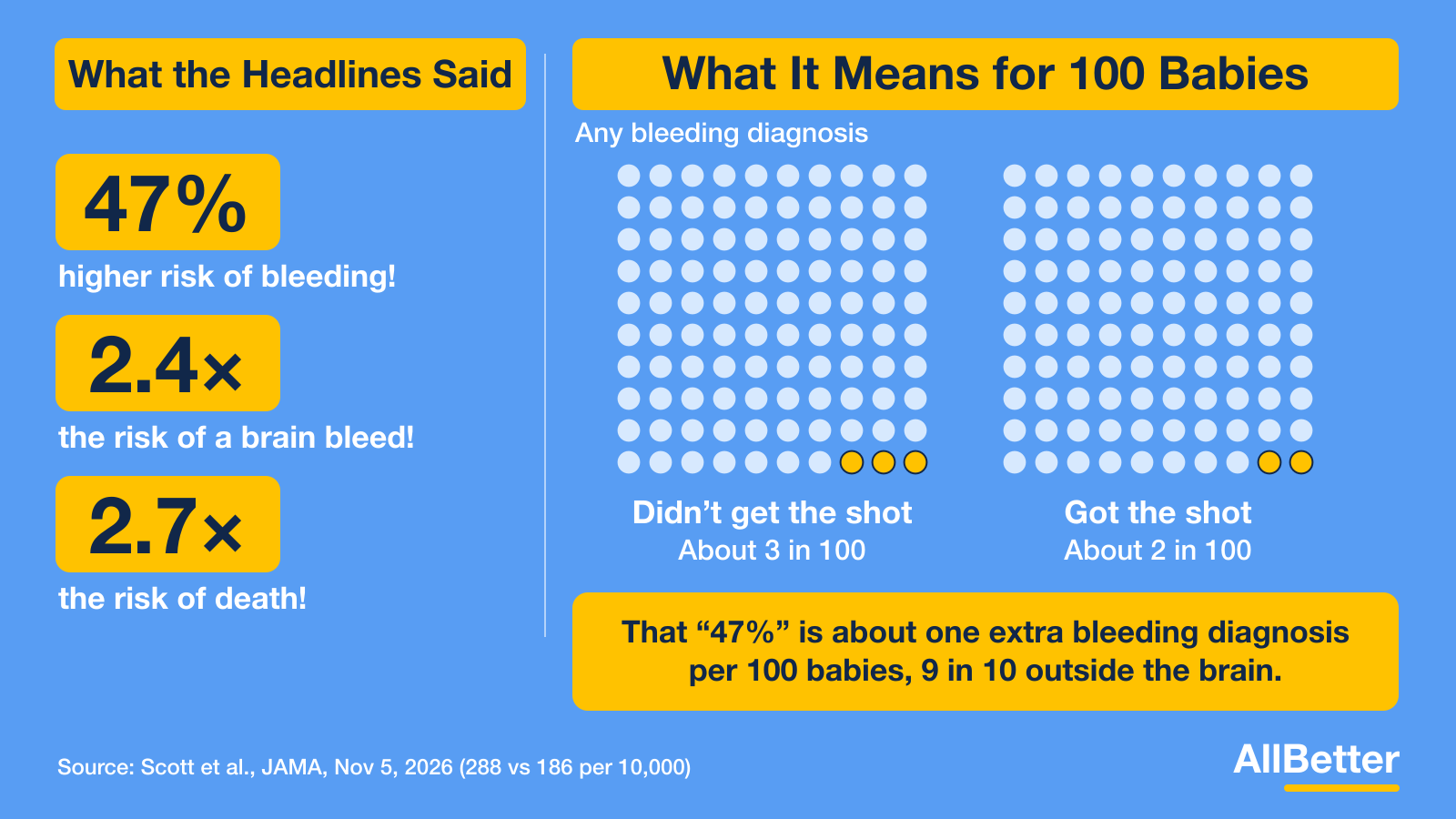
Any bleeding diagnosis by 6 months: 6,762 babies who didn’t get the shot (about 1 in 35), versus 93,066 who did (about 1 in 54). This includes bruising and belly-button oozing.
A bleed in or around the brain: 776 babies who didn’t get the shot (about 1 in 300), versus 6,594 who did (about 1 in 760).
Death during the birth hospitalization with any bleeding diagnosis on the chart: 69 babies who didn’t get the shot (about 1 in 3,400), versus 531 who did (about 1 in 9,400). This includes critically ill babies who died of something else.
Of course, that’s not how you heard it. The coverage ran with relative risk: a 47% higher risk of bleeding, 2.4 times the risk of a brain bleed, 2.7 times the risk of death. Relative risk makes a small absolute difference sound like a five-alarm fire.
Alex Berenson, an occasionally heterodox voice on medicine who took years of incoming fire for his COVID dissent, called the shot a “no-brainer” and told his readers to lean on any parents on the fence. Case closed, supposedly.
I read the study, including both supplemental appendices. It doesn’t give a well-nourished mother the evidence she needs to make an informed decision. And when she tries to make one anyway, look out.
This One Is Personal
My fourth grandbaby was born recently. Let’s pause to ogle him:

My daughter initially declined the vitamin K1 shot.
The Authorities did not accept her answer, naturally. For the next 24 hours, they kept up a struggle session of threats and fearmongering, back to her bedside again and again, until she finally gave in. She was sleep-deprived, and worn down from delivery. What they got from her in the end was the “yes” of a postpartum mother who had run out of strength to keep saying no.
Bullying and manipulation is not what “shared decision-making” looks like, people.
The Wrong Window
I’m a recovering epidemiologist, but I’d like to keep my license to complain about everyone else’s epidemiology, so let me stipulate what’s true. Vitamin K1 deficiency bleeding (VKDB) is real. The late form is rare, around 4 to 10 cases per 100,000 among babies who didn’t get the shot, but the bleed is often in the brain, and some of those babies die or are left disabled. The shot seems to work at the population level, and this study lines up with a Swedish study of 2 million babies. Got it. Stipulated.
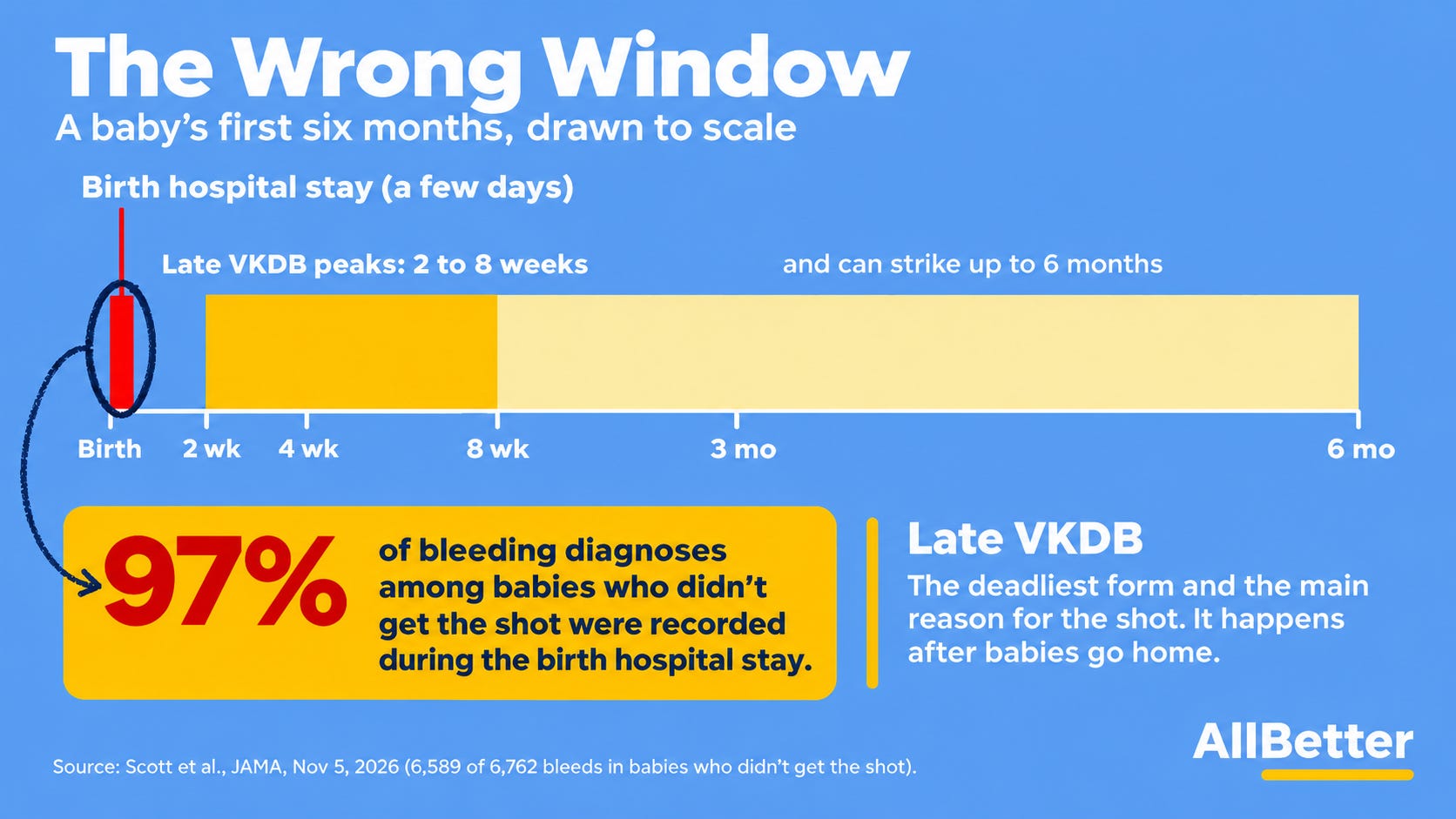
Now look under the hood. Late VKDB, the deadliest form and the main reason the shot exists, typically strikes between 2 and 8 weeks, long after most babies go home.
Yet about 97% of the bleeding events in this study were recorded during the birth hospitalization: 6,589 of 6,762 in the babies who didn’t get the shot. “Any bleeding” here is a grab bag of diagnosis codes: umbilical oozing, skin bruising from a hard delivery, gastrointestinal bleeding, low-grade bleeds in the brain’s ventricles, and the VKDB code itself. Some are trivial, and some come from the mechanics of birth with nothing to do with vitamin K1.
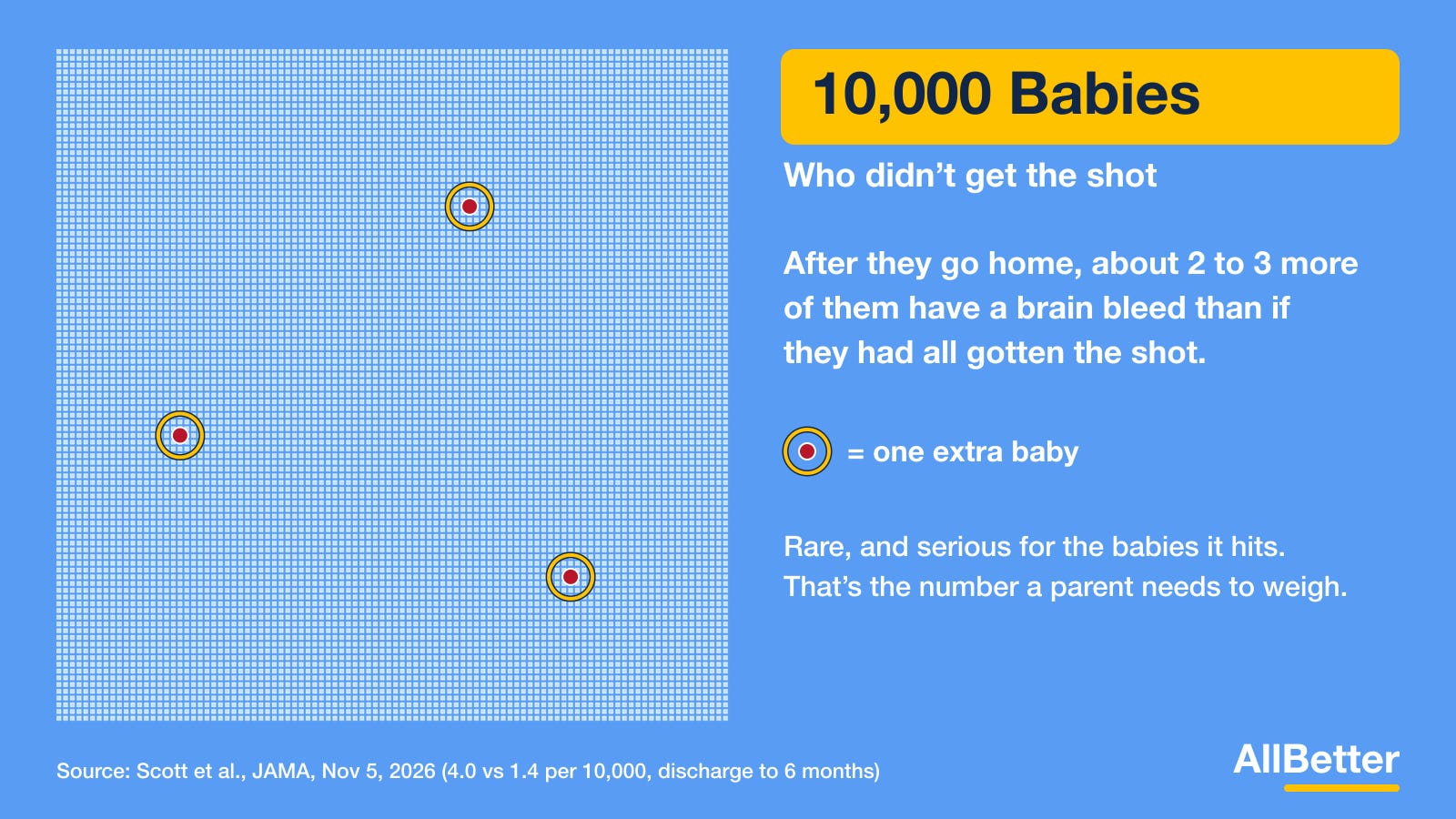
In the window that matters most - after discharge through 6 months - about 10 per 10,000 babies who didn’t get the shot had a bleeding diagnosis, versus about 5 per 10,000 who did. For brain bleeds, it was about 4 versus 1.4 per 10,000. That’s a real difference of about 5 babies in 10,000 for any bleed, and 2 to 3 for a brain bleed.
How a Label Becomes a “Bleed”
The biggest bias in the paper, which the authors admit: doctors label a baby’s bleeding differently depending on whether that baby got the shot.
When a baby hasn’t had the shot, everyone in the hospital knows it, and doctors are primed to reach for the VKDB code, P53, when anything looks off. Apparently, a baby who got the shot with the same minor bruise systematically gets a different code, or none.
During the birth hospitalization, 1,648 babies who didn’t get the shot got the P53 code, versus 397 who did, an adjusted risk ratio of 73. But only 47 of those 1,648 had any second, separate bleeding diagnosis on their chart, like a brain bleed or a gastrointestinal bleed (versus 40 babies who got the shot). Using that stricter definition, the risk ratio fell to 25. The other 1,601 unshot babies carried the label with nothing else to back it up, and every one of them counts as a “bleed” in the headline number.
By my back-of-the-envelope math, remove the babies whose only bleeding diagnosis was that label, and the birth-hospitalization bleeding rate drops to about 212 per 10,000 for babies who didn’t get the shot, versus about 181 for babies who did. The risk ratio falls from about 1.5 to about 1.2. Some labeled babies surely did bleed, but the study can’t say how many, and that gap separates a “no-brainer” headline from a modest one.
The authors themselves acknowledge the VKDB numbers are likely inflated this way. The media didn’t repeat it. Berenson leads with brain bleeds, then posts a chart of all-cause bleeding, so readers picture brain hemorrhages when the chart is mostly bruises, birth bleeds, and labels. I like Alex, and he’s been right about plenty. On this one, he passed along the same scary framing as the legacy outlets he usually skewers.
So the shot does appear to reduce serious bleeds across the population. For a parent, that’s not the hardest question.
Why Informed Consent Needs Two Numbers

Every medical decision has two sides: how much it might help you, and how much it might hurt you. Imagine a pill that lowers your risk of being struck by lightning, and that may also be associated with developing type 2 diabetes over the next 20 years. No one’s sure, because it hasn’t been studied long enough to know.
A groundskeeper on a Florida golf course in July faces real lightning risk and might accept the diabetes question mark. An office worker in Minneapolis in January has a risk close to zero, and half of almost no risk is still almost no risk. For her, the decision is entirely about diabetes: a possible 20-year risk in exchange for protection against something that was never going to happen to her. Put that way, it sounds absurd, because it is.
That may be a well-nourished, K1-replete mother’s position. The kicker: no one can tell her whether she’s on the golf course or in the office, because no one has measured it.
Who Benefits, and Who Might Not
The benefit we know about is a population-level benefit, concentrated in specific groups: babies whose mothers took certain drugs during pregnancy, like anticonvulsants or blood thinners; exclusively breastfed babies whose mothers’ milk is low in K1; and babies born with certain liver conditions. But you’re not the population’s parent, you’re the parent of ONE baby with a specific risk profile, and no study has measured whether the benefit shrinks, or disappears, for the babies of exceptionally well-nourished or supplemented mothers.
The biology here gives us reason to ask. Before birth, the placenta holds the baby’s K1 far below the mother’s, and maternal supplements barely move it. After birth, the story changes: when nursing mothers take K1, the K1 in their milk rises substantially. The placenta tells us what nature wants for the unborn baby, a tightly limited amount. The breast’s milk composition tells us what nature wants for the born baby, whatever mom’s diet provides. A well-nourished mother’s milk may be doing exactly what it was designed to do.
Which brings me to dental researcher Dr. Weston A. Price, DDS. In the 1930s, Price studied isolated people groups with no access to refined sugar and white flour, and found remarkable health: straight teeth, strong bones, broad faces, little chronic disease. When modern foods arrived, that health fell apart within a generation.
The isolated communities’ “wise traditions” turned out - what a coincidence! - to look a lot like the diet modern science associates with optimal health. One tradition Price found again and again: young couples approaching conception got the community’s most nutritious foods, like organ meats, fish roe, pastured butter, and bone marrow. Those sacred preconception diets were rich in vitamin A and other fat-soluble vitamins, including a factor Price called “Activator X,” which we now know is vitamin K2. The modern Wise Traditions dietary principles add plenty of K1 too, without trading one problem for another: leafy greens and other vegetables cooked in grass-fed butter, ghee, or tallow. The fat helps the body absorb the K1 locked inside the plant, and cooking lowers the oxalates that make those K1-rich greens like spinach and chard harder on the body.
(Nutrient nerds: K2 is the animal and fermented-food form. The shot is K1, the plant form, which the baby’s liver leans on most for clotting factors.)
So is the low K1 in modern breastfed babies partly a modern artifact, a reflection of how far the average American mother’s diet has drifted from what babies evolved expecting? There’s a simple way to find out. A baby’s liver makes clotting proteins whether or not it has enough K1 to finish them. When K1 runs short, half-finished versions called PIVKA-II (“protein induced by vitamin K absence”) spill into the blood, and a routine blood test can measure them. High PIVKA-II means a baby is running short on K1.
Here’s the study I want to see. Among families who have already chosen to decline the shot, compare three groups of nursing mothers: those eating according to ancestral wise traditions, those on the standard American diet, and those on the standard American diet plus K1 supplements. Measure K1 in the milk and PIVKA-II in the babies. Within a year, we’d know whether mom’s diet protects these babies, and whether a supplement can do the same job. As far as I know, it has never been done.
What About the Liver Conditions?
A small number of babies are born with liver conditions that keep them from absorbing fat-soluble vitamins, no matter how rich the milk is. They’re at the highest risk of late VKDB, and the conditions are usually invisible until a bleed or jaundice shows up.
The most common, biliary atresia, has no known cause. Researchers have looked at viruses, immune problems, genetics, and toxins, but as far as I can find, maternal and preconception diet has never been seriously studied. Others, like alpha-1 antitrypsin deficiency and cystic fibrosis, are genetic, though whether nutrition affects their severity has also gone unasked.
So no one can say these conditions are unpreventable. But no one can rule them out in the delivery room either, and these babies are the ones the shot protects most. The uncertainty runs both ways, which is exactly the problem.
Newborn K-Maxxing
If the benefit for a low-risk baby turns out to be small, the risk side becomes everything, just like for our Minneapolis office worker. And we know remarkably little about that risk.
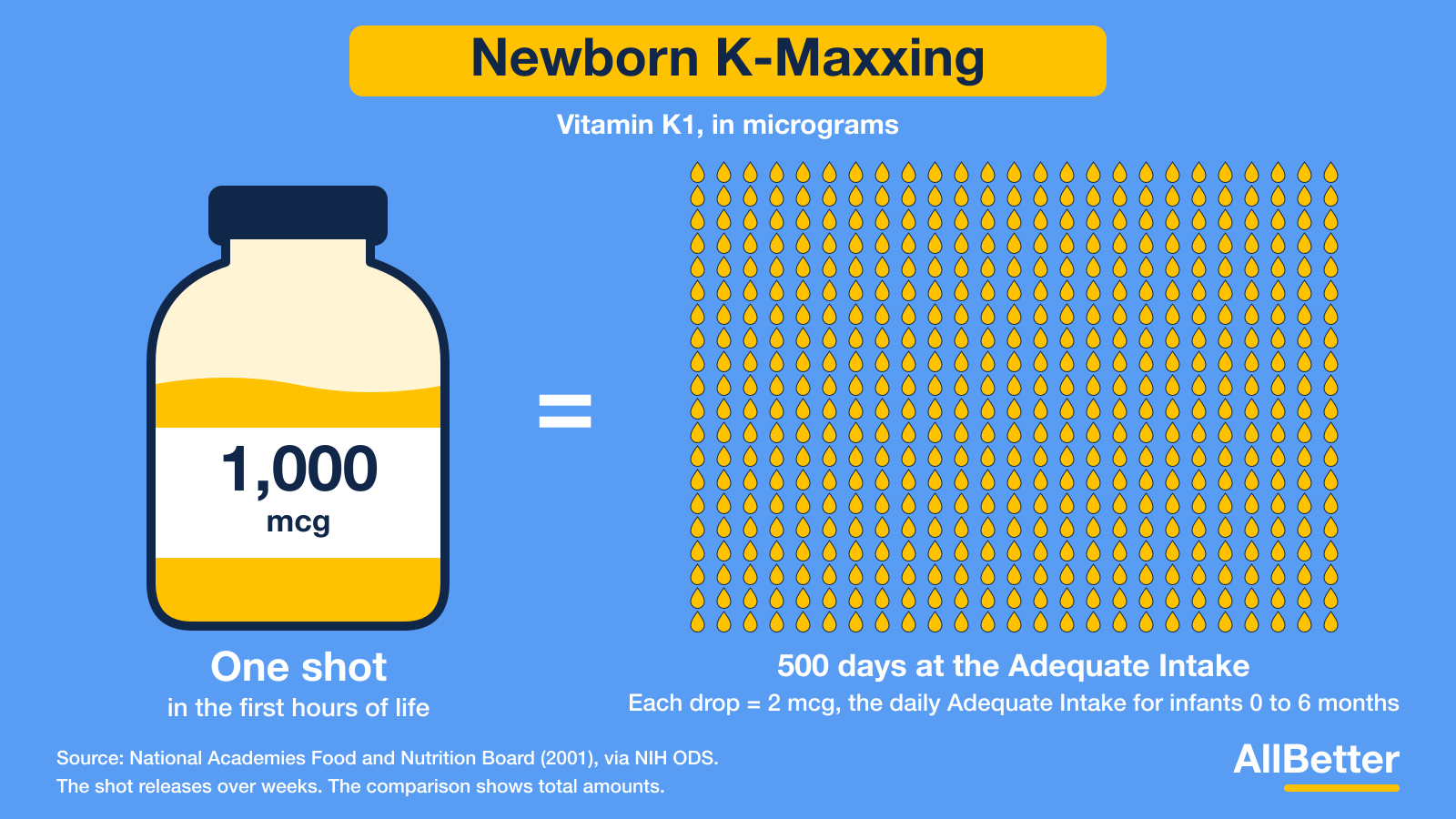
Start with the dose. The standard shot is 1 milligram, or 1,000 micrograms, of vitamin K1. The adequate intake for a baby in the first six months is about 2 micrograms a day. So the shot delivers roughly 500 days’ worth in one injection in the first hours of life. It releases from the muscle over weeks, but still produces blood levels far beyond anything a breastfed baby would get from food. Hence: newborn K-maxxing. The dose was chosen decades ago to maximally prevent bleeding, but never optimized against everything else K1 does.
And K1 does much more than clot blood. The proteins it’s known to activate so far include osteocalcin, which helps mineralize bone; matrix Gla protein, which keeps calcium out of blood vessels and soft tissue; proteins C and S, the body’s own natural blood thinners; and Gas6, which regulates cell growth, cell survival, and key parts of the immune system. That list is almost certainly incomplete. Has anyone compared shot and no-shot babies for bone, vascular, clotting, or immune development over time? No. A safety record only shows the outcomes someone thought to check.
Take autoimmunity. God knows we’re living through an explosion of it. Federal researchers found that the share of Americans 12 and older with antinuclear antibodies, the most common blood marker of autoimmunity, rose from about 11% around 1990 to about 16% by 2011-2012. Among adolescents, it more than doubled, from 5.0% to 12.8%. No one associated with The Science knows why. Has anyone asked whether newborn K-maxxing affects how a baby’s immune system calibrates itself through Gas6, or whether a mother’s diet changes the answer? As far as I know, never. The shot has been routine since the 1960s, so it can’t explain a recent rise by itself, but diets and the microbiome have changed dramatically since then, and no one has studied how K-maxxing interacts with either.
What Else Is in That Shot?
K1 doesn’t dissolve in water, so it needs help. In the most common neonatal formulation, each dose contains 1 milligram of K1, 35 milligrams of a polyoxyethylated fatty acid derivative, about 19 milligrams of dextrose, and 4.5 milligrams of benzyl alcohol as a preservative.
That emulsifier appears on another manufacturer’s label as polyoxyl 35 castor oil, from a family of compounds known to cause allergic-type reactions. The label carries a boxed warning about severe reactions, including deaths, mostly with IV use, but also reported with injections into the muscle. It also warns of gasping syndrome linked to benzyl alcohol in neonates, which was tied to much larger doses in premature babies decades ago. But the warning is on the label for a reason. Preservative-free versions swap in polysorbate 80 and propylene glycol, which raise the same questions.
Injecting anything into a newborn in the first hours of life is serious business. Every ingredient should be studied for long-term effects in newborns, not just immediate reactions, and as far as I can find, no such studies have been done. A mother who reads the label and gets nervous isn’t being irrational.
The Cancer Question Isn’t As Closed As They Say
The only long-term outcome anyone ever studied seriously was childhood cancer, and that research is shakier than The Authorities let on.
In the early 1990s, British researcher Jean Golding reported that babies given the shot had roughly double the risk of childhood leukemia. Most follow-ups found no clear link. In 2002, researchers pooled data from the six major studies, covering 2,431 children with cancer and 6,338 without. Many old records didn’t say whether the baby got K1. Treating a missing record as no shot, the leukemia odds ratio was 1.09, not significant. Filling the gaps from hospital policy, it was 1.21, which is statistically significant. The authors couldn’t rule out small effects but found no convincing evidence of a link.
Read as an epidemiologist, that’s not exactly a clean bill of health. It’s more like “our data were too messy to see a small effect, and one of our two analyses found one.” A 20% increase in a rare childhood cancer would be easy to miss here but would be a big deal across the huge population of every American baby. And cancer is one outcome among innumerable possible long-term associations, apparently the only one anyone looked for.
Doesn’t Anyone Want to Know Why Nature Does This?
Here’s why I can’t get fully comfortable with newborn K1-maxxing: every human baby is born low in vitamin K1.
Why?
No really, why??
The standard answer is that babies are born “deficient,” so we give them a vitamin. Cuz, nature’s just dumb, I guess.
But in 1997, researchers published a paper with a remarkable title: The Riddle of Vitamin K1 Deficit in the Newborn (Israels, Israels and Saxena, Seminars in Perinatology). They treated low K1 as a puzzle rather than a mistake.
K1’s job is to switch certain proteins on. Israels et al pointed out that the fetus has only enough K1 to partially switch them on, that the placenta maintains a steady gap between mother and baby, and that some K1-dependent proteins help control cell growth. Their hypothesis: during the fastest growth of a human life, limiting K1 may act like a dimmer switch on growth signals. Too little is clearly harmful; babies exposed early in pregnancy to warfarin, which blocks K1, can be born with facial and bone malformations. But too much stimulation of growth pathways might be harmful too. The fetus may need a calibrated amount, not the maximum.
The placenta’s behavior supports this. It actively pumps the brain-building fat DHA to the baby, so it can move fats just fine. Yet the K1 gap holds even when the mother takes more, like a gate held shut on purpose. It does the same with vitamin A, which causes birth defects in excess but is utterly critical in the right amounts. And the same gap shows up in other mammals researchers have studied, and traits conserved across species usually serve a purpose.
None of this proves low K1 benefits a newborn after birth; the outside world comes with falls and bumps. But G.K. Chesterton made the relevant point in 1929, imagining a reformer who wants to clear away a fence he doesn’t understand: “If you don’t see the use of it, I certainly won’t let you clear it away. Go away and think.”
We are dropping a nuclear bomb on a carefully regulated pattern of human development on the first day of life, for nearly every baby in America, and we still can’t say whether it’s a feature or a bug.
The Authorities Need a Mirror
Given everything we don’t know, you’d expect a humble conversation in the delivery room about what’s known, what isn’t, what’s in the shot, and what the options are. Instead, too many parents get what my daughter got, and some get worse.
In Illinois, the child welfare agency (DCFS) classified the vitamin K shot as medically necessary in 2015 and treated refusal as an indicator of neglect. The Boughers were told before their fifth baby’s birth that they could decline on religious grounds. Afterward, the mother says a doctor called her beliefs stupid and wrong, held her newborn away from her for about 12 hours, and reported the family to DCFS. An internal memo later found potential medical neglect in only 7 of 138 families investigated for declining.
When parents sued, the courts dismissed their cases.
Translation: the hospital can call the state on you, and you can’t easily sue the hospital for it.
CPS exists for abuse and real neglect. Aiming it at a mother asking thoughtful questions, about a decision where the science on her individual risk has never been done, is an abuse of power.
White coats, you’re upset that refusal rates have doubled. I’m sure it’s upsetting to see blind obedience decline, especially when you think such obedience saves lives. But before you reach for the next threat against such parents, look in the mirror. Every bullied family tells everyone they know (and some have Substacks with audiences in the many thousands, just sayin’). If you want trust back, try humility. Admit what you don’t know, fund the studies, offer options, and treat mothers like the adults with legal and moral authority over their children that they actually are.
What Should Happen Instead
Fund the subgroup study described above. It’s cheap, fast, and long overdue.
Fund long-term follow-up for bone, vascular, clotting, immune, and autoimmune outcomes.
Find the lowest dose that prevents bleeding, and study the additives.
Get CPS out of the delivery room. Declining a legal option after an informed conversation isn’t criminal neglect, period.
Offer oral options. Denmark and the Netherlands use repeated oral doses over the first months. They’re somewhat less effective than the shot (again, measured only at the population level), but parents should be able to choose them without a fight.
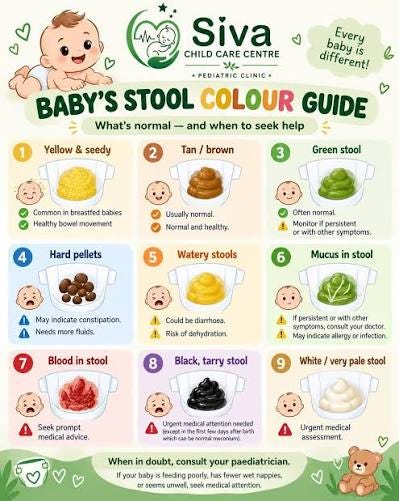
Whatever you decide, learn the warning signs. Pale, chalky, or clay-colored stools, jaundice lasting past two weeks, dark urine, nosebleeds, oozing from the umbilical stump, or unexplained bruising all mean a call to the doctor that day, as they can indicate the liver condition that leads to the brain bleed. If you decline the shot, these signs matter even more.
The shot may well be the right choice for many babies, maybe most. I’m not telling anyone to refuse it. But the people demanding you accept it, under threat, because of population studies that haven’t been stratified by risk profile, can’t tell you what it does for your baby, or what it does to your baby over a lifetime. They’ve never measured it for your baby’s risk profile. Until they do, the least they owe you is honesty about what they don’t know, and the right to decide without a struggle session at your bedside.
Thank you for composing and publishing this article.
Studies of newborns should also include gut microbiome disruption via formula, circumcision, and other shots.
The farther we stray from what nature/God intended, the worse off we will be.
Fascinating, and not an issue I was at all familiar with (being well past child rearing years). I've been a paid subscriber to Alex Berenson's Substack since the beginning, largely due to his stand on Covid vaccines (and a long-time fan of his books). To be honest, I do find him too credulous on certain health issues. If Covid taught us anything, it is that even the beloved family doctor can (perhaps unwittingly) be a shill for big pharma. I trust virtually nothing any more without trying to verify and/or read contrary points of view. This makes me a difficult patient to deal with sometimes, but that is the wages of deception. Never again!