



The story of a nurse from Alaska is circulating around the podcast circuit these days.
McKenna West, a single mom of two, signed up to be a surrogate mother last year to make some extra money. Twenty weeks into the pregnancy, a scan found the baby had hypoplastic left heart syndrome - a serious but survivable condition requiring early surgeries but also, for most kids, an otherwise normal childhood.
The couple who’d contracted with her invoked the abortion clause in their surrogacy contract. She refused, and they sued her for a quarter million dollars. She fled to Texas, where they frown on forced abortion. The baby, Gabriel, was just born this week. The courts have ordered that he be provided the life-saving care he needs, but also that his genetic parents should have custody of him. As a result, McKenna wasn’t even allowed to hold him and provide the skin-to-skin contact that triggers a variety of critical developmental cues for him after birth.
This is just the latest, but by no means the only, controversy arising out of our country’s status as the most permissive IVF haven in the world. With President Trump and most of Congress trying to convert IVF into an entitlement, employers better buckle up.
Congress is Coming for Your Health Plan
There are a couple versions of a mandate on employers to cover IVF that have been floating around Congress for a few years now.
The Democrat-only one was actually attracting Republican support a couple years ago before the pro-life community (including, aggressively, me) raised heated opposition. That bill, sponsored by Senator Cory Booker, then and now, requires every employer plan in the country to cover IVF, with no religious exemption and no limits. It also would offer IVF to anyone, whether they’ve been diagnosed with infertility or whether they just want IVF. The bill explicitly bans “discrimination:” meaning, you’d better offer IVF to same sex couples, singles, transgender people, and senior citizens, presumably including the costs associated with commercial surrogacy, gamete purchase, etc.
The bill with bipartisan cover isn’t much better. H.R. 8119, introduced in March by Rep. Zach Nunn, a Republican from Iowa, along with Rep. Debbie Wasserman Schultz has picked up a dozen cosponsors from both parties. It requires an infertility diagnosis before coverage kicks in (nice try), but the definition of “infertility” would include seniors, people who’ve never reproduced before (maybe because they’re same sex attracted or transgender or single) - anyone whose “reproductive history” or “physical findings” render them infertile.
The bill with Republicans on it is actually worse in one way: it comes with a draconian reporting regime: every employer has to prove to the Department of Labor every year for five years that its IVF benefit is generous enough to pass muster. The Labor Secretary can order corrective action against plans deemed to be insufficient, and then fine them $100 a day and name-and-shame them publicly in a report sent to Congress.
Where Do We Even Start?
Let’s set the moral case aside for a second and look at the cost. Because employers are already saving so much money on health care these days.
Oh wait…
A single IVF cycle runs $15,000 to $30,000, and most women need more than one, and are associated with higher risk and complicated pregnancies, and more expensive pregnancies and deliveries.
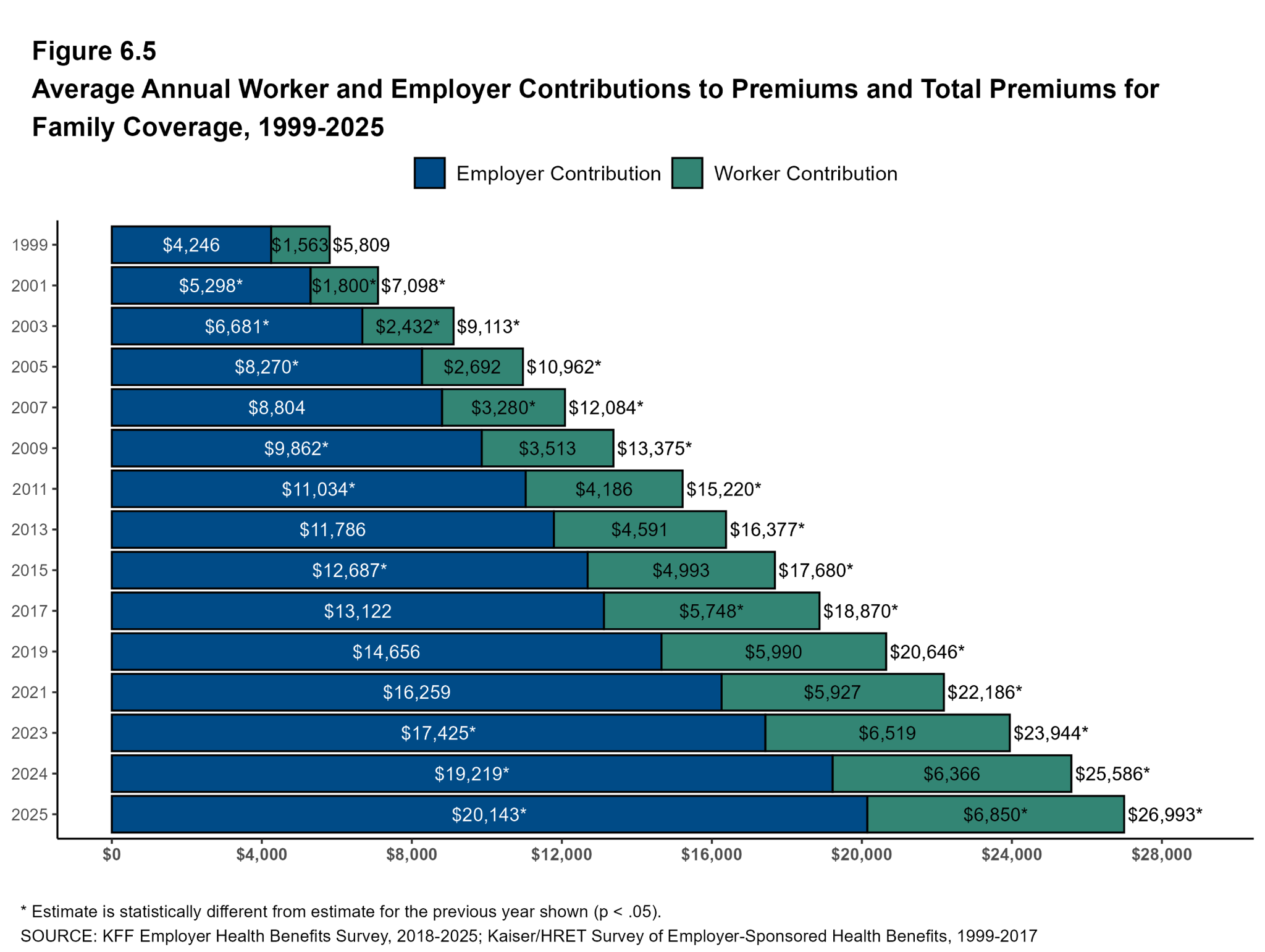
Family premiums have more than quadrupled since 1999, from just under $6,000 to $27,000. Ten percent of families with job-based coverage are already costing employers over $30,000 a year. Almost half of all large employers report that they’re raising what employees pay next year just to keep up with the costs already on the books. The bills amend ERISA - the law that governs the health plans that cover two-thirds of all Americans who get their insurance on the job - and more than half the country overall. The Democrat bill covers all non-ERISA plans too. So this is a much bigger impact than the usual in-fighting in DC about health policy in the 20-million ACA market.
Remember what happened to the price of insurance when the government mandated that everyone buy it?
IVF still runs largely on cash right now, which is one of the only things keeping any lid at all on the cost. Mandate a benefit like this and you know what happens to the price of that benefit in the marketplace.
A business scared of getting on the DOL naughty list is going to overspend on IVF coverage to stay safely above suspicion, and then tighten the screws somewhere else - a higher deductible here, a stingier coinsurance rate there. Who suffers the most from this cost-shifting? Employees dealing with cancer, expensive drugs, or a kid with a genetic condition. Chemo doesn’t come with its own federal reporting mandate demanding proof your employer is paying enough for it.
What Coverage Actually Buys
Most of the “should employers cover this” debate treats it as a binary question - yes we cover it or no we don’t. But covering IVF means funding an entire industry’s standard operating practices. Most people (and politicians) haven’t looked under the hood on those.
According to CDC and IVF industry data, 90 percent of the tiny humans created by IVF die before making it to live birth. IVF has recently surpassed non-IVF abortions as the leading cause of death in children. Most fertility clinics create a batch of embryos at once rather than one or two at a time, because creating them one at a time is brutally expensive and bad for the clinic’s business model. They want you coming back to try again with your frozen embryos when the process fails the first time, without having to re-do the agonizing (and dangerous) step of hormonal manipulation, ovarian hyperstimulation and egg retrieval.
Every embryo gets eugenically screened for “fitness” (however the clinic determines it at the time) and the ones not implanted get frozen indefinitely, at your (or your employer’s) expense, or discarded. Genetic screening and sex selection are routine. After the embryos are transferred into the mother’s or the surrogate’s womb, if too many of them fail to die, then you have what’s called “selective reduction” - that’s Orwell-speak for aborting the extras to improve the odds for the one, two or three left alive.
Surrogate contracts ensure that the eugenics continue - the “terminate per contract” boilerplate provision requires the surrogate to undergo an abortion if some prenatal test along the way makes the buyers of the baby uncomfortable. Like Gabriel and his treatable heart defect.
By the way, health conditions later in life are more common in babies created under these unnatural circumstances, to the surprise of no one. Mother Nature dominates all other competitors.
And then you have third parties introduced into the IVF “benefit.” Third parties are baked into a shocking share of IVF cycles, which is an ethical and legal minefield that your company’s Benefits Committee has never been briefed on.
Motherless and Fatherless By Design
Every time a health plan pays for sperm procurement, egg procurement, or a surrogate, it’s paying to manufacture a child who will grow up permanently severed from at least one biological parent, on purpose, before he’s even conceived. Adoption exists to heal that wound after tragedy strikes a family. IVF with purchased gametes (can we drop the charade about “donors?”) creates the wound as a business model.
The research on these babies when they grow up isn’t encouraging - struggles with identity, a documented longing to know the missing half of their genetic story, higher rates of depression and a sense of being a product rather than a person.
The Egg Market

Don’t look too closely at what actually happens to the young women who sell their eggs to fund somebody else’s family.
To harvest enough eggs to make a cycle worthwhile, clinics shut down a woman’s own cycle with Lupron and synthetic hormones, then hyperstimulate her ovaries to produce ten or twenty eggs in a single month instead of the one nature intended. The known risks include Ovarian Hyperstimulation Syndrome, ovarian torsion, kidney disease, and a documented link between the estrogen doses involved and breast and uterine cancer, stroke, and blood clots.
Some women have lost their own fertility permanently from a process meant to replace somebody else’s.
And of course, when all this goes down, the egg seller isn’t the clinic’s client or the “patient” being treated. (The person paying for the cycle is the customer.) The genetic mother is merely a vendor, and a disposable one. If something goes wrong with her ovaries, her kidneys, or her fertility, either right away or years later, there’s no established system connecting that harm back to the sale, no long-term registry tracking her outcomes, and no incentive for the clinic that profited off her eggs to find out whether she’s okay.
The Sperm Market
Sperm collection sounds clinical until you say it plainly: it happens in a room down the hall from the waiting area, stocked with pornography, where a man is paid to masturbate and ejaculate into a cup. That’s true whether it’s an anonymous seller or the intended father producing his gene pool. Either way, if your plan covers the procedure, it’s covering that room and what happens there. Your company becomes complicit in all the trafficking, exploitation and other crimes pervading the porn industry.
The sperm market runs on the same eugenic sales pitch as the egg market - catalogs sorting sellers by IQ, height, athletic history, eye color, complexion, and race, sold to customers shopping for the most “desirable” genetic material available. And the vetting on the supply side has failed spectacularly and repeatedly. Indianapolis fertility doctor Donald Cline inseminated dozens of his unsuspecting patients with his own sperm through the 1970s and ‘80s - at least 50 confirmed children, by some counts closer to 100. Prosecutors discovered that what he’d done wasn’t even a crime under Indiana law at the time.
Surrogacy and the Farms
Surrogacy breaks asunder what God has joined: motherhood. Nature gives one woman all three jobs: the genetic mother whose egg gets fertilized, the birth mother who carries and bonds with the baby, and the social mother who raises the child. Surrogacy turns that into a menu - rent one role, buy another, skip a third entirely.
Once you add a surrogate mother to the mix, you’re not just buying a service, you’re buying into an industry that too often goes looking for the cheapest, most desperate wombs on the planet. Anand, a small city in Gujarat, India, became a global surrogacy hub in the 2000s precisely because poor Indian women could be recruited for a fraction of what an American surrogate charges - until India banned the practice in 2021. Ukraine’s BioTexCom, the largest surrogacy clinic in the world, got in a pickle when Russia invaded in 2022 and dozens of newborns ended up living in a bomb-shelter basement, cared for by nannies, because the foreign parents who’d ordered them couldn’t get into the country to collect them.
And the babies born through this system are subject to exactly the kind of quality control you’d expect from an industry that treats them as a product. In 2014, an Australian couple hired a Thai surrogate to carry twins, and when a prenatal test found that one of the babies had Down syndrome and a heart defect, they asked her to abort him. She refused. They took the healthy twin sister home to Australia and left the boy, whom she’d named Gammy, behind with her.
Thailand banned commercial surrogacy for foreign clients that same year.

Things are no better in America: it’s still poor women, often of color, who choose to give away their own children, or rent their wombs for the gestation of others’ children, becoming the only voice, the only smell, the only heartbeat that baby has ever known, only to be ripped away at birth, forever.
Nobody Checks Who’s Buying
Adoption in America comes with home studies, background checks, courts involved and mounds of regulatory oversight. Commercial surrogacy and gamete markets come with none of that.
In the case of the Australian couple who left Gammy behind in Thailand, David Farnell, the father, was a convicted child sex offender with three young girls as his victims. He flew home with his daughter anyway, and it took reporters digging after the Gammy story broke to find out who he actually was.
That same year, Thai authorities and Interpol investigated a young Japanese man who had fathered at least sixteen children through Thai surrogates and reportedly wanted ten to fifteen more a year. He was never charged with anything, because there was no framework in place that required anyone to ask why. Laws in every country, including ours, are woefully behind the whack-a-mole of ethical nightmares created by Big Fertility.
Legal quagmires, even for the normal couples
Now, you might be thinking about the earnest couples who try to sidestep all these ethical landmines: they create only the embryos they intend to implant, implant every one, and skip the genetic screening. That version of IVF is theoretically possible, but it’s rare, since it’s the most expensive, inefficient version and clinics have every incentive to steer people away from it.
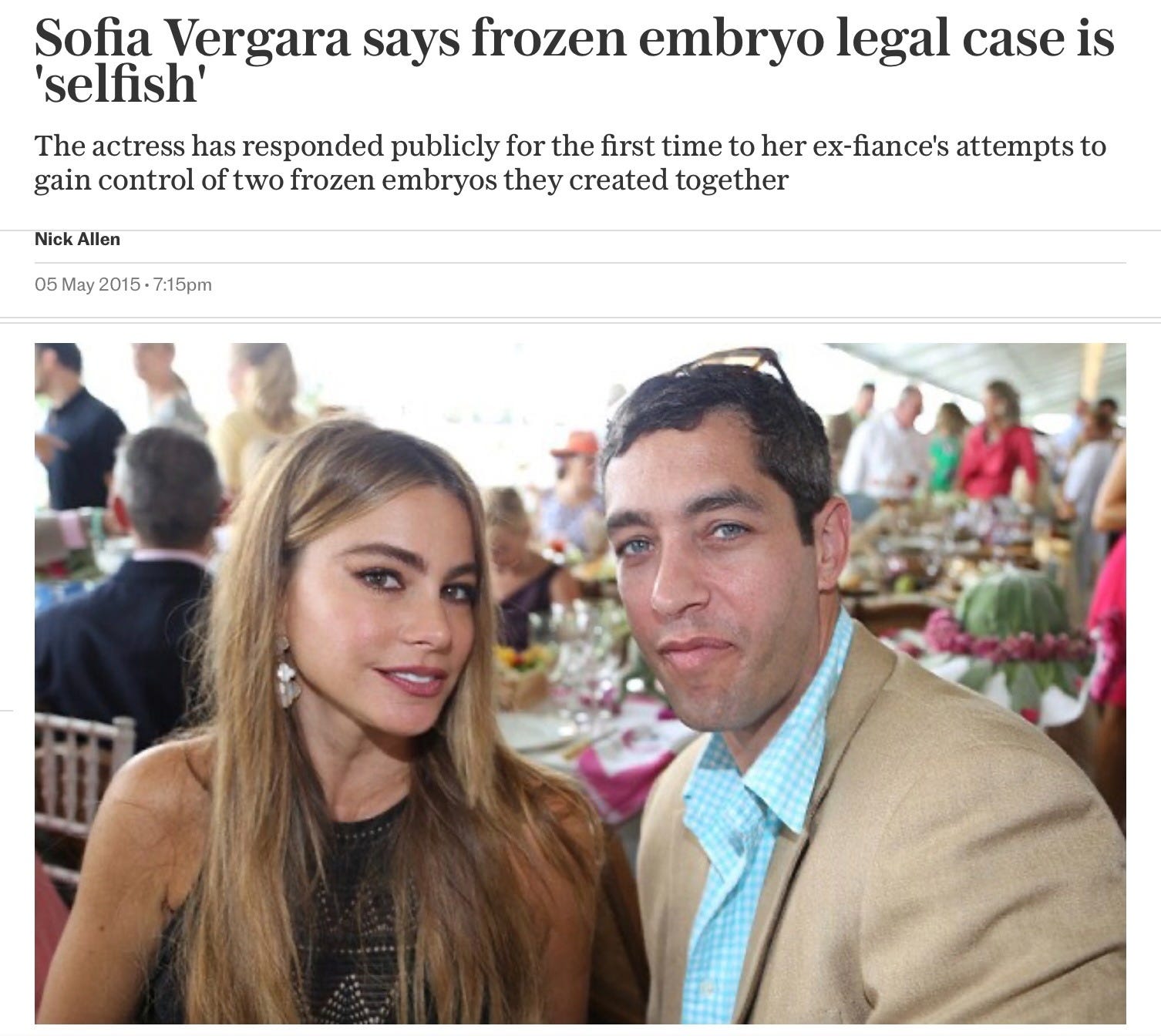
And of course, couples break up or get divorced. There are numerous high-profile examples of celebrity couples fighting in court over the fate of their frozen embryos, with one parent wanting to keep them and one wanting to throw them away.
Then there’s the question of what happens to the embryos themselves once they’re sitting in a freezer somewhere, which is where I guess Congress wants your employer’s money sitting too, sometimes for years, sometimes for decades.
The current political frenzy over IVF traces back to a single freezer accident.
In December 2020, a patient wandered into the unsecured storage unit at a fertility clinic attached to a Mobile, Alabama hospital, reached into subzero cryogenic tanks out of curiosity, burned his hand on the cold, and dropped several embryos on the floor, destroying them instantly. Three couples whose embryos were among the ones destroyed sued the clinic. When they won because Alabama applied its definition of minor child to the embryos, political hysterics ensued. Republicans, starting with President Trump, running for his second term, competed with each other to prove who was the most committed to making IVF as accessible as a car wash - calling it pro-life, pro-family, with zero due diligence.
Whose Money, Whose Conscience
Neither bill in Congress lets an employer opt out on religious or moral grounds. Almost a quarter of the country is Catholic, and the Church teaches plainly that IVF is intrinsically immoral and that Catholics can’t fund it, cooperate with it, or look away while it happens on their payroll. Plenty of other faiths object to parts of it too. Under either bill, a Catholic hospital, a Christian college, a family business like Hobby Lobby, or a small pro-life advocacy group - all of them would be required to pay for deeply objectionable, unethical aspects of the IVF playbook, along with every employee whose premium dollars would help cover a colleague’s embryo olympics, whether they believe it’s right or not.

We already ran this exact fight over the Little Sisters of the Poor, a group of nuns who take vows of poverty and who spend their lives caring for the elderly, when the Obama administration tried to force them to pay for their non-nun employee’s birth control. It went to the Supreme Court, and the government lost. I know, because I was at the White House, holding a gun to the Trump DOJ’s head to make them settle with the sisters and the 100+ other plaintiffs.
The Employer Checklist
If you’re still determined to add IVF to your plan after all this, at least your eyes are open a little wider. But you don’t get to just check a box marked “covers IVF” and call it a day. You have to actually write the policy (I write policies for a living and it’s way more complicated than you think) which means putting an answer, in writing, next to every one of these questions:
Who gets the benefit?
Does it cover only married couples, or anyone with a policy and a pulse?
Does it cover same-sex couples and single people, meaning you’re paying to create a child who will grow up without a mother or a father by design?
Does it cover transgender employees who sterilized themselves as part of their transition?
Is there an age cutoff, or will you pay for a 60-year-old employee to become a parent using a purchased egg and a surrogate? What about the 45 year old who, statistically, is extremely unlikely to be successful, no matter how many cycles her employer pays for?
Is there an age too young - do teenagers qualify?
Will you cover employees who want to sell their own sperm or eggs, or serve as a surrogate, including for a family member or a colleague?
Third parties
If you’re buying eggs: are you paying for the hormone injections, the hyperstimulation, and the retrieval? What happens if she develops Ovarian Hyperstimulation Syndrome, or loses her own fertility as a result, immediately or years later? Who decides that the harm is connected to the egg retrieval, and who pays for it then? Does the plan still pay if none of her eggs turn out to be usable?
If you’re buying sperm: are you paying for the room and the materials facilitating the sample collection?
If you’re covering a surrogate: what happens if she miscarries? Do you pay for a second surrogate? A third? Is there a cap on how many surrogacy arrangements you’ll fund per employee per year? Will you cover a surrogate based overseas, and if so, how will you verify her medical bills, her age, or whether she was recruited, coerced, or trafficked into a surrogacy farm? If you won’t cover the surrogate’s own costs, will you still cover everything else if your employee chooses a foreign surrogate from a farm anyway?
Embryos
Will you pay for genetic screening of embryos? Just viability, or also disease risk, the parents’ preferred sex, and other traits?
If none of the embryos created are graded as “fit,” do you still pay for a transfer if the couple wants to try anyway?
How many embryos will you pay to create in a single cycle?
How many will you pay to transfer into the womb at once - all of them? Two? Three?
If too many implant, will you pay for the abortion, I mean, “selective reduction” that follows? How many implanted embryos count as an acceptable number to let survive?
Will you pay to freeze the embryos that aren’t used? For how long? What happens to that bill after five years? Ten?
Procedure coverage
How many cycles will you cover per employee, and is there a dollar cap per cycle or per lifetime?
Does the benefit cover egg freezing for an employee who just wants to delay having kids, with no infertility diagnosis at all?
Conscientious objectors
What’s your plan for employees with a sincerely held religious objection to funding a plan that covers IVF?
Will you offer a separate plan option that excludes IVF, or are you prepared to defend this one in court?
Not trying to be judgey. I’ve been there.
I got the “infertile” diagnosis myself more than a decade ago, off one ultrasound cycle, from a doctor I never thought to question. I didn’t do a single savvy thing with that information. I didn’t investigate root causes, didn’t fix my hormones, didn’t find some enlightened doctor who bothered to ask why my body wasn’t working. I believed her, grieved it, and my husband and I adopted.
Years later, studying to become a naturopath, I learned that infertility was a symptom, not the disease, very often reversible rather than a life sentence. That ought to give employers a better option when it comes to helping their workers have the babies they so desperately want. The real gap in coverage is for functional, root cause healing. Infertility is the tip of the iceberg of metabolic and other bodily meltdown that will translate to misery and high employer costs later. But health coaching, functional lab tests, couples counseling, homeopathy, and holistic sleep specialists - the type of services that can help reverse the metabolic disorder, inflammation, and hormonal chaos behind much infertility - are rarely covered by your employee health plan.
Beyond the whole-system approach, more targeted, restorative reproductive medicine is a burgeoning field that has finally started to go mainstream. When coded properly, it’s usually covered by health plans, but it’s important for employers to check on that, as it’s been a gap in the past.
None of this requires an ERISA mandate, a federal reporting scheme, or a conscience fight.
Back to the Question
So, should your health plan cover IVF? Should any employer health plan cover IVF?
Well, sure. If your company is down for doing a deal with the devil: a business with a 93 percent loss rate, routine eugenics, intentional separation of children from their biological parents, and contracts that treat a baby’s heart defect as grounds for forced abortions. Her body, her choice, amiright?
Baby Gabriel is still in some NICU, separated from the only mother he’s ever known, waiting on the parents who tried to force her to kill him to oversee the medical care for him that a court had to order over their objections. Unless we want this story at industrial scale, employers should opt way out of this one and fight any legislation being recklessly pushed by uninformed politicians - who clearly need better staff - with everything they have.
This (I.e. - Congress and those clowns we've called presidents over the last 100 years) is why "health insurance" is out of control. There are numerous better ways to handle the underlying interest here that don't involve mandating every health plan (or even some) cover IVF.
If we're going to totally ignore incentives, costs, and individual autonomy why not just write a bill that says every conceivable health issue must be covered???
Just f#$&ing absurd.
... Okay... I feel mildly better now... 😋
Thank you for writing this. While the argument of government interference of coverage is evident (and very important), the piece often missing in IVF discussions is the babies (yes, babies) who are terminated. You are giving those babies a voice. Thank you.