


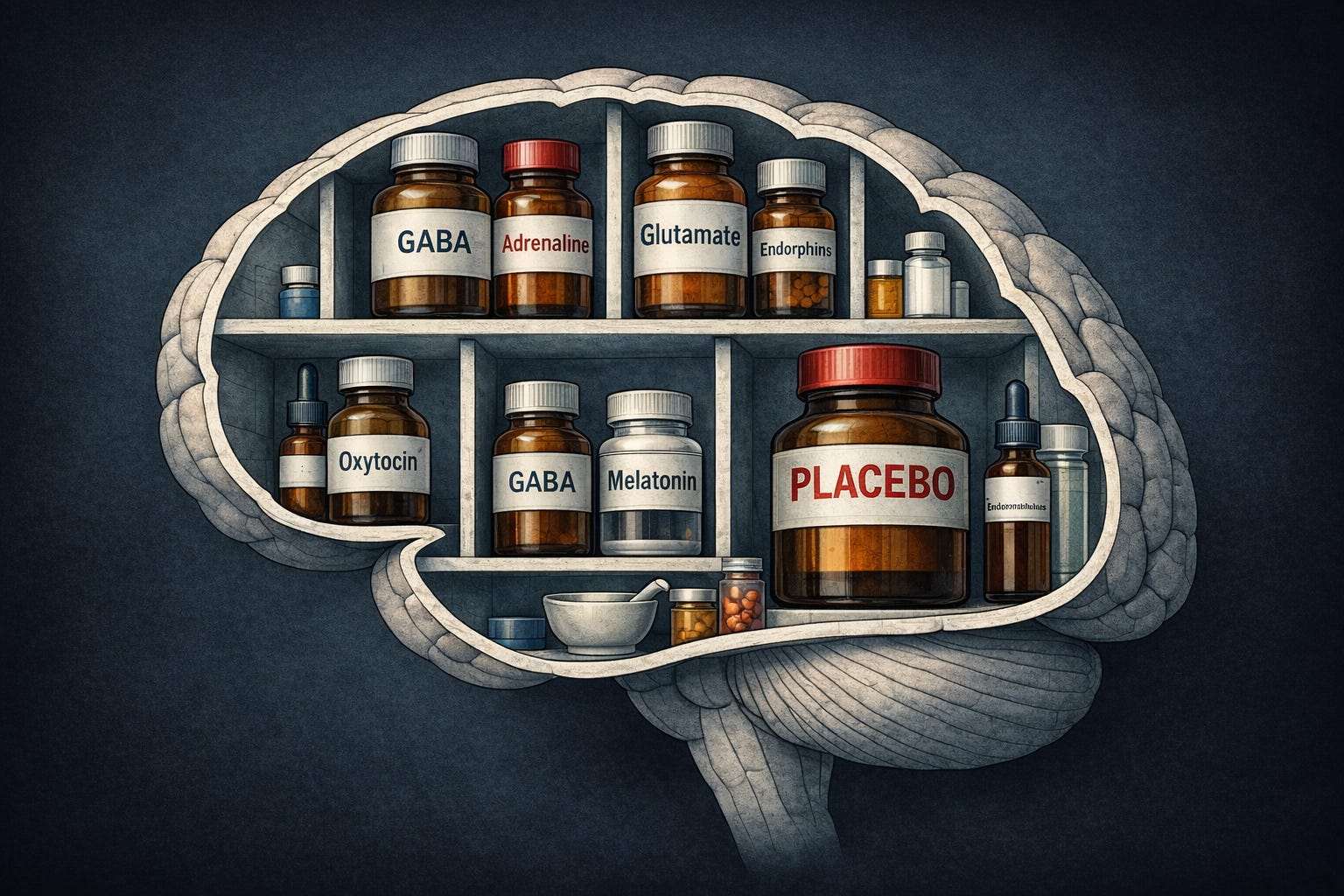
Imagine this: the most powerful drug isn’t locked in a pharmacy — it’s sloshing around in your skull: free, refillable, and with zero adverse effects (except maybe too much hope).
I’m talking about the placebo effect, that sneaky Jedi mind trick. But what if we could unpack its secrets and bottle it as an essential element in our own healing?
Back in epidemiology school, one of the most memorable things I ever learned was that the biggest modifiable predictor of people quitting smoking wasn’t family, fear, or government-funded PSAs — it was a doctor telling them to.
That’s the power of trusted authority.
We’ve turned modern medicine into a religion, with priests in lab coats prescribing penance, and prognosticating doom or salvation.
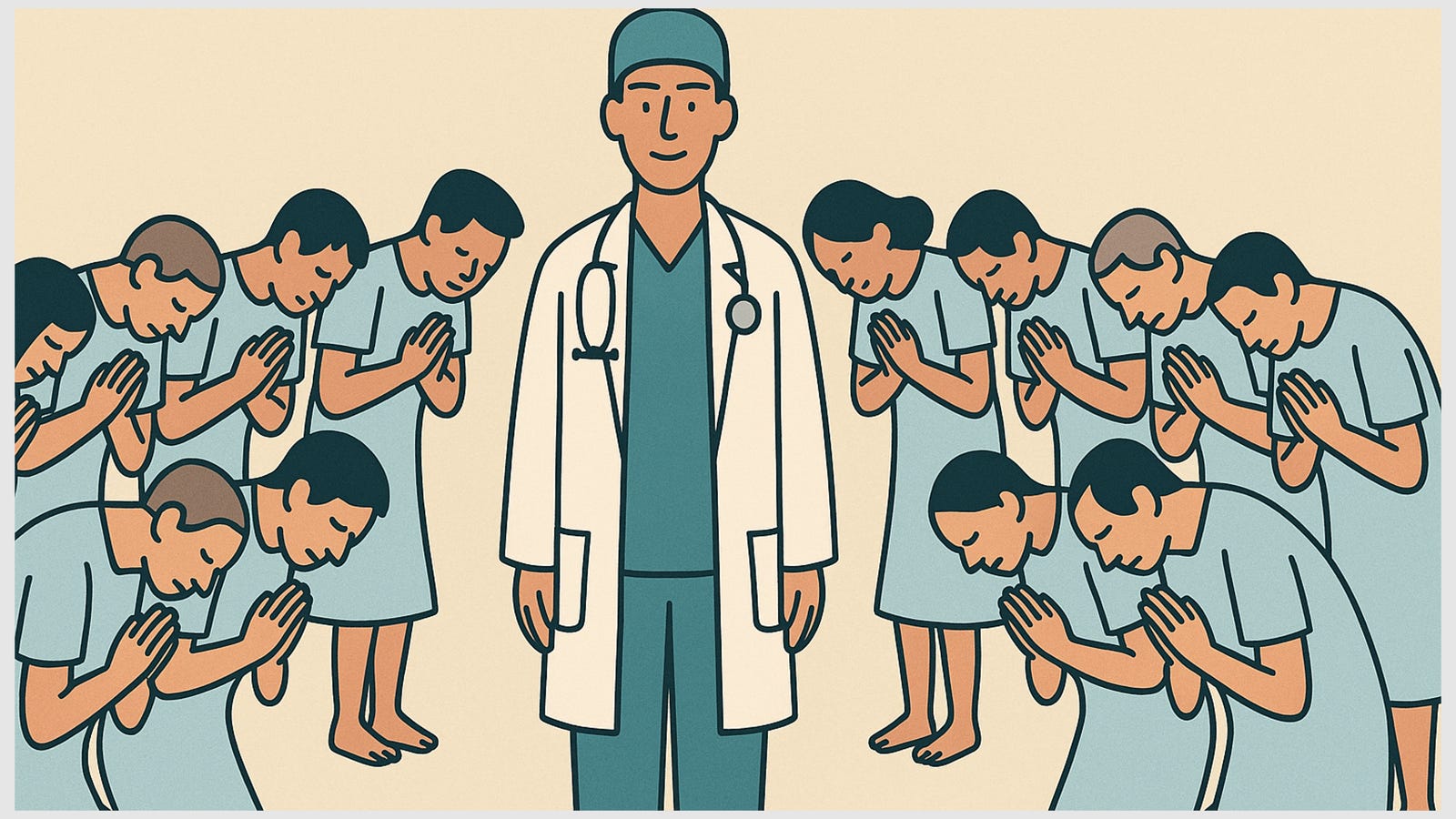
Doctors have an unmatched level of trust in society, and with that trust comes power and authority. We believe they know what they’re talking about. We believe that their protocols will work.
But what if the secret sauce behind the healing they deliver isn’t the protocols but the belief itself?
The placebo effect isn’t just woo-woo — it’s hard evidence that your mind can change your biology. That expectation can trigger your body to make its own opioids for pain relief, tweak immune responses, and heal arthritic joints.
By “bottling” it — harnessing expectation, meaning, emotion, and context – you can take significant power over your prognosis.
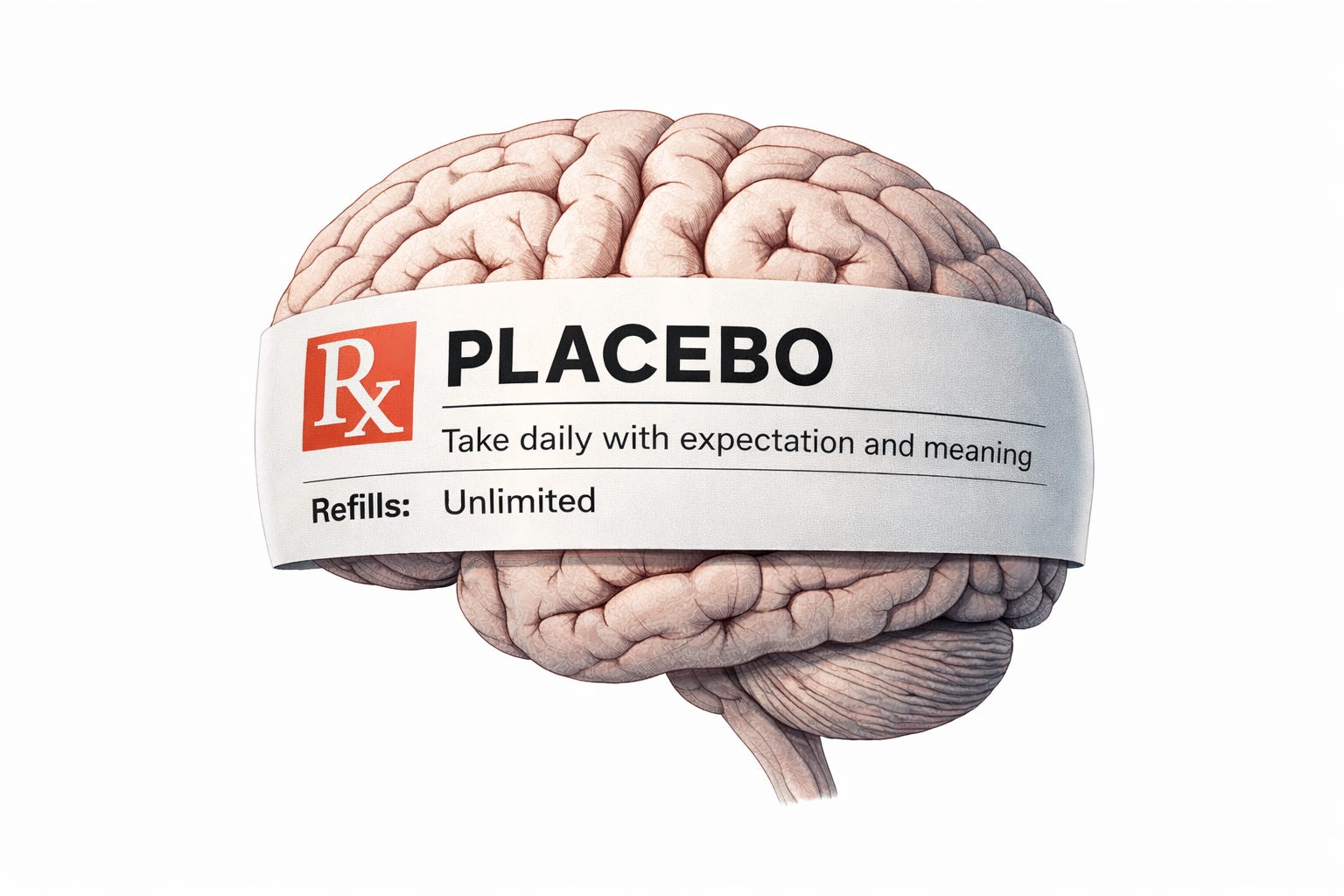
Early caveat: I’m not doling out medical advice here, and medicine absolutely has its proper place. If you’ve got a bullet in your belly, a bone sticking out, or a tumor blocking your colon, there’s nowhere on earth I’d recommend being more than an operating room in the U.S. If your organs are shutting down from sepsis, antibiotics are critical. If your kidneys have failed, I want you on a home dialysis machine at night.
But for a lot of the rest: we’ve ignored a massive lever that science keeps demonstrating matters way more than you think.
The evidence is wild.
The Science of Placebo – Your Mind’s Underground Lab
Placebo isn’t “fake healing” — and it’s not just the idea that pain or disease is “all in your head.” It’s your mind turning on your biology’s inherent adaptive capability.
You even have a built-in pharmacy–
Dopamine boosts for mood,
Endocannabinoids (your body’s own medical marijuana),
Endogenous opioids for pain (without the criminal record),
Oxytocin for calming and safety signals, and on and on.
Your mind can also work against you – snarkily called the “nocebo” effect – where you believe you’re given a poison or a curse, and your biology responds in kind.
A diagnosis can also be a nocebo, acting like a hex, and a prognosis as a sentence, locking in a bleak despair that tanks clinical outcomes and accelerates disease progression.
If all this sounds too “woo,” consider a more familiar example.
You’re walking home in the dark. You hear someone’s footsteps approaching a little too fast from behind.
Nothing has happened to your body externally. No attack, no words exchanged. But your mind is now in overdrive, and fight-or-flight physiology is switched on. Your heart rate quickens, your breathing shallows, your circulation changes, digestion stops, detoxification stops.
Because of your mind.
Your mind is the single most powerful influence on your biology. And it’s beyond your brain.
Your brain is processing the sound waves from the footsteps, to be sure. But it’s your mind that gives those footsteps the “unsafe” meaning that turns on the stress physiology.
This time of year, many of us reflect on the Incarnate Word becoming flesh.
The Greek word for, well, “Word,” used in this context is Logos, which connotes not so much the spoken word, but rather the intellect, the rationality, the system of coherence and meaning, the thoughts — aka, the mind.
Christians believe that we’re made in the image of God, and that, through that Logos, all things were made.
Well, if the Logos of God creates all physical reality, and we’re made in the image of that Logos, then it makes sense that our own logos has a creative power too, even if only a shadow of the divine version.
Indeed, the science suggests as much.
Consider a type of research called “sham surgery” trials.
In these studies, one group receives the standard surgical procedure while the placebo group undergoes a “fake” one: they’re wheeled into the OR, put under anesthesia, given an incision, subjected to some trivial poking and prodding, then sewn back up — without the actual standard surgery ever being performed.
The results will blow your mind:
A 2002 study published in the New England Journal of Medicine showed that sham knee arthroscopy improved pain and disability as much as real surgery.
A 2009 study published in the New England Journal of Medicine showed the same thing when testing vertebroplasty (cement injection for painful osteoporotic fractures) v. sham surgery: no difference between actual surgery and fake surgery.
A 2014 systematic review of randomized, sham-controlled trials, published in the British Medical Journal Open, found that across 55 trials, 75 percent showed improvement in the placebo (sham) arm, and more than half showed no difference between the real procedure and the sham.
A 2015 systematic review of randomized, sham-controlled trials, published in the British Medical Journal Open, found that across 39 trials, the placebo effect (as measured by post-sham improvement) was on average 65 percent of the benefit of actual surgery. For some procedures, like weight loss or pain surgeries, it was well over 70 percent of the benefit.
Consider spontaneous cancer remission.
Many people think of cancer remission as something that only happens via chemotherapy, surgery, or radiation. But Kelly Turner’s best-selling book Radical Remission – a compilation of hundreds of unexpected remission cases – documents that in real life, people sometimes recover in ways that conventional science can’t yet fully explain, and that mindset, meaning, community, and lifestyle often figure prominently in their stories.
Are we measuring the wrong treatment?
The placebo effect is not just doing nothing and getting better by chance. The placebo effect is doing something and getting better because of it.
The common factor between both groups in placebo-controlled trials is that both the treated group and the placebo group believe something good is happening.
When a placebo-controlled trial is run, and there appears to be, say, 30 percent improvement in the treated group and 30 percent improvement in the placebo group, the typical interpretation is that the treatment doesn’t work, because there’s no difference between the groups.
But nobody ever talks about what IS working, which is the absolute wizardry hiding in plain sight.
It’s not that the treatment doesn’t work. It does work, 30 percent of the time.
It’s that the “treatment” isn’t what we think it is.
The “treatment” is the healing ritual of: submitting to trusted authority, entering an institution that is respected by society as being built to heal. It’s taking off your worldly garments and adornments and putting on the classic patient gown. It’s getting caring attention from smiling nurses, buoyed by glossy photos and testimonials in the hallways, the placards thanking rich and important donors who valued this place enough to fund it, and all the other reassurances that this is the way. “You’re in good hands.”
It’s not that the surgery didn’t work. It’s that everything else about the healing ritual did work.
Your Biology Listens to Your Mind
Some have suggested that the placebo effect is just in your head and that your body isn’t really being affected. Your mind is just tricking you into thinking your pain (or nausea or some other symptom) is better without actually changing your biology. Apparent improvements are merely coincidental and the placebo effect is simply the name for what would have happened without intervention.
This theory is belied by the evidence.
The intervention is actually essential for the placebo to work. Doing nothing often doesn’t work. (And let me state again for the record that this article is not an endorsement of doing nothing.)
When you take out the ritual and its trusted authority and context, and you don’t get good results, that doesn’t disprove the placebo effect, it proves it. It shows that the experiences we have and the meaning we place on them are what change our biology. It does not imply that spontaneous healing would have happened without all that context.
When it comes to chronic illness or pain, there’s nothing spontaneous about healing.
Our minds and our beliefs and the meaning we ascribe to things say “jump” and our biology says “how high?”
A 2009 meta-analysis by Satin et al. found that depression was associated with a 25 percent higher risk of cancer mortality.
This is purely associational, meaning that we don’t know which comes first — the depression or the cancer progression and death. The nocebo effect would suggest it’s both. A cancer diagnosis is depressing. Biology is listening to the hopelessness and anxiety of that depression. The cancer grows, in part, as a result, which causes more depression. And the interplay continues, until death.
One of the strongest proofs that the placebo effect is real biology — not our minds playing tricks on us — comes from experiments using a drug called naloxone.
Naloxone is what ER doctors use to reverse opioid overdoses; it blocks the brain’s opioid receptors. In placebo pain studies, subjects are told they’re receiving a powerful painkiller but are actually given a saline injection. Many experience real pain relief anyway.
The placebo doubters would say that the degree of perceived pain is just driven by mind tricks, not by actual biology. But here’s the kicker: to test that theory, researchers conducted the study as normal, observing pain relief from the placebo injection. But then they gave the subjects naloxone along with the placebo. Their previous pain returned. The only thing naloxone does is block opioid receptors, which means the placebo had triggered the brain to release its own morphine-like chemicals. When naloxone was added, those endogenous opioids were blocked and the pain relief ended.
Belief didn’t “fake” relief — it activated the body’s internal pharmacy. Expectation became chemistry.
By the way, even when patients know they’re getting placebo, the placebo can still deliver.
Ted Kaptchuk’s work at Harvard Medical School’s Program for Placebo Studies (yes, that’s a real thing) shows that these so-called “open-label placebos” (where you know it’s fake) still reduced IBS symptoms, chronic pain, cancer-related fatigue, and even improved treatment retention in drug addiction trials.
What if medicine’s “magic” is mostly placebo in fancy packaging?
Population-level data on cancer treatment is sobering:
A landmark 2004 analysis (Morgan et al.) found cytotoxic chemotherapy contributed only two percent of 5-year survival in adult solid tumors – most gains were not from chemo but rather from surgery, radiation, or natural history (including placebo effect or chance). That suggests that huge amount of the positive clinical trial results before FDA approval might have been placebo.
A 2022 review, published in the Journal of Clinical Oncology, of hundreds of oncology drugs (including targeted and immunotherapies) showed median overall survival benefit of under three months.
A similar review two years later, published in The Lancet Oncology by Huseyin et al. showed that only a third of new drug indication approvals that were approved using surrogate endpoints like tumor shrinkage demonstrate clear survival advantage of any time at all.
A 2024 review by Liu et al, in JAMA confirmed that, when cancer drugs given “accelerated approval” by the FDA, usually by observing less meaningful endpoints rather than reliable survival data (usually in a rush to speed “cures” to patients rather than waiting on so-called “red tape” at FDA), it turns out that fewer than half the drugs later show any survival benefit, even after years of follow-up.
Nonetheless, most cancers that are “treated” – even with these weak-sauce or overly toxic chemo drugs – are more likely to go into remission than “untreated” cancers. In other words, the process of undergoing cancer treatment is more effective than the controlled trials of the chemotherapy itself would predict.
What if the treatment process itself is a placebo far superior to the chemo drugs?
Doctors swear by the cut. Sham trials whisper: “Hold my scalpel.”
Accelerated approvals based on non-meaningful clinical end-points? Over half fail to confirm actual benefits later. White-coats have way less monopoly on expertise than advertised.
We’ve shredded the myth that healing is pure mechanics or pharmacokinetics.
Now the juicy part: real people who bottled this power and flipped the script on grim diagnoses.
Plus the exact steps to start hacking your own mind today.
Ready to uncork the placebo potion? It’s for those serious about agency.
Real Stories of Bottled Magic – Outliers That Teach Us Leverage
Data points are cold. Stories are fire. These aren’t guarantees — they’re proof of what’s possible when you bottle expectation and ditch nocebo spells.
One of the most famous placebo stories in the medical literature comes from a 1957 case report by physician Leonard Cobb. A cancer patient named Mr. Wright had terminal lymphosarcoma, orange-sized tumors, days to live.
He begged for a drug known as Krebiozen, despite his physicians’ skepticism. Within days of taking it, his tumors reportedly shrank dramatically. He was discharged and went into near-miraculous remission.
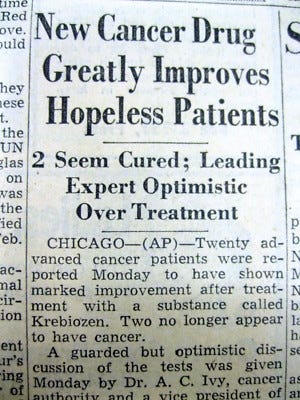
Shortly thereafter, Mr. Wright read news stories that Krebiozen was showing itself as ineffective and he became convinced that the drug wouldn’t really work. His tumors reappeared and he was deteriorating rapidly.
His clever physician, Dr. Cobb, told him that a new and improved version of Krebiozen had just been released and he administered this drug (actually a saline placebo). Mr. Wright’s tumors regressed again, his symptoms improved, and he rallied for several months. Later, the American Medical Association formally denounced Krebiozen as ineffective. When he heard this news, Mr. Wright lost belief entirely and he died shortly thereafter.
Modern placebo researchers cite Mr. Wright — not because his story is typical — but because it illustrates something uncomfortable:
The mind can meaningfully alter biology, even in severe disease, for better or for worse, yet medicine still treats belief as noise rather than signal.
In 1964, journalist and public intellectual Norman Cousins faced a dire diagnosis: ankylosing spondylitis, a crippling spinal disease for which he’d been hexed with a one-in-500 chance of recovery. Perceiving that the hospital’s rigid protocols, toxic food, stressful lighting and noise, and loss of agency were hurting him rather than helping, he checked into a hotel nearby.
His sympathetic doctor monitored him as he dosed himself with high levels of vitamin C and — most famously — prescribed himself daily marathons of Marx Brothers films and Candid Camera episodes.
He discovered that 10 minutes of deep, belly laughs granted him hours of pain-free sleep, more effective than any narcotic.
Against all expectations, Cousins steadily healed, regained full mobility, and lived another 26 vibrant years. His story, first printed in a 1976 New England Journal of Medicine essay and later expanded in the bestselling Anatomy of an Illness as Perceived by the Patient, reminds us that joy, humor, and an active role in our own healing can be true medicine. Cousins is a forceful demonstration of the power of agency, intuition and trusting in your own expertise.
Honest synthesis: These are stories and not guarantees. They demonstrate the power of your mind as leverage — perhaps the most important leverage — over what your body does next.
Back to our friend walking home in the dark. What if his pursuer suddenly calls out in his teenaged daughter’s voice, “Dad, wait! Slow down!”
All the biological threat-response he had turned on would immediately switch off and endorphins of relief and love would flood his body as he turns and welcomes this surprise encounter of his daughter with delight.
What if we translate that process into a longer version of a health journey, where the footsteps are symptoms of a fearsome disease? And what if instead of the daughter’s voice, our own voice and daily practices create a healing ritual that communicates to our subconscious mind and body that everything is ok and happening for our good?
How to Bottle It – Your DIY Mind-Pharmacy
Bottling placebo isn’t passive — it’s active hacking. Start here, backed by science:
Reframe threats: See symptoms as healing signals from your subconscious mind to your conscious mind, using your body as the messenger (fever as immune activation, insulin resistance as a sign of stress response, inflammation as a rest request).
Cultivate expectation: Daily visualization or mental rehearsal of a future healed state. Feel the heal of tomorrow today. Your subconscious doesn’t know the difference.
Build meaning & social nets: Social connection is life. Release toxic emotions. Forgive to slash stress hormones.
Ditch nocebos: Reject the hex of a scary diagnosis or doomsday prognosis. These are just words doctors use to match up symptoms and lab numbers with a certain drug or procedure from their short list of limited tools. Shift identity from “victim” or “[disease X] patient” to “resilient agent.”
Amplify with habits: Concoct significant healing rituals to communicate to your body that you are a trusted authority (such as meditation), going to special places designed for healing (like exercise in a gym or nature), administer healing elixirs (such as food-as-medicine, certain teas, supplements, and so forth).
Doctors won’t script this — it threatens their authority. But you can brew it daily.
The Placebo Revolution
We’ve been sold the lie that healing is just mechanics: pills, protocols, and scalpels.
Science keeps shouting the truth: your mind is the ultimate bootleg pharmacy, serving up its own opioids, dopamine, and sometimes even miracles on demand. Bottle it with raw expectation, deep meaning, and unapologetic agency, and watch the white-coat nocebo empire crumble.
In the next post, we map out a more detailed Placebo Playbook: how to become your own Primary Care Provider, recruiting and quarterbacking white-coats and other consultants to your healing journey like a BOSS.