


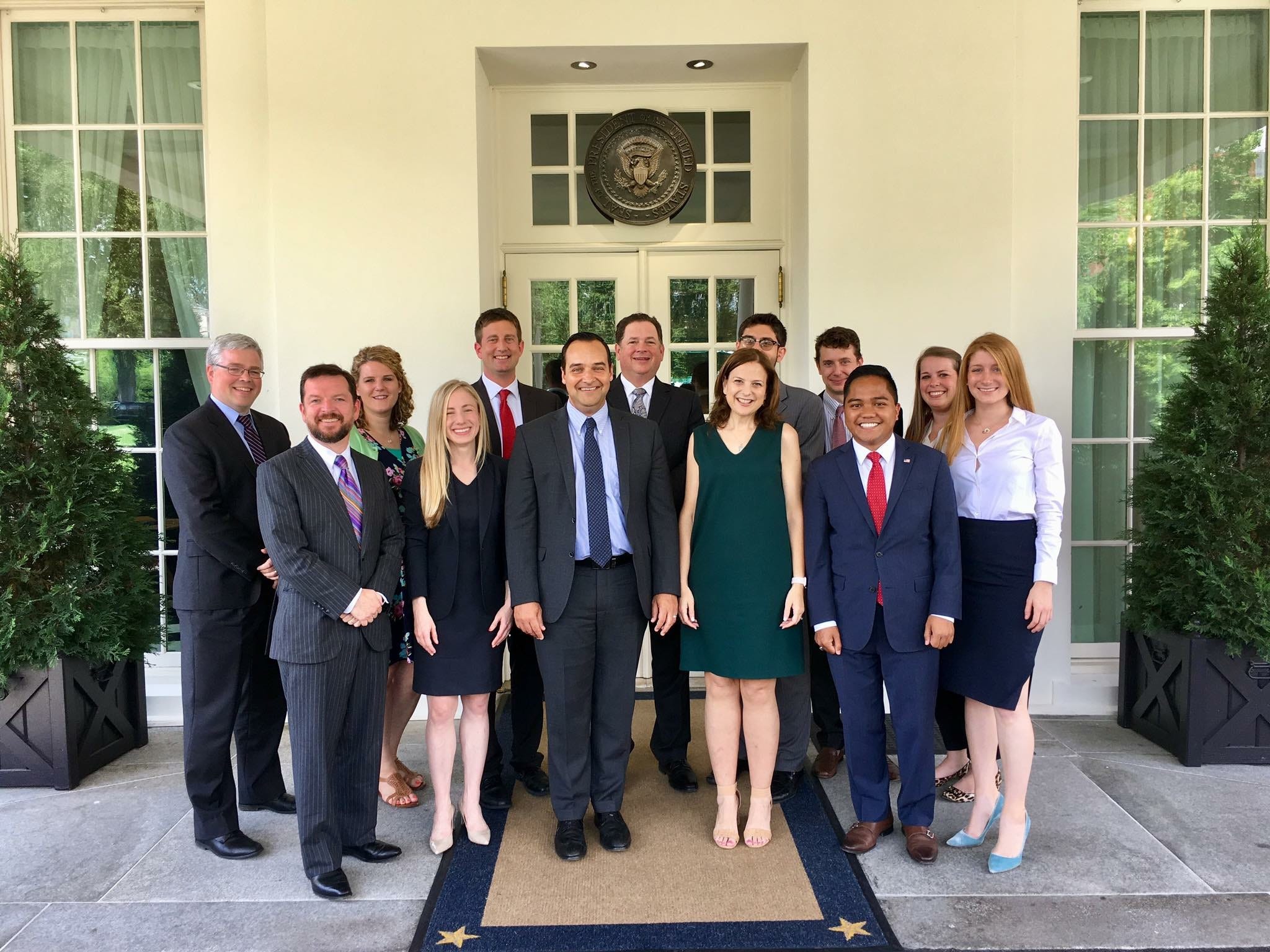
It was my first year on the Domestic Policy Council (DPC), and we ran the smoothest, most harmonious policy process of my entire career.
Every single agency with a stake in the outcome - and there were an absurd number of them - agreed. Completely. Unanimously. With no disputes to escalate, no fights to referee, nobody storming into a room to announce “this is bullshit” (that’s a different story).
It was about marijuana. And it went absolutely nowhere.
Some Background
A little Senate enthusiasm for legalizing marijuana was bubbling up in early 2017, and the White House Office of National Drug Control Policy (ONDCP) came looking for direction. What’s the president’s position?
I wasn’t aware he had one, and I didn’t have one to hand him either - which, if you know me, is… unusual. I show up to a policy meeting with a clear agenda and limited patience for dissent. But on the question of weed, I genuinely saw both sides. (That was then. Soon after, my kids became teenagers and my usual dogmatism came roaring back.)
So I asked the obvious question: what does the data say?
Nothing. We didn’t have any. ONDCP told me, kind of sheepishly, that Obama’s team had ordered federal agencies to stop collecting data on marijuana’s health effects. There was no current science on an increasingly popular drug. Super.
With nothing but vibes to work from, I convened a Policy Coordinating Committee and invited everyone with an “equity” in the outcome (White House lingo for a reason to care and the standing to make your life difficult if you leave them out).
I expected Health and Human Services (HHS) to have thoughts, and Department of Education. I did not expect nearly every agency in the federal government to raise its hand with a marijuana problem I’d never heard about.
State showed up to warn that going soft on marijuana would violate the international narcotics treaty - we were, in their words, “the last country holding the whole thing together.” Is that what you want, Katy? No. I hadn’t previously considered that legalizing a plant might unravel international law.
Treasury arrived with a story about Suspicious Activity Reports - paperwork banks must keep filing, every 90 days, for any account tied to the illegal drug trade. Since, it’s still federally illegal to sell cannabis, regardless of what Colorado said, that now meant that the HVAC guy in Oregon who services a dispensary, or the janitorial company that cleans one, get tagged as colluding with cartels. Banks were just closing their accounts instead of doing the filings. What do you want us to do, Katy?

Interior had cartels running illegal weed grows inside national parks - guys with Uzis, occasionally shooting a hiker who stumbled onto them. Clear them out and risk a shootout? Burn the crops? Airdrop pesticides on them? Fish and Wildlife, meanwhile, wants to know who’s cleaning up the pesticide runoff those same grows dump into the water table. I did not have strong opinions on any of it, but setting fires or dumping toxins in national parks didn’t seem awesome.
Customs and Border Patrol pointed out that hemp and marijuana are genetically the same plant, one just bred with less THC - so if the Senate legalized hemp (Senate Majority Leader McConnell was pushing hard for his state’s farmers), every truck carrying the plant over the border would need stopping and testing to prove it wasn’t carrying the illegal version. Congress solving one problem was about to hand CBP a much bigger one.
Transportation, which sets drug testing standards for bus drivers nationwide, wanted to know whether Colorado’s late-night party-bus drivers should get a pass for testing positive off insane amounts of secondhand smoke, or keep the current standard - screwing up non-using drivers’ records.
And then there was National Institutes of Health (NIH), which runs the sole government-sanctioned research weed farm in America, at Ole Miss. It’s the only legal source of marijuana for researchers in the country, and the product is derived from the weed on the street in the 1970s, so weak and outdated compared to what’s on the street today that studying it is basically studying a different drug. Worse, the hoops to get any of it are so brutal most researchers gave up, which is part of why we still didn’t have great data.
The hits kept coming, a dozen agencies deep.

And Then, a Miracle
We took all these normally warring fiefdoms - DEA, FDA, CDC, NIH, State, Treasury, Interior, Fish and Wildlife, Customs, DOD - through a set of policy recommendations, without having to escalate once from our level to the Cabinet-level people above us, and they agreed. On everything. Every single agency signed off.
So, we picked our moment. Kellyanne Conway (who was crushing it on the president’s combating opioid addiction initiative), as well as my DPC colleague who covered law enforcement, and I would brief the president, hopefully get his blessing, and hand the agencies the clarity they’d been begging for.
The meeting got scheduled. Then, it vanished off the calendar. “Scheduling conflict.” Ok, the president is a busy guy. Then, again. And again. For months.
Eventually I found out why.
Someone very close to the president - someone with one of those vague, ad hoc titles that were created outside the more formal org chart in the White House - had an equity we never knew about, and simply made the meeting disappear. Had we known, we’d have put them at the table and fought it out like men. Instead, it just died.
I never briefed the president on marijuana policy. Near as I can tell, nobody ever did. The most harmonious policy process of my career produced an airtight, unanimous consensus that went straight into a black hole.
So what does this have to do with why things aren’t happening on health care?
I used to tell that story as a fluke, the one time an unlisted stakeholder short-circuited an otherwise working process. But that process isn’t working anymore.
Inside every White House, and every agency’s political staff, there are two groups of staff, and which kind is driving the bus can change things quite a bit.
There are policy people - the subject matter experts (supposedly, LOL) who build the substantive case, weigh who wins and loses, and land on a recommendation. And there are relationship people - Communications, Political Affairs, Public Liaison, Intergovernmental Affairs, Legislative Affairs - whose job is to flag possible outside relationship threats posed by a policy and, once a policy is set, to sell it, rally the winners, and absorb the fury from whoever lost.
Policy people historically have led the process in every other administration, including the first Trump term. But the portfolio is so enormous, and the affected interests so numerous, that no policy shop can field every hysterical call alone - and if you leave the relationship managers out of the team, something you never saw coming could run you over. Policy, like politics, is a team sport.
The White House Org Chart
Every White House in recent decades has three policy councils: Domestic Policy (DPC - maybe a dozen people), the National Economic Council (NEC - about the same size), and the National Security Council, which dwarfs the other two combined - 300 to 400 people, roughly 80 percent detailees on loan from every foreign policy agency in government, maybe 40 to 50 political appointees mixed in.
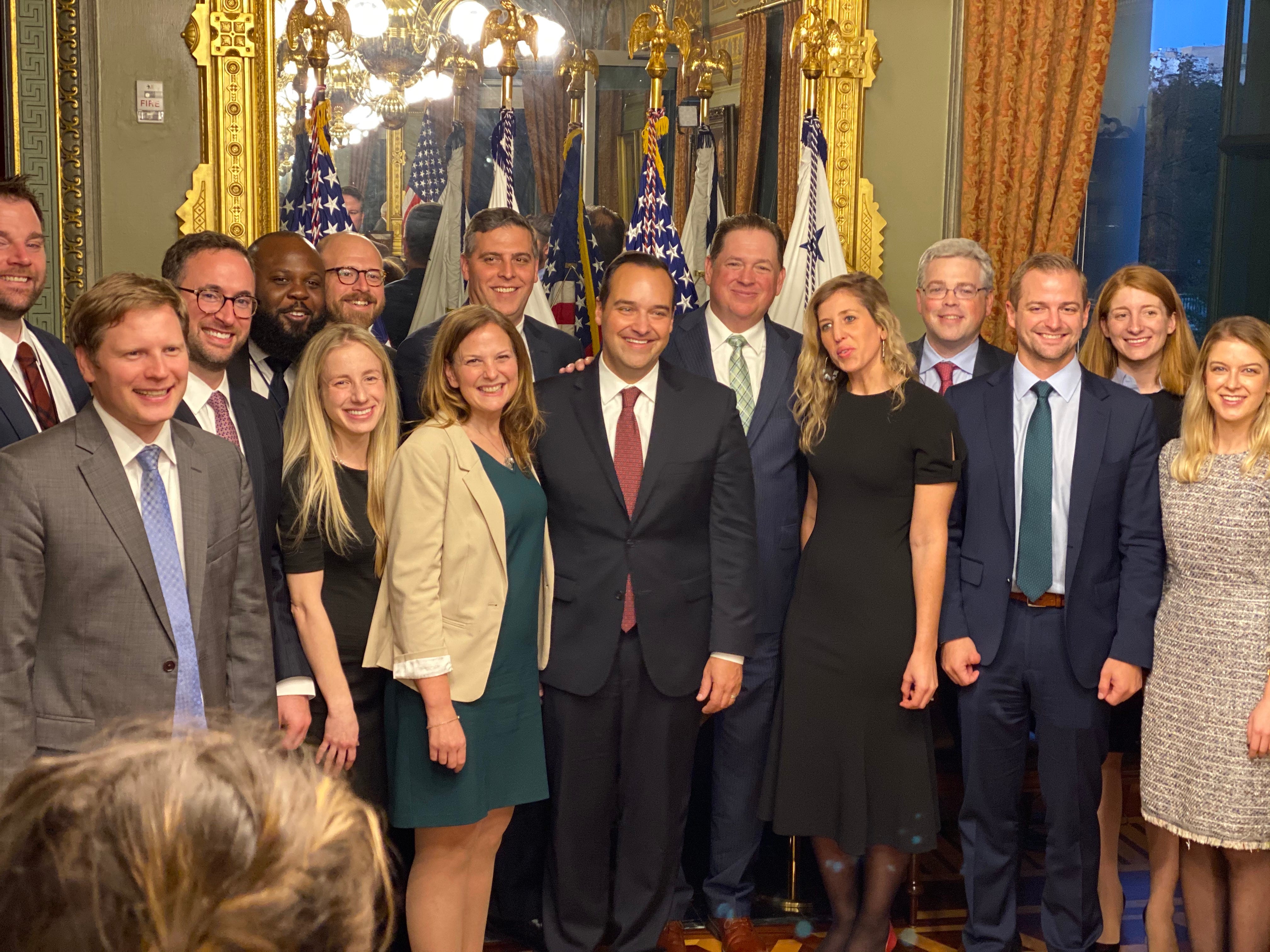
Somehow DPC and NEC, in charge of the issues touching American voters most directly, each get an eighth of a hallway on one floor, while NSC occupies two (three?) entire floors of the Old Executive Office Building. Still aggrieved about this, apparently, ten years later!
Two more offices round out the building. The Office of Management and Budget (OMB) prices out the president’s agenda and approves every agency’s spending, and somehow manages to be despised by literally everyone else in government, usually (though not always) through no fault of their own.
White House Counsel tells you all the ways you can’t do what you’re trying to do. If they are sharp and aligned, they’re worth their weight in gold. If they’re bureaucratic or not aligned, a nightmare. Most of them are fast talkers, logical thinkers, and some of my most favorite people, who always helped us lawfully get to “yes” on the president’s priorities.
The Relationship Offices
Each manages exactly one type of outside constituency.
Public Liaison runs the outside groups - trade associations, pharma, hospitals, pro-lifers, farm bureaus. Need doctors and patients filling chairs at a Rose Garden event? OPL finds them. First Lady wants to visit a school? OPL picks the perfect setting.
Political Affairs handles donors, campaigns, and pollsters, and is one of the only offices allowed to be openly partisan on the clock, since the Hatch Act bans it for most others. Give enough money to the re-elect or inaugural committee, and this office might return your panicky call about a policy rumor coming out of HHS. They can also poll an idea for the president when he wants the politics, not just the substance, which sometimes helps your case and sometimes kills it.
Legislative Affairs babysits all 535 wild-eyed egos, committee by committee, usually staffed by former Hill aides who already know the players. Any Senator with a gripe usually calls their OLA contact first, not the policy person, since OLA juggles that member’s whole relationship with the White House, not just on one issue. Sometimes they might call the policy people directly, or the policy people might call them directly. OLA hates when this happens because you might blow up some unrelated ask the White House is already working with that Senator, mid-flight. Ask me how I know.
Intergovernmental Affairs liaises with the governors of both blue and red states, mitigating various state funding grievances, disaster declarations, supply chain problems and other important situations.
Communications counts as a relationship office too since the media can kill a policy before it’s ever formally voted on, just by drowning it in hostile coverage before rollout.
You want every one of these people at the table when policy is being made. Not necessarily for a vote, but for the early-warning radar about any restless natives or grassroots insurgency popping off outside the building.
The Hierarchy, and How Fights Climb the Ladder
The org chart undergirding this whole circus - the people heading each council or relationship office - are Assistants to the President, APs - cabinet secretary rank, no Senate confirmation required. Under them, Deputy Assistants, DAPs - deputy secretary rank. Under them, Special Assistants, SAPs - assistant secretary rank, and the designated subject matter experts. That was me: SAP for health care at DPC. Which meant, on my plate: all of HHS, social issues, and any cross-agency issues where health or social questions arose. Not to mention that NSC never staffed global health with a political appointee, so whatever health questions their people couldn’t answer landed on my desk to.
APs, DAPs, and SAPs, and their counterpart Secretaries, Dep Secs and Senate-confirmed Assistant Secretaries at the federal departments, are what are called “commissioned officers,” as identified in Article II of the Constitution, holding the only default seats in the formal policy making process. Which means, at some point, a fancy calligrapher (actual job at the White House) writes up your commission for the president to sign.
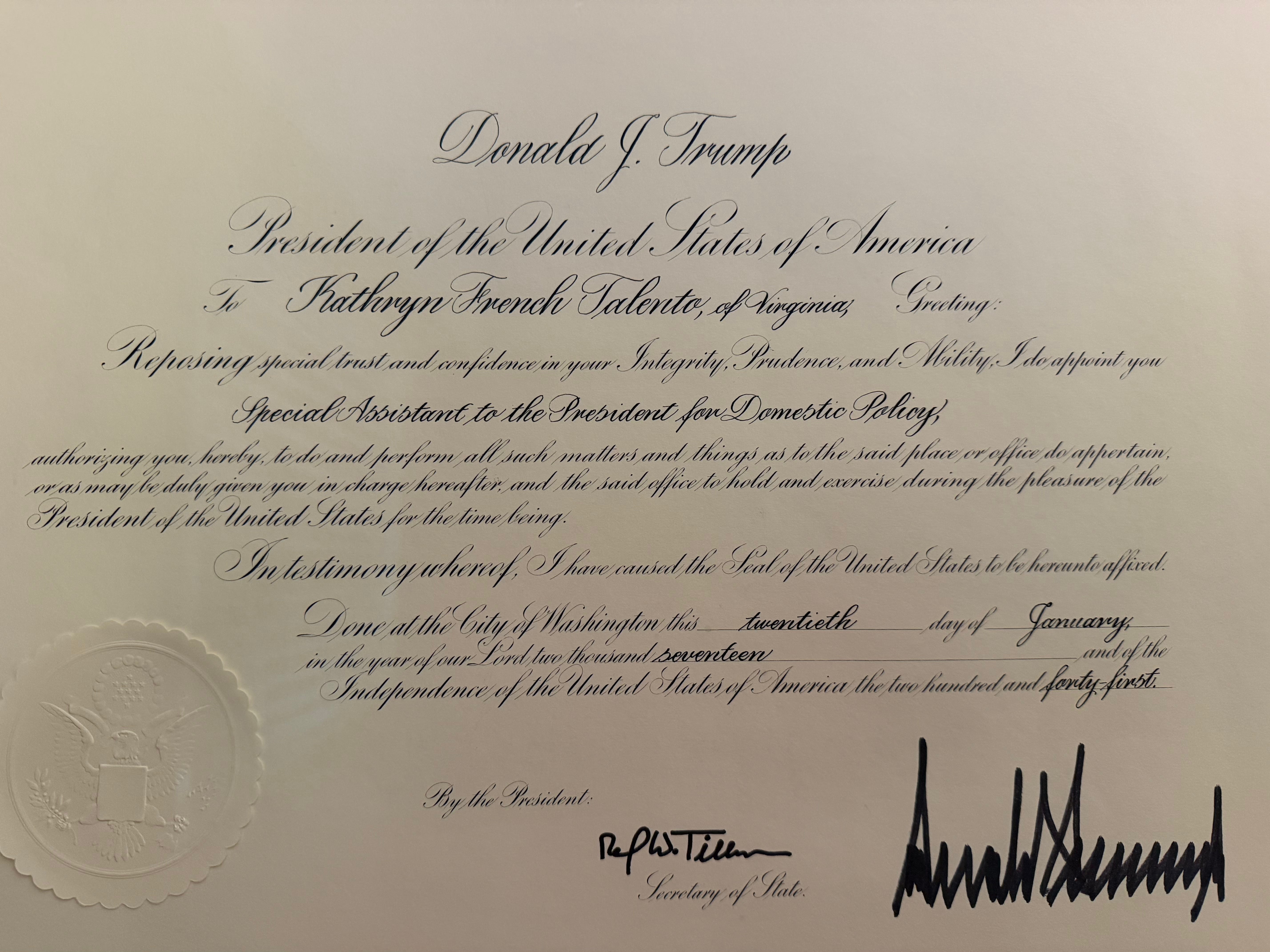
The policy process and the White House hierarchy are structured around the layers of commissioned officers. Everyone else gets invited at the discretion of whoever’s running it. Then there are the ad hoc, extra-special jobs every president gives to his closest advisors - various czars, “Counselors to the President” like Kellyanne, or the president’s own daughter and son-in-law - who are often important to have at the table, have invaluable feedback, or have equities and interests that will get shared with the president if you don’t accommodate them in the meeting.
The formal process is a Policy Coordinating Committee, starting at the SAP level: policy people from the White House offices, and the federal departments, as well as the relationship managers, counsel’s office, and OMB. Disagreement escalates one rung at a time - SAPs to DAPs, DAPs to APs, and if even that fails, straight to the president. That’s the theory - and, not coincidentally, the structure of my weed story, except it worked flawlessly and the result still got lost in space, because somebody entirely outside it had an equity we hadn’t realized.
Most of the real work happens before a committee convenes - weeks or months talking to agency people, outside groups, and, of course, the lawyers about what the statute allows. These are the Super Bowl of policy jobs: you can call the best expert or biggest celebrity on earth on nearly any topic, and because the White House is calling, they pick up. The meetings stay pretty informal on the domestic side, unlike NSC’s memo-heavy choreography, since we don’t have the staff to maintain the rigid paper trail they do. Usually ninety percent of the paper is agreeable to everyone; it’s the one or two live disputes that need working out.
Escalating is slow and expensive. Regulation can take two years to finalize, longer if sued, and a term only has four years. Every level has an incentive to compromise rather than kick it upstairs.
This is roughly how it’s worked under Bush, Obama, Clinton, Biden and even the admittedly chaotic first Trump term, all of them - not because anybody would call it a good time, but because it’s the best mechanism anyone’s found for making sure the president gets the best, most expert and most vetted advice before he decides.
All of that was how things usually work. It does not seem to be how things are working right now.
At least that’s my working theory about why policy-making in this White House has felt so sideways, so inconsistent week to week, so contradictory - frankly so demoralizing, at least on the health issues I follow closely.
Everything you’ve read so far describes how a White House is designed to make decisions. But that’s not how this White House operates. In the paid section, I explain what has replaced the traditional policy process, who now drives decisions, why the normal checks have disappeared, and what that means for governing. If you’re not seeing the rest of the article, you’re missing out on the best part! Consider upgrading. The rest of you, let’s get to the good stuff.
