


For the past eight years, I’ve run the health plan for a group that I call “my nuns.”
I say “my” because, I was, in fact, one of them. Two years in the convent, a decade before I ever dreamed I’d end up as their benefits advisor.
As regular readers may recall, in the middle of my Senate career, I got sick of government and wanted to escape.
I’d recently become Catholic, fell in love with the Church and figured that meant I should probably become a nun. As one does.

In reality, I was just burned out by a stressful career and thought joining a convent would be like going on retreat for the rest of my life. Which still sounds awesome.
It turns out that a need for a vacation, being impressed with Catholic theology, and fatigue with the whole hair/makeup/heels ritual did not actually mean God intended for me to marry Him. I mean, who could blame Him?
So I washed out. The breakup was entirely amicable.
They literally sang me down the aisle, Sound-of-Music style.

What I never managed to escape was their health plan.
Back then, when I was still in the convent, it was a garbage fully-insured Blue Cross plan with a $4,000 deductible. Not one of the sisters (myself included) had a penny of income, of course.
They never will. (That’s kinda the point of the vow of poverty thing).
Shortly after I left, like Job, my life was restored to me - my parents gave me back my dogs, my sister gave back my cats, we kicked the renters out of my Capitol Hill house, and I returned to my career in health policy in the Senate like nothing had happened. That’s when the sisters started asking me for help with their health plan.
Couldn’t I do something about the constant rate hikes?
I called up the BCBS lobbyist I knew and tried shaming. It didn’t work, unsurprisingly I guess.
I went back to my life, periodically trying to help the sisters with ideas over the next few years. Then, in the White House, I met a group called Health Rosetta - a tribe of insurgent benefits advisors - and learned that you could do radical things with health plans.
What I didn’t know then was that it would lead me exactly where I am today.
[Now, all you Health Rosetta readers out there, you know what’s coming next - the formula for saving a health plan - so this won’t be any big news to you!]
We Fired Everybody
A year or so after that initial meeting, I left the White House and called up the sisters and said “I think I now know how to help you guys.”
And so began the inevitable argument with their insurance broker at the time, a nice man who sold status quo garbage for a living, who refused to obtain their data so we could do any analysis on their fully-insured plan. (“Fully-insured” = garbage, overpriced, carrier-owned plan. “Self-funded” = employer-owned plan that may also be garbage if run by a carrier, but can also be awesome, depending on how you run it).
No matter.
We fired Blue Cross. We fired Express Scripts - their rapey/pillagy pharmacy benefits manager, the largest in the country.
We went all in on the most radical plan design - no network.
The plan’s “allowable amount” - that’s the starting point for negotiations for what the plan pays docs and hospitals - was set to 125 percent of Medicare rates. Readers might recall from previous posts that Medicare rates are used as a proxy for wholesale cost of care, and that a 50-80 percent markup above that rate is generally considered a “good” rate on a commercial plan. If you can get health care providers to accept that rate most of the time, then you can still save a ton even with the few times that a provider tells you to pound sand and you have to pay more. So, 125 percent is aggressive.
But my thinking was: start at a really good price and threaten anyone who doesn’t accept that rate with a long time in purgatory for having screwed over nuns.

Gob-Smacking
We just started the eighth year since ditching the Blues. The results are truly gob-smacking.
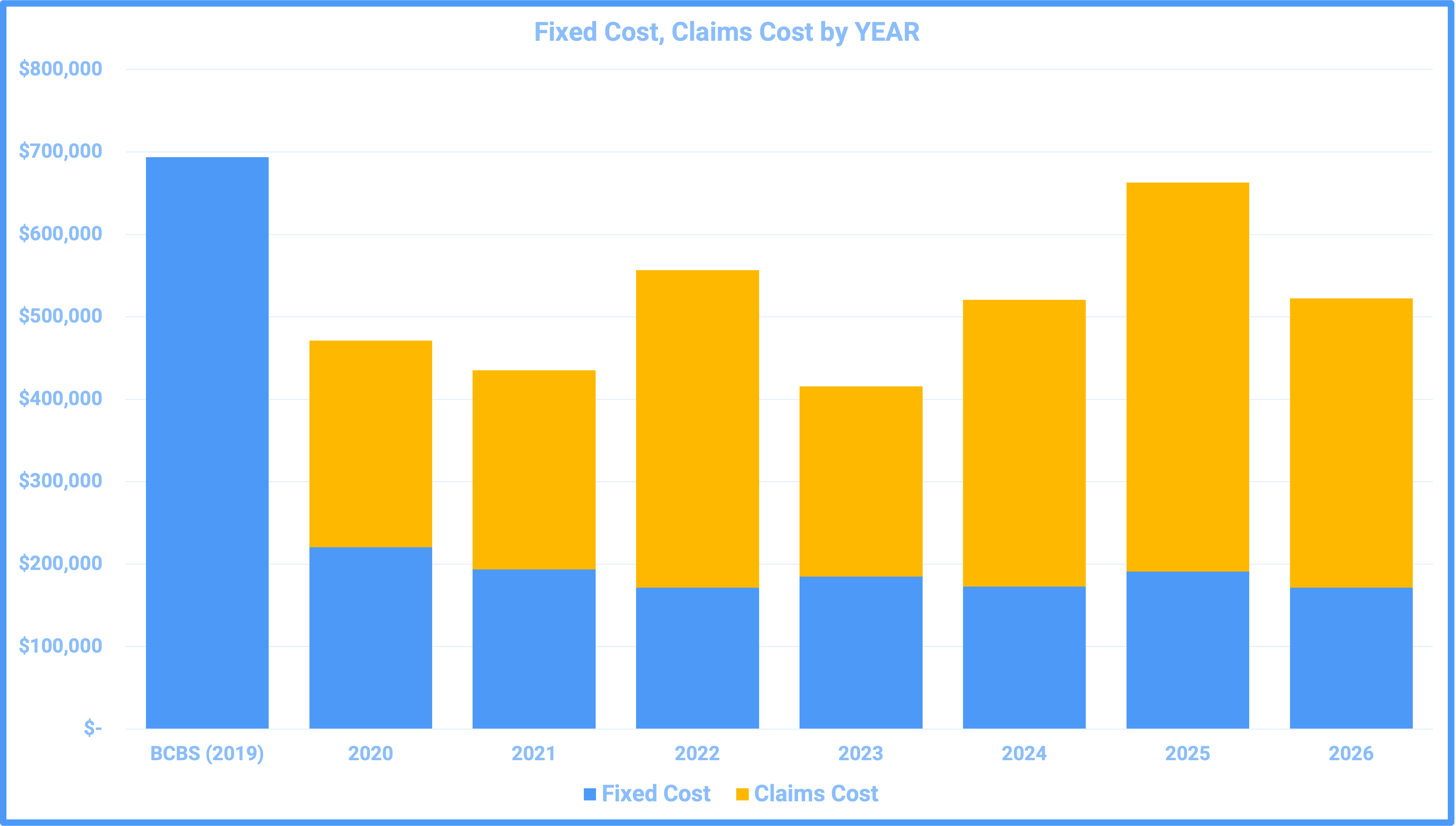
In case you don’t believe your eyes, yes, after slashing spend by 32 percent in year 1, we have beaten the 2018-2019 fully-insured Blue Cross rates every year in terms of absolute, non-inflation-adjusted dollars - and that’s with increasing enrollment from 108 sisters when we started to about 120 now.
In other words - almost a decade later, with a dramatic increase in overall inflation as well as health care inflation - the sisters are still paying WAY less today than they were with Blue. The dollar figure associated with these savings, in absolute, non-adjusted dollars, is $1,272,504 less than what they paid for their garbage plan in the 2018-2019 plan year - if Blue had never raised their rates since 2018.
But of course, Blue did raise their rates each year, and how.
So, to estimate a savings amount based on some assumptions of what Blue might have raised the rates to be, let’s assume a ridiculously unrealistic health care inflation rate of, say, five percent each year. That’s ridiculous because the actual annual trend has been closer to 10 percent each year.
Assuming only that five percent, the sisters have saved $2,347,379 since leaving Big Blue.
But we can do better than just make conservative trend assumptions. We can actually ask Blue to tell us what they’d charge the sisters by requesting a quoted premium price if the sisters were to come back to the Blue plantation - which we did a few months ago. The quote came back at almost three times what the sisters are currently spending.
But wait, it gets better! Remember that $4,000 deductible on the old Blue plan that the sisters would have to raise and pay for a sister, before their coverage even kicks in at all?
Their new, un-Blue plan was designed to have no member costs. Zero. Meaning, no deductibles. No copays. No coinsurance. Since the sisters have no personal income and the religious order was going to have to raise money for “member” costs as well as “plan” costs regardless, we just eliminated all the member costs.
It Wasn’t Easy
This hasn’t been a cake-walk.
Regular readers will know that this group was both my first - and my last - reference-based pricing plan (RBP), full stop. RBP or no-network plans can save a ton of money. But when a provider doesn’t accept the plan’s 125 percent of Medicare rate, the patient gets a balance bill. That problem has real consequences - nuns being sent to collections (apparently, eternal damnation is not a deterrent to every health care provider. But we already knew that, didn’t we?). However, it is also easy to solve when you have a competent vendor that negotiates with the aggrieved doctors and hospitals. Which we have now.
That’s the easier problem.
The harder problem to solve is the access friction with a no-network plan, which can be agonizing. Front desk people at the doctor or hospital insist that they don’t take the plan (because there’s no network logo on the ID card) and refuse to give the sisters an appointment. It has taken years of adjustments to the navigation and negotiation workflow to get things just right so as to minimize delays in care.
We’ve had our horror stories.
I will say that only this year - for the first time in seven years - have we landed on a navigation partner who can actually pay cash upfront and effectively overcome this problem once and for all. I am so grateful for this partnership.
Nothing but cash-pay has ever worked for us on the access friction question.
Some advisors hack this problem by doing direct contracts with a bunch of providers in their local community, essentially creating a custom network. But the sisters are spread all over the country in little groups of 3-8 - not enough volume to lure a hospital into doing contracts with us.
Cash is king! Cash is the future! All hail cash!
But Don’t They All Qualify for Medicaid or Charity Care?
As I mentioned, none of the sisters has any personal income, which means they would all qualify for Medicaid - the government safety net insurance program for poor people. But the sisters prefer not to use government programs most of the time. Although we do occasionally request charity care from nonprofit hospitals.
Scheduling staff see that the sister has a plan ID card and think, not knowing anything about self-funded plans, that the sisters have some deep-pocketed carrier insuring them. It takes significant effort to explain that, no, the sisters fund their own plan (hence, “self-funded”) through charitable fundraising, and so they still qualify for most hospital charity programs.
The ACA requires all tax-exempt, “not-for-profit” hospitals (LOL) to have a financial assistance program to offer poor patients. It requires nothing about how big or generous that program has to be, who is eligible, or any other rules. We generally steer the sisters far away from hospitals for all the reasons I’ve written about before. But when emergency or inpatient hospital care is unavoidable, we offer cash first, a single-person contract for that sister second, and if we can’t get fair rates either way, then we will often apply for the hospital’s charity care. Hospitals are free to turn down the sisters, but they usually don’t, at least in cases when the care has already happened. This is because you usually can’t even apply for the financial assistance program until you’ve already received service and now have a bill in hand.
Sometimes you can apply earlier in the process - but only once you’re already a patient, meaning, at least after you’ve been scheduled for care. But as I mentioned earlier - the sisters often can’t get in the door to get scheduled without paying cash upfront or negotiating a single-member contract. Once you’ve done one of those things, the hospital isn’t going to give you charity - they got their money.
Even if they do accept you into the charity, usually the program only covers the member’s cost, not the plan cost. But recall that the sisters don’t have member costs. So then the hospital will say, “but you have no costs, and your plan is covering everything, so why do you need charity?” It’s very hard to make them understand that the plan itself is just the religious order, that has no income just like the sister has no income, and the plan has to raise charitable donations to cover the sister’s bill. It just doesn’t fit the use case these hospitals expect.
Hospital Charity Programs Can Work for Your Employer Plan Too
We apply for the programs on behalf of the sisters ourselves, and they are easy applications because there is literally no income, no tax returns, nothing. Your workforce might be more complicated. But that doesn’t mean you don’t have lower-income workers and dependents on your plan who would qualify. There are vendor partners out there who can help you design your plan to actually optimize the use of hospital financial assistance programs for your lower-income plan enrollees. And if you design the benefits with this in mind, you could save your enrollees a boatload. You can save the plan a ton as well.
If the Plan Doesn’t Have Money Except Donations, What Happens When the Bill Is Insanely High?
Good question - the sisters don’t have deep pockets.
When they get hit with a surprise multi-thousand dollar bill for one dose of a medicine, they have to take deep breaths, just like you or I would. Fortunately, we’ve planned for this situation.
Once claims on any one sister exceed the plan’s level of risk tolerance - their stop-loss reinsurance coverage kicks in. They pay a small - under $100 a month premium per sister - for this risk mitigation in the case of per-member claims that exceed $40,000 in a given year.
Even with this layer of fixed cost baked in, their annual spend has been dramatically improved compared to when they were “fully-insured” with Blue.
What Does All This Mean for Me?
Most of our clients don’t want to assume cost control measures quite as aggressive as the sisters do: no network, very low payment rate compared to Medicare, paying cash upfront for almost everything, use of charity programs when appropriate.
Your plan probably uses a network. And network plans - even when the carrier itself has been fired as the plan administrator, and the plan is just renting the carrier’s network - have had a wildly volatile few years recently. With the infusion of AI into exam rooms listening to your conversation with your doctor for opportunities to gouge you more, and with anti-competitive (I would argue, illegal) network contracts (with both employers and with providers), even the most aggressive employers are rarely enjoying plan performance as sweet as my nuns’.
But the nuns’ experience is worth examining anyway, because it shows what’s possible in the cash-pay health care economy of the future.
That future is increasingly being built, one plan at a time, partnering with next-gen vendor partners who are able to bypass networks or leave them off altogether. Innovative plan designs that don’t yet use cash can still obtain dramatic cost reductions compared to status quo plan designs.
It is well worth you calling up HR at your company and asking:
Have we considered firing our carrier and just renting a network?
Does our plan have a solution for paying cash to save money?
Have we fired our PBM in favor of an indie, less conflicted version?
Are we making use of hospital financial assistance programs for our lower-income colleagues?
Do we have access to our claims data so that we know what’s driving our costs?
Most HR directors are by nature extremely risk-averse. They don’t want you to have a bad experience with the health plan that you rely on. They’re overworked already and look quite askance at a big change management project that a new plan transition can require. But if they start getting asked these questions by you and your colleagues - along with your reassurance that you would welcome and encourage these kinds of reforms to your company’s plan, they’re far more likely to entertain crazy ideas!
And every bit counts.
Any step you can take - even a simple health reimbursement arrangement program that allows workers to pay cash and get lower prices - represents progress toward disrupting the corrupt status quo that we spend so much time excoriating in this space.
Trust me when I tell you: no one is coming from government to save your company’s health plan.
The revolution starts with you and your colleagues, refusing to be fleeced by big carriers eating away your wages and your company’s growth year after year.
Be the change!

(And of course, if you need help, that’s what I do).
If the cost of health care is crushing you, this one’s for you. Send it to your HR director. And your CEO. Then leave a comment below, let me know what they said.
All I can say is... this is so freaking cool. Keep sharing the secrets.
A few years ago, I failed to make my December payment for my drug insurance plan on time, and got kicked off of it for a year (government rules); I panicked, but everything turned out great. During the next year, I paid about $1,000 less for my prescriptions. It turned out that by not having prescription insurance, I was eligible for various discounts, and have saved over $6,000 since then. Took a little work and research on my part, at first, but now I’m just coasting.
So much about medical costs, just doesn’t make sense (I had an interesting discussion with my pharmacist about this yesterday). Medical treatment is a cash cow. Walking into a lot of hospitals is like walking into a casino, run by a hedge fund.
Great article!