



Loyal readers have met my nuns before. They were my first clients, and trying to make their health plan work has taught me more painful lessons about American health care than all my years on the Hill and in the White House put together. Here’s the latest.
One of the sisters needs a joint replacement. Desperately. Her pain is intense and brutal, the kind that turns every step into a nightmare.
We found her a wonderful surgeon. He’s high quality with great outcomes, and, by some small miracle, a kind and devout Catholic man. He operates at, and is employed by, a tax-exempt community hospital with a religious name invoking Jesus. So we called the hospital right away with the offer every hospital CFO claims to dream about: we’ll pay cash, upfront, all in. One bundled price, no claim denials, no chasing us for 120 days. Just give us a fair rate.
Our plan’s standard allowable rate is 125 percent of Medicare, so that’s where we started. The hospital came back at 250 percent.
Fine. That’s a negotiation. Our navigators went back and explained who they were dealing with. The sisters have no income. They raise money from donors to cover their medical bills. Every one of them would qualify for both Medicaid, and for the financial assistance program this hospital is required by federal law to offer poor patients as a condition of its tax exemption. And we weren’t asking for charity. We were offering to pay not only more than Medicaid, but more than Medicare, the rate this hospital accepts for most of its patients because most of its patients are seniors. We just weren’t going to pay two and a half times Medicare’s rates for an all-in, upfront cash price.

Then my navigators called me with the hospital’s answer. The price had doubled again.
Eighty thousand dollars, for a surgery Medicare pays about $16,000 for. Five times the Medicare rate, quoted to a woman who took a vow of poverty, because her health plan had the gall to ask for a discount.
This is the spite reserved for no-network plans that dare to flee the network plantation. Ask for a fair price and you get a surcharge for your trouble.
We felt terrible, but we had no choice but to look for alternatives. We started looking for a physician-owned outpatient surgery center, one with reasonable prices and no hospital anywhere in its ownership. That meant our sister would have to start over with a new surgeon.
When her surgeon found out what his own institution had done, he was (appropriately) horrified. At time of publication, he is in discussions with the hospital’s leadership himself, asking them to accept what we told them would be our final offer: 1.8 times the Medicare rate - $30,000.
Bless his heart.
If that doesn’t work out, I will name this hospital in a future post.
Charity, Hospital Style
Now you might be asking yourself, “Self, aren’t these hospitals supposed to be charitable organizations and thereby tax-exempt under IRS rules?”
That would be a good question. Let’s look at what federal law says about this.
Under Section 501(r) of the tax code, which the Affordable Care Act added, a tax-exempt hospital can’t charge a patient who qualifies for its financial assistance policy more than the “amount generally billed” to patients who have insurance. Hospitals are allowed to calculate that amount using what Medicare would pay.
So if our sister had walked in uninsured and filled out the hospital’s charity application, which she would almost certainly qualify for, federal law would cap her bill at roughly what Medicare pays. Because she has a health plan offering to pay more than Medicare, in cash, before the surgery, the hospital felt free to quote her five times that.
Get your surgery as a charity case and the law protects you. Show up with a plan willing to pay a fair price and you’re fair game.
This is the kind of greed, corruption and, well, uncharitable behavior that employer health plans deal with every day. My sisters are just the most sympathetic possible victims of it.
What We’re Paying For
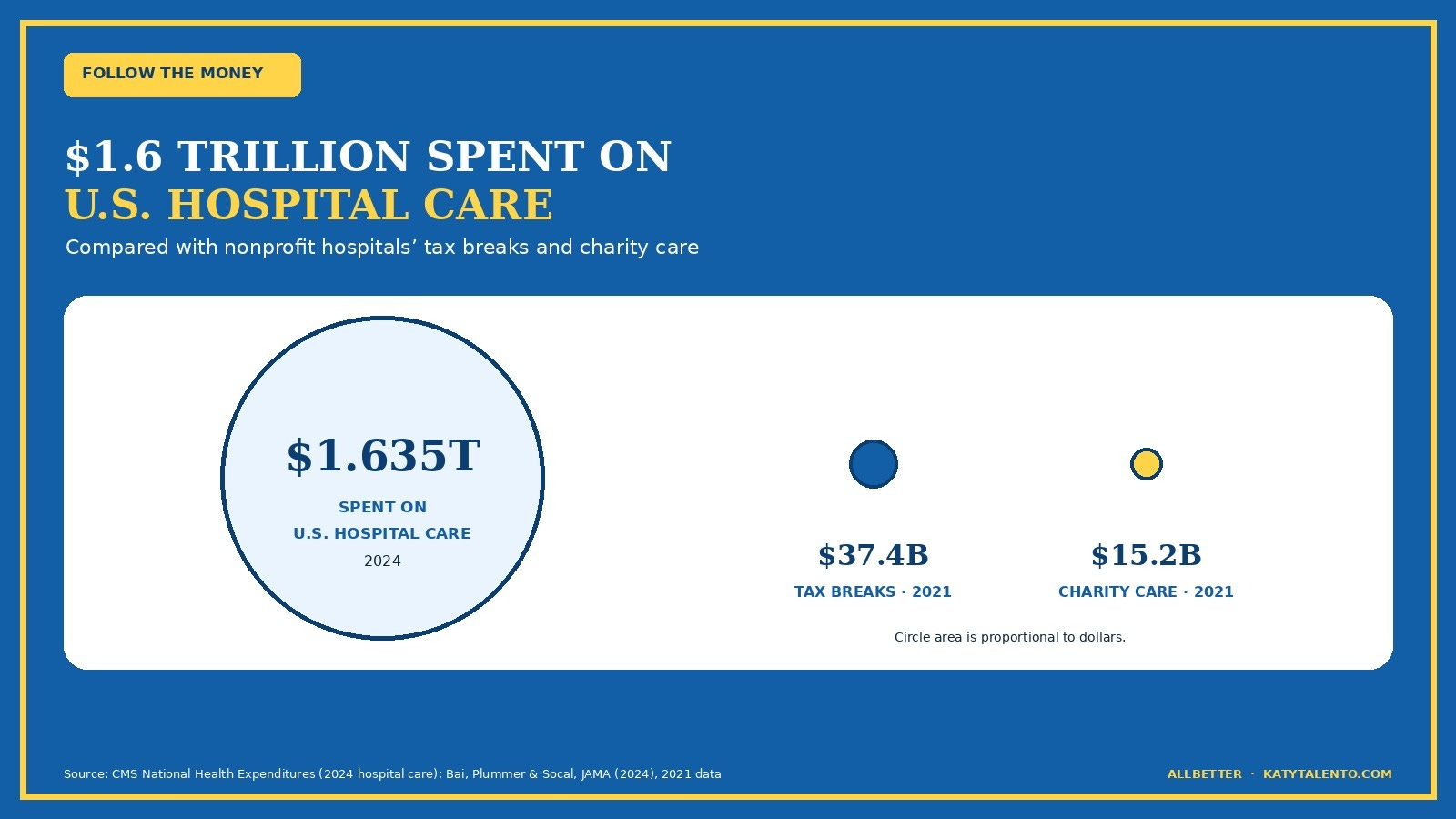
Start with the size of the pie. Americans spent $1.6 trillion on hospital care in 2024, nearly a third of every health care dollar in the country, according to CMS data as analyzed by KFF. Hospitals also drove 40 percent of the growth in national health spending between 2022 and 2024, more than any other part of the system. The vast majority of hospitals collecting that money are nonprofits.
And the nonprofits are doing just fine, thank you.
By 2022, according to the incomparable Ge Bai, a fabulous health economist at Johns Hopkins, they had piled up $447 billion in investment assets, and the richest 1 percent of hospitals held 42 percent of it. That’s a lot of charity parked in the stock market.

On top of all that, we give them a tax break.
In a 2024 study in JAMA, Bai and her colleagues valued that perk at $37.4 billion for 2021 alone: $11.5 billion in federal income tax they didn’t pay, $9.1 billion in sales tax, $7.8 billion in property tax, and the rest in state income tax, tax-deductible donations and cheap tax-exempt bonds.
Like the investment portfolios, the tax breaks flow to the top. The biggest 7 percent of nonprofit hospitals collected as much as the other 93 percent combined.
So what did $37.4 billion buy us?
That same year, nonprofit hospitals provided $15.2 billion in charity care. That might sound like a big number, but it’s really only about 41 cents of charity for every dollar of tax break we handed them. Measured against the whole hospital pie, their charity care comes to pennies on the dollar.
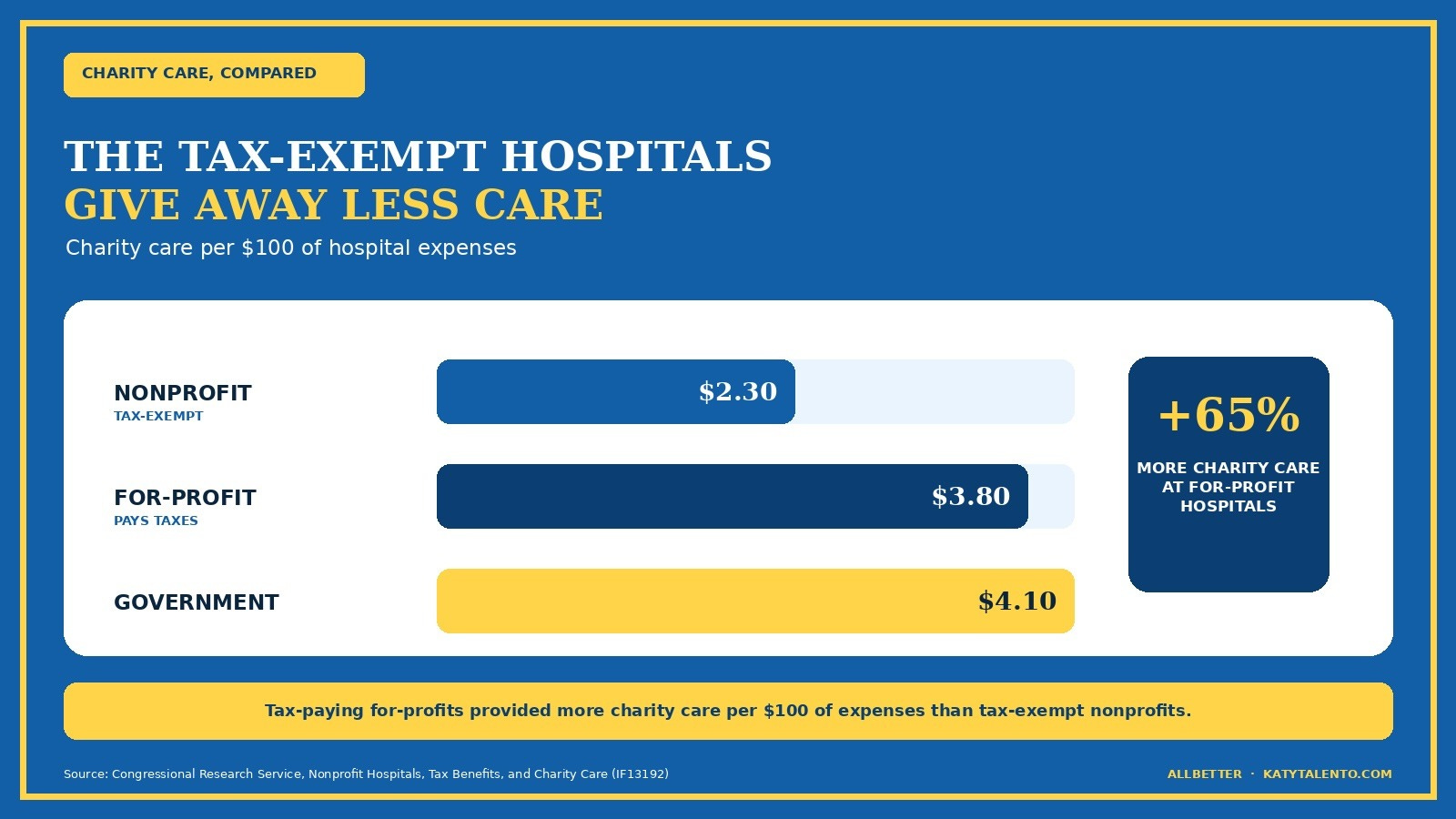
It gets more embarrassing when you line them up against the hospitals that pay taxes.
Once again, Dr. Ge Bai to the rescue, reporting that nonprofit hospitals spend about $2.30 on charity care for every $100 in expenses. For-profit hospitals spend $3.80, and government hospitals spend $4.10. The tax-paying hospitals give away more free care than the ones we excuse from taxes in the name of charity.
Every other charity in America has to pass what the IRS calls the operational test.

A tax-exempt charitable organization must be “primarily” engaged in its charitable purpose. Hospitals pass because the IRS counts delivering medical care as “promoting health.” But for-profit hospitals deliver medical care too. So what makes one hospital a charity and the one across town a taxpayer?
Under the IRS’s 1969 rules, it comes down to a checklist: a community board, an emergency room open to everyone, accepting Medicare and Medicaid patients, and putting surpluses back into the hospital instead of paying them out to shareholders. For-profit hospitals take Medicare and Medicaid patients too. Since 1986, a federal law called EMTALA has required every hospital with an emergency room that takes Medicare to screen and stabilize anyone who walks in, whether or not they can pay. Once you set aside what every hospital already has to do, the real difference is who keeps the profits. For-profits pay theirs to shareholders. Nonprofits spend theirs on seven-figure CEO salaries and a half-trillion ($447 billion) investment portfolio.
The Lown Institute runs the numbers hospital by hospital, comparing what each one spends on charity care and community investment with what its tax breaks are worth. In its latest analysis of 20 states, 54 percent of nonprofit hospitals came up short, by a combined $11.5 billion a year.
Ge Bai has spent years dragging these numbers into the light. President Trump has nominated her to be HHS Assistant Secretary for Planning and Evaluation, and the Senate Finance Committee advanced her nomination on Thursday. I can’t think of a better person to have running the numbers at HHS. Confirm her, Senate, and let her bring her spreadsheets.
The Natural Experiment
This month’s news gives us the cleanest test of the question I’ve seen.
Three economists at Georgia State University, Sukriti Beniwal, Federico Corredor and Meghna Paul, just published a peer-reviewed study in the Journal of Regulatory Economics. It follows 150 hospitals that converted from for-profit to nonprofit status between 2010 and 2023.
The design is elegant. When a hospital converts, the building stays the same, and so do the neighborhood, the patients and mostly the doctors. The main thing that changes is that it stops paying taxes. If the tax exemption buys charity, this is where you’d see it.
You don’t see it.
The conversions “did not produce a meaningful increase in charity care.” Total uncompensated care fell about 4 percent after conversion, mostly because the hospitals wrote off less bad debt. And the local school districts, which depend on property taxes, lost an average of $25 per resident once the hospital came off the tax rolls.
So when a hospital becomes a “charity,” the charity care stays flat and the local schools take the hit.
How Charity Got Written Out of the Charity Rules
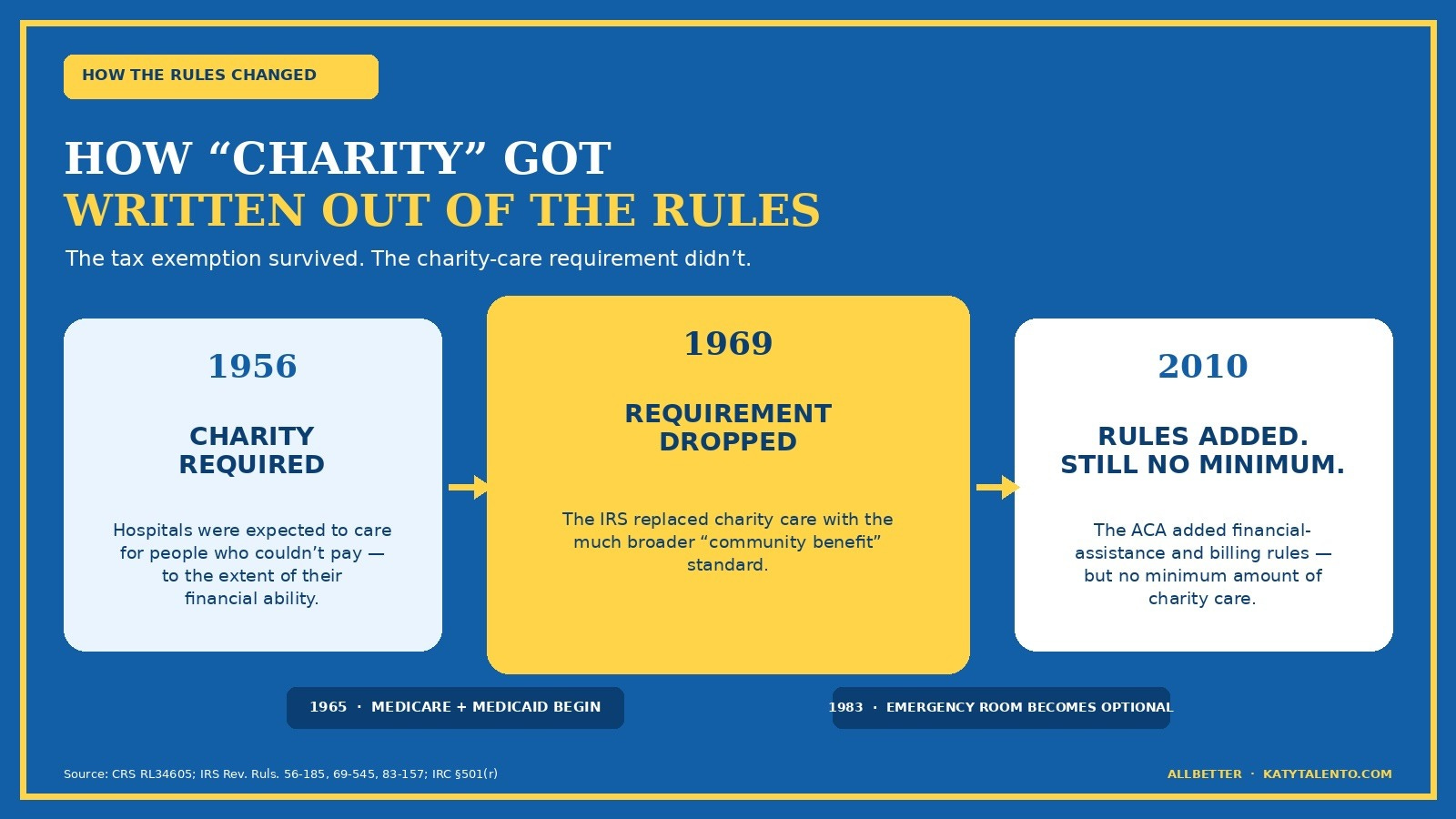
It wasn’t always like this. In 1956, the IRS said a hospital earned its exemption by caring for patients who couldn’t pay, “to the extent of its financial ability.” Charity was the whole point.
Then came Medicare and Medicaid in 1965.
With the government now paying for the elderly and the poor, the IRS decided hospitals didn’t need a charity care requirement anymore. In 1969 it replaced the old standard with a vaguer one called “community benefit,” meaning - promoting the health of the community. The hospital in that 1969 ruling admitted only paying patients. It qualified as a charity anyway, because it kept an emergency room open to everyone. In 1983, the IRS decided even the emergency room was optional.
Congress has noticed now and then.
In 2006, Ways and Means Chairman Bill Thomas introduced a bill requiring nonprofit hospitals to adopt charity care policies for low-income uninsured patients. It went nowhere. Senator Chuck Grassley kept up the pressure for years, and eventually the ACA gave us Section 501(r): hospitals have to do a community health needs assessment every three years, have a written financial assistance policy, cap what they charge eligible patients, and follow some (but not many) limits on collections.
What 501(r) doesn’t include is any minimally acceptable amount of charity.
The Government Accountability Office has been pointing this out for years. In 2020, GAO told Congress that “the law is unclear about what community benefit activities hospitals should be engaged in,” and found 30 hospitals that reported spending nothing at all on community benefit in 2016. In 2023, GAO noted that the IRS “does not have authority to specify activities hospitals must undertake.” When the IRS revoked a hospital’s exemption under the ACA rules for the first time, in 2017, the reason was that the hospital hadn’t done its needs assessment and posted it publicly.
In other words, the one enforceable rule is that a hospital has to write a report. It doesn’t have to be charitable.
The Rap Sheet
I laid out the hospitals’ crimes in Part III of my series on needing less health care, so here’s the short version.
According to RAND, hospitals charge private plans an average of 254 percent of Medicare for inpatient care and 279 percent for outpatient care, which is WAY beyond what they need to break even (usually under 150 percent, according to the National Academy of State Health Policy). That’s before a hospital decides to double its price out of spite.
Providence, one of the largest “Catholic” health systems in the country, hired McKinsey to design a revenue program called “Rev-Up.” According to Washington’s attorney general, staff were trained to “ask every patient every time” for payment and “don’t accept the first no.” Providence stopped screening patients for charity eligibility and sent Medicaid-eligible patients to debt collectors. In other words, it hired the most overpriced management consultants in the world to help it better hide its federally-mandated charity program from needy patients. In 2024, Providence agreed to $157.8 million in refunds and debt forgiveness for nearly 100,000 Washingtonians.
Meanwhile, researchers at Rice University’s Baker Institute found that nonprofit hospital CEO pay rose 34 percent between 2012 and 2019, to about $1.3 million on average. Nurses’ pay rose 2.3 percent over the same period. CEO pay tracked size and profits much more closely than quality of care.
The Only Value in the Whole Enterprise
What gets me most about my nun’s case is her surgeon.
The doctors and nurses are the ONLY source of value in that building. They’re the ones who fix the joint, deliver the baby, find the tumor, monitor recovery, exercise judgment, hold patients’ hands. It’s their work that produces literally all the revenue, and yet, they see pennies on the dollar of what the hospital charges for their work. Then the institution that employs them turns around and squeezes the poorest and sickest patients, making doctors and nurses complicit in the corruption.
That’s moral injury, and I see it in earnest clinicians all the time.
Most of them never find out what their hospital quoted the patient. This one did, and he’s putting his own standing on the line to fix it. He is doing more to live up to the word “charity” than the hospital’s entire board of directors.
So Are the Tax Exemptions Worth It?
For most hospitals, based on the numbers and my own experience, no. But I’m not asking for the tax exemption to be abolished. I’m asking Congress and the states to make it buy something.
Set a floor. Tie each hospital’s required charity care and community investment to the value of the tax breaks it receives. Bills have been introduced in this Congress to do just that. A hospital that can’t clear its own tax bill shouldn’t be called a charity.
Count honestly. Require facility-level reporting, which GAO has recommended, so a system can’t hide one hospital’s zero behind another’s surplus. Count charity at actual cost and publish it in a way ordinary people can read.
Build open-to-all into the brand. A tax-exempt hospital should be required to care for all patients, regardless of their ability to pay, but especially those willing to pay an upfront cash price without having a rapey network logo on the front of the ID card.
Outlaw spite pricing. Post a real cash price and honor it for everyone, including self-funded plans and the people in them. If it charges a cash-paying plan more than it charges its insured patients, it should lose its exemption. If a hospital raises its price because a needy patient asked for a discount, that should count as evidence against its charitable status.
Let local assessors do their jobs. Property tax is where communities feel the exemption most. In 2010, the Illinois Supreme Court upheld the state’s decision to strip a hospital of its property tax exemption because it provided so little charity care. More counties should ask the same question.
Employers, go around them. Until the law changes, the best leverage a plan has is its feet. Independent, physician-owned surgery centers and direct contracts with doctors are often a fraction of the hospital price, and they don’t punish you for asking.
The Church teaches that charity is a theological virtue, the love of God working through us toward our neighbor. At most nonprofit hospitals, charity is a line on a tax form.
I’ll let you know how the surgeon’s appeal goes. If the hospital says no, you’ll get its name.
Sources
KFF: The Estimated Value of Tax Exemption for Nonprofit Hospitals Was About $28 Billion in 2020
Congressional Research Service: Nonprofit Hospitals, Tax Benefits, and Charity Care
Congressional Research Service: 501(c)(3) Hospitals and the Community Benefit Standard
GAO-20-679: Opportunities Exist to Improve Oversight of Hospitals’ Tax-Exempt Status
GAO-23-106777: IRS Oversight of Hospitals’ Tax-Exempt Status
Healthcare Dive: IRS revokes hospital nonprofit status for the first time
Washington Attorney General: Providence must provide $157.8 million in refunds and debt relief
Alaska Public Media: Providence pressured patients to pay, even when eligible for free care