


I spent a big chunk of this week watching Calley Means set fire to the West Wing.
First came a marathon episode of Joe Rogan. Liquid fire. Then on Sunday he sat down with Margaret Brennan on Face the Nation and named names: the lobbying firms, the political aides, and the Chief of Staff herself. Calley left the White House in disgust after watching industry kill the policies he was brought in to deliver. One of them was a plain-English federal definition of ultraprocessed food that, by his account, was pulled days before it was supposed to be announced. Now he’s saying all of it out loud, on the record, and he has publicly demanded that the people he’s accusing preserve their records.
By the end of the week, Susie Wiles was out as Chief of Staff.
Of all the bombs Calley dropped, the one that hit me hardest was about fruit-flavored vapes. Part of that is because I watched my friend Marty Makary go through hell on this exact issue at FDA this spring. The other part is that I fought the very same fight myself, from inside the first Trump White House, seven years ago.
We won that one - barely. This White House lost it. I’ve spent the week thinking about why, and I think I can name the reasons.
What Happened to Marty Makary
At least ten of my friends or friends of friends who were trying intensely to push the president’s and the Secretary’s MAHA agenda through deep state and industry opposition have been relieved of duty by either White House or HHS hacks. The most painful one was Marty, and regular readers will remember that I wrote about it when he left FDA in May. I called the FDA Commissioner’s chair the most dangerous job in Washington, and I reminded you that the industries FDA regulates are not your friends. This week, the public got a lot more of the story.
Here’s the short version. Under the 2009 tobacco law, FDA can only authorize an e-cigarette for sale if the company shows it is “appropriate for the protection of the public health.” That means weighing whether a product helps current smokers get off cigarettes against whether it hooks people who never smoked, especially kids. Fruit flavors fail that test. Year after year, the federal government’s own youth tobacco survey finds that the overwhelming majority of kids who vape use flavored products, with fruit at the top of the list.
Marty knew that, and he refused to authorize them. Then, according to the Wall Street Journal, the President personally pressed him to approve them. (More on how that happened in a minute.) On May 5th, FDA authorized mango and blueberry vapes from a company called Glas. A week later, Marty resigned.
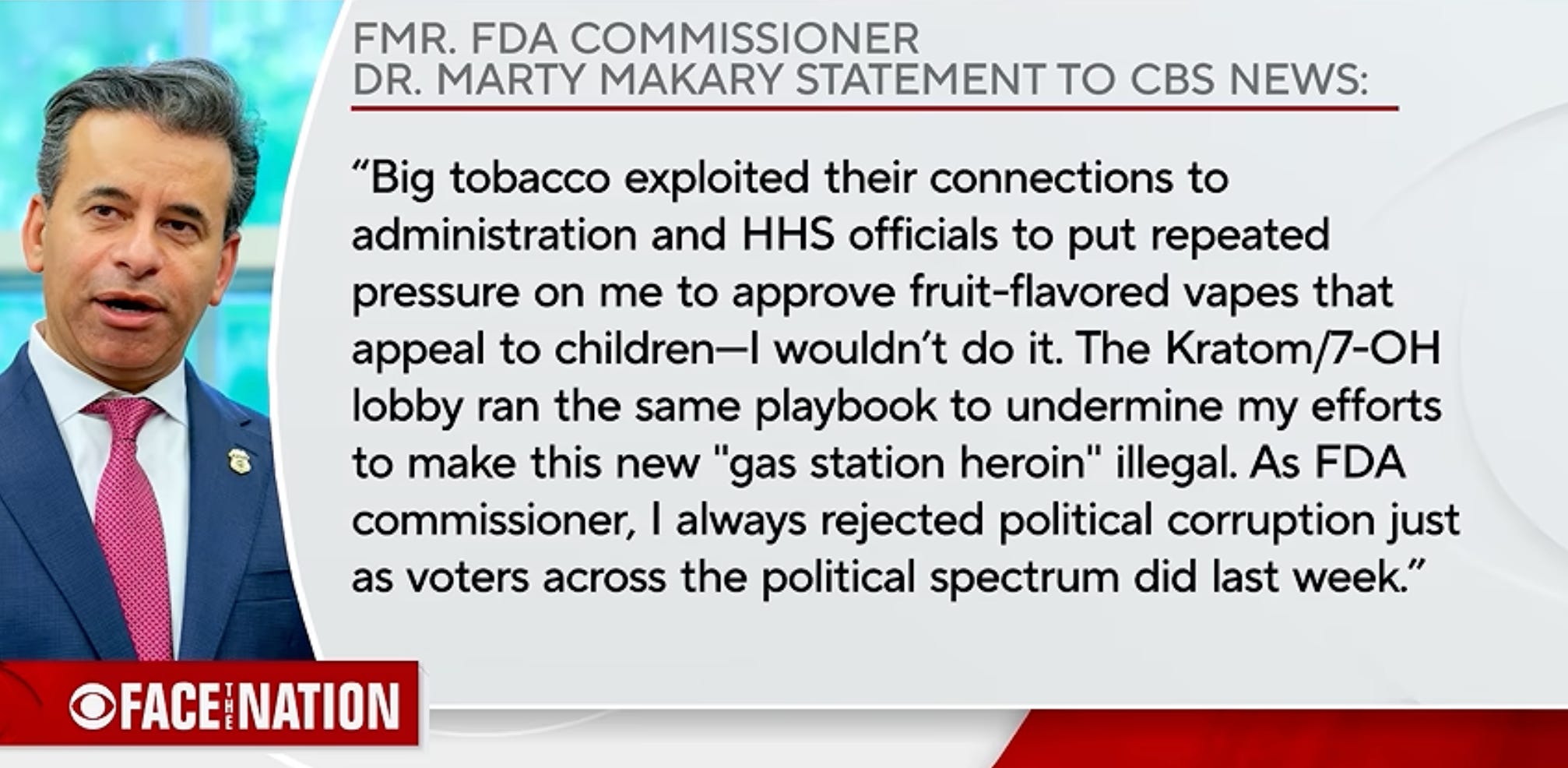
This week, Marty told CBS: “Big tobacco exploited their connections to administration and HHS officials to put repeated pressure on me to approve fruit-flavored vapes.”
Calley went further. He called Heidi Overton, who runs health policy at the White House Domestic Policy Council, “the biggest block to MAHA policies I encountered in the government.” He said that after Marty left, “partly due to the vaping issue, she drove the creation of the relaxed vaping strategy,” and that her deputies were “still relentlessly pushing HHS to find a pathway for fruit-flavored vapes.” He also said James Blair, the President’s political affairs chief, “was relentless on helping the fruit-flavored vape industry.” (Blair told CBS he “didn’t promote flavored vaping specifically at all,” whatever that means.)
In fairness to Glas, its mango vape comes with a gimmick. You verify your age with a government ID on your phone, and the device only works when it’s paired over Bluetooth to that phone. Anyone who has parented a teenager knows exactly how long that will hold up. And the public health standard covers more than kids. It asks whether a product creates new nicotine addicts, period. A mango vape is built for people who don’t like the taste of tobacco, which mostly means people who don’t smoke.
I’ve Seen This Movie Before
From 2017 to 2019, I was the health policy lead at the Domestic Policy Council. FDA had been putting off decisions on e-cigarettes for years, because the agency was terrified to make such a radioactive call in either direction. Meanwhile the products stayed on shelves under FDA’s “enforcement discretion,” which is bureaucrat for “we know it’s illegal and we’re choosing not to do anything about it,” and teen vaping exploded. The law required FDA to decide on these products in a timely way, and to decide them on public health grounds. Pressure mounted from a pediatricians’ lawsuit, Congressional oversight, and the data showing an epidemic of nicotine addiction among teenagers.
So we crafted a compromise. Tobacco and menthol flavors could move forward, because those are the flavors current smokers know from their cigarettes, and therefore what they’d reach for when trying to switch. Fruit, candy and dessert flavors would not, because those exist to bring in new customers who never touched a cigarette. My job at the White House was to defend the Commissioner and the policy, and to keep FDA moving on both halves of the law at once: decide on time, and decide for public health.
I was lobbied out the wazoo. Big Tobacco came in to see us. Juul, then the rising star of vaping, came in too. Juul’s pitch, delivered with total sincerity, was that it was saving the world from Big Tobacco. Putting the cigarette companies out of business was its whole reason for existing.
A couple of months later, in December 2018, Altria, the parent company of Marlboro maker Philip Morris USA, bought 35 percent of Juul for $12.8 billion. They had been negotiating the whole time they sat in our meetings telling us how different they were from each other.
The pressure didn’t stay in our office. Industry took its complaints up the ladder through the political side of the White House. The Commissioner left that spring, and I left a few months later. We each left for a variety of reasons, but for both of us, the internal tensions from above, caused by the vaping industry pressure, was a real contributor.
Still, the policy held. That September, after I was gone, the President stood in the Oval Office and announced a ban on flavored vapes, then backed off when the vape lobby turned up the heat. What survived all that drama was the line we had drawn: yes to tobacco and menthol for adult smokers, no to fruity flavors. FDA kept denying flavored products for years, and in 2025 the Supreme Court unanimously upheld those denials. The policy held for six years. Until this spring.
I wrote up the whole saga in The Federalist after I left, and named the outsiders who pressured us.
So why did good policy survive a President’s own public wobble in 2019 and then lose to the same industry in 2026? In my July post on how a White House actually decides stuff, I walked through how the process is supposed to work. Here are the four ingredients that made it work for us then, and what happened to each of them this time.
1. Grownups Doing Policy
White House policy work on radioactive issues is a contact sport. The people who do it well have usually spent years staffing an elected official who has to regularly face angry voters - meaning, they’ve had to engage at town halls and grocery stores where people get in their face. They’ve had to respond to the oppo ads of their opponents mocking their records. They’ve had to participate in literal debates, on TV, with their opponents, where the stakes are everything for them. Staffers of those type of officials know how to prepare their bosses. They are always thinking ahead about “how will the other side demagogue this?” or “How will we respond to the earnest people who are worried about the consequences of this vote?”
These kinds of staff prepare the boss to see every side of a fight where someone is guaranteed to end up mad, help him debate and defend the position, get him through the media hits and the donor tantrums, and bring him out the other side a political winner. Once you’ve done that a long time, for a variety of different bosses in different states and media markets, a lobbyist with a slick set of talking points and a veiled threat is just another Monday morning. That was the job I’d done in the Senate for fifteen years before I ever set foot in the White House, and it’s why Juul’s white-hat act never stood a chance with me.
There are two kinds of people who scare easily. The first is the executive-branch lifer who has only ever staffed other mid-level officials and has never been responsible for staffing someone highly placed enough to actually face voters. The second is the outsider with barely any government experience at all, whether a campaign operative or a doctor who recently stumbled into government. When the heat comes, both kinds tend to fold. When one of them is the boss of a team full of qualified policy staff, it gets ugly. The staff might know exactly what the right answer is, but they have nobody above them willing to fight for it.
This term, the person doing my old job, running health policy day to day at the White House, is Heidi Overton, the DPC official Calley called “the biggest block to MAHA policies I encountered in the government.” The funny thing is that I helped get her in the door. Years ago, Marty, who had mentored her at Johns Hopkins, asked me to meet with her about applying to be a White House Fellow. I did, and I recommended her. Her rookie year in government, started a couple of months after I left the White House. A few months after that, she was promoted to run the health portfolio at DPC, the job I had just left. Then COVID hit, and the task force and HHS drove the health-policy bus. She spent the Biden years at a think tank and came back in 2025 to run health policy for a President elected on a MAHA mandate. In the irony of ironies, she has since been nominated to replace Marty as FDA Commissioner. The Senate hasn’t voted yet, and Calley’s truth bombs surely won’t help.
I don’t recount any of this history to personally attack Heidi. Put anyone that inexperienced in the driver’s seat of health policy, and it’s a recipe for disaster. The trouble is that she can’t move much of anything forward on her own. And when the people above her want an outcome industry is paying for, she gets the kibosh assignment, on a collision course with everyone else in the administration trying desperately to drive through the MAHA agenda. That is how Calley describes her role, and it matches what I’ve heard from many others who have worked with her.
2. A Policy Chief Who Could Take Incoming
For most of our vape fight, I had a boss at DPC who knew what he was doing. He protected me and FDA while the guidance was being developed, which meant he deftly absorbed a lot of incoming so we could do our jobs. When the political side of the building got nervous, he was the one who walked down the hall and took the heat, so the people drafting the policy could keep drafting it. He left right before the policy went live. His successor was weaker and less adept at managing the hand-wringing coming out of the political offices. He lasted less than a year in the job, and the tensions between us over this issue, among others, eventually led to my departure.
This term, the head of DPC is a good man whom I respect. He was a gifted speechwriter in the first term, brilliant at defending policy. For reasons that haven’t been explained, he has been sidelined onto “special projects.” I don’t blame him for any of this, but the result is a policy council where the person with the title doesn’t have the power, and the people with the power don’t have the experience.
3. A White House That Respected the Process
Even with a weaker policy chief, our vape policy survived because it was already finished when industry turned the heat up all the way up the chain. FDA had the law and the science on its side, the process had been run properly, and the Chief of Staff’s office protected that process instead of putting a thumb on the scale.
I saw what that looks like on a different fight. We were working on a pro-life regulation, and it kept getting delayed and stalled. The cause was one person close to the President who would meet with him alone and give him a one-sided political argument against the policy. So we gathered up the communications gurus, the political office armed with polling data, and the policy team, and went in to see then-Chief of Staff John Kelly. Our ask was simple: get the full story in front of the President before he decides, and stop the stealth end-run. Kelly understood his job. The President trusts his people and will generally take their advice, so if he’s only hearing one side of an issue, he isn’t being served well. The full case got made to the President, and the policy went forward.
That is the most important part of a Chief of Staff’s job: making sure the President gets staffed with every view in his administration so he can weigh all sides and make an informed decision. It means industry doesn’t get into the Oval Office, or a lunch at a Florida golf club, without a policy staffer in the room, someone who can kick the tires on whatever is being sold and help the President ask the right questions. It also means fundraising stays as far from policymaking as you can push it.
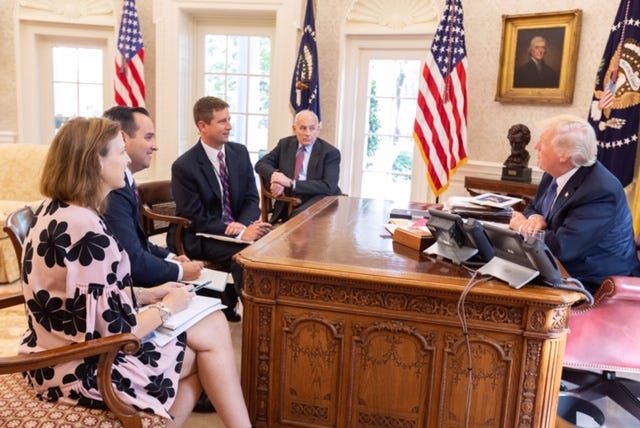
Here’s what it looks like when that doesn’t happen. On May 2nd, the President had lunch at his golf club in Jupiter, Florida, with a top executive from Reynolds American, the maker of Camel and Newport, along with lobbyists from Ballard Partners, the firm Susie Wiles came from and that Calley has singled out. According to the New York Times, the President interrupted the lunch to call Marty, who was on a plane and couldn’t be reached. So he called Secretary Kennedy and Dr. Oz instead, to complain about FDA’s regulation of e-cigarettes. Three days later, FDA authorized the mango and blueberry vapes. Campaign finance filings later showed that a Reynolds subsidiary had given $5 million to MAGA Inc., the President’s super PAC, on April 30, two days before the lunch. The Times said it found no definitive evidence tying the decision to the lunch or the donation, and Senator Ron Wyden has opened an investigation. You can draw your own conclusions. Nothing reported about that lunch suggests anyone was at the table to make the public health case.
Susie Wiles came up as a campaign professional and a lobbyist. Before this job, she had never served at a senior level in a White House or federal agency. Perhaps she didn’t know that protecting the policy deliberation process for the president was her job. Perhaps she didn’t know the political offices aren’t supposed to set policy. I’m not going to assume she was acting primarily to benefit her old lobbying colleagues, or her daughter’s firm, or to fill the President’s PAC accounts ahead of the midterms. Calley has made specific allegations about all of that, including about Continental Strategy, the firm tied to her daughter. Continental calls his claims “inaccurate and baseless” and says it never lobbied on vapes. I’ll let Calley’s record-preservation demand play out.
This also answers what might be an obvious objection to everything above: the President wanted the flavors approved, so what’s the scandal? A President decides using whatever information the elaborate White House policy process puts in front of him. In 2019 he wobbled in public, but he never ordered FDA to abandon the line it had drawn. In 2026, industry got to the President over lunch, and the policy staff who should have been there to push back either weren’t in the room or weren’t willing to do their job.
4. Political Offices That Stayed in Their Lane
The relationship offices in the White House - Political Affairs, Public Liaison, Legislative Affairs and the rest - exist to manage angry donors, constituencies and industries on the President’s behalf. In the first term, like in every administration, they took a lot of incoming. When the President was talking tough on drug prices and Medicare, Big Pharma got hysterical and demanded meetings with us. The political folks asked us nicely whether we’d take the meeting. We said yes, nicely. We met with Big Pharma, listened, kicked the tires on their arguments, and declined to reassure them.
The political offices passed along the complaints and made sure the President understood the political implications of aggravating industry. We and FDA got to be in the room to argue the other side. Then the policy decision got made and everyone managed the fallout. The political shop never mistook itself for the policy shop.
According to Calley and many others I’ve talked to, things are different in the second term, and the political shop runs policy. The vape push came out of political affairs. Calley says the ultraprocessed food definition, a policy he says has 90 percent public support, was pulled out of Susie’s office days before it was supposed to be announced, and that the President’s pollster, Tony Fabrizio, advised against it while being paid by Pepsi. Fabrizio calls that “demonstrably false.”
No political or other relationship office should have the primary policy-making vote in the White House.
These Industries Are Not Your Friends
I said it in May and I’ll keep saying it. Pfizer paid $2.3 billion in 2009 to settle fraud charges over illegal drug marketing, and GlaxoSmithKline paid $3 billion in 2012. Big Tobacco’s crimes need no recap from me. And Big Food is, in large part, Big Tobacco’s offspring. For years Philip Morris owned Kraft and General Foods, and R.J. Reynolds owned Nabisco. A 2023 study in the journal Addiction found that while tobacco companies owned those food brands, their products were significantly more likely to be engineered for hyperpalatability than competitors’ products.
These companies have spent decades and billions of dollars learning how to make things you can’t stop consuming and which will make you patients for life. They aren’t your friends, they aren’t mine, and they aren’t the President’s.
Grownups Wanted
Taking these industries on requires guts. It requires spiritual fortitude, the kind you only get from knowing exactly why you’re there, who you work for and whose interests you serve. It requires experience and savvy. It’s work for grownups, and even then these industries usually take out the best of us. They took out the Commissioner I served with in 2019, then they worked hard to make things unpalatable for me, and then they took out Marty this spring.
So I’m grateful to Calley Means for his courage. Naming names on the biggest media outlets in the world, knowing what comes next for you, is not something most people in this town will ever do. He called it what it is: corruption at the highest levels, which no one voted for when they pulled the lever for President Trump in 2024.
And here’s my one piece of good news. I’ve worked with Stephen Miller, and he is single-mindedly focused on delivering the America First agenda. He has driven his boss’s agenda no matter how hard it got, and he spent two terms helping staff the President to defend it. That makes him a policy staffer’s best friend, because policy is the only reason the man gets out of bed in the morning. (Although finding a good woman and becoming a dad during the Biden interregnum seems to have significantly softened him up, LOL.)
A Chief of Staff who has actually done policy knows which lane is which. I expect Stephen to let the policy shop do its job, keep the political shop doing its own, and make sure the President hears from both before he decides anything.
Reagan’s people used to say “personnel is policy.” This week the President got a new Chief of Staff, and soon the Senate will decide whether to hand Marty’s old job to the official Calley calls the biggest block to MAHA policy in the government. That’s two big personnel calls in a matter of weeks. Now we find out whether the policy changes too.
When we strip away the influence of campaign finance, it seems that a basic principle remains: the importance of listening to different perspectives. (In this case, the public health perspective).
I can't open your pieces fast enough, Katy. Thanks for this.
Listened to the Joe Rogan interview with Callie last Friday. It was interesting cause I listened right after it was announced that Wiles had been fired. As I was listening, I was wondering how his observations compared to your experience during Trump I. Was hoping you would comment. You are spot on about seperating policy from campaign/FR side. Thanks for weighing in on this and also observations about Stephen Miller.