


You may have heard that the bipartisan deal-making on health care is falling apart. Don’t believe it.
There will be a deal — because there has to be one.
The next government shutdown deadline is January 30th, and Washington doesn’t do ideological purity when the lights are about to go out.
But there’s a reason health reform keeps failing — and it may not be not the one you think.
I worked on these issues for fifteen years in the Senate and the Trump White House — health care and pro-life policy, both portfolios, at the same time. I know how this sausage gets made (and how it doesn’t), and I have the scars to prove it.
There’s a lot more to say in next week’s article: The Tax Code’s Abortion Problem. But for now, let me explain how we got here, and what’s actually going on behind closed doors.
How Health Care Became the Hostage
Like clockwork, last Fall brought us the end of the fiscal year and, with it, another round of brinkmanship to keep the government funded. At the same time, Open Enrollment for the 2026 ACA marketplace was approaching, which corresponded to the expiration of the COVID-era expanded subsidies at the end of 2025. These subsidies increased the amount of premium assistance for people already subsidized before COVID (with incomes up to 400 percent of the federal poverty level), as well as extended new subsidies to populations not previously eligible — with no income cap at all.
No Republican had ever voted for the ACA or the COVID-era subsidies, and they’re running the place now. Many of them hoped that government welfare designed to help people in a lockdown economy during COVID might finally expire.
All Republicans had to do was NOTHING and most of them would get their preferred policy.
But some Republicans, especially those in swing states, were panicking about being blamed for steep premium spikes caused by the subsidies ending.

Warnings of a health care apocalypse echoed through the halls of the Capitol. And for many marketplace consumers, the looming costs were all too real.
That’s when ACA policy collided with the annual shutdown showdown.
Most bills, though not all, as we’ll discuss later, require minority support because they’re subject to the Senate filibuster, including appropriations bills to fund the government. The filibuster is simply the procedural fact that the Senate votes on whether to vote. Even though it takes only 51 votes to pass a bill, it takes 60 votes to vote to vote on the bill, which is why it matters if Democrats will play ball. So yeah, it takes more votes to vote on whether to vote on a thing than it takes to vote on the thing. Got it?
This is why the minority party has so much power in the Senate.
The Shutdown Hoe-down
Democrats seized the moment, demanding an extension of the COVID subsidies as a condition of supporting the spending bill that would keep the government open with the start of the new Fiscal Year, October 1st.
Republicans countered by offering an extension (a major concession, since it would be a precedent-setting first time that Republicans go on record voting for the ACA). There was just one catch: the extension had to include beefier guardrails to enforce the existing law and prevent illegals from receiving taxpayer-funded benefits. The ACA technically prohibited such subsidies, but enforcement had been a joke.
Democrats refused.
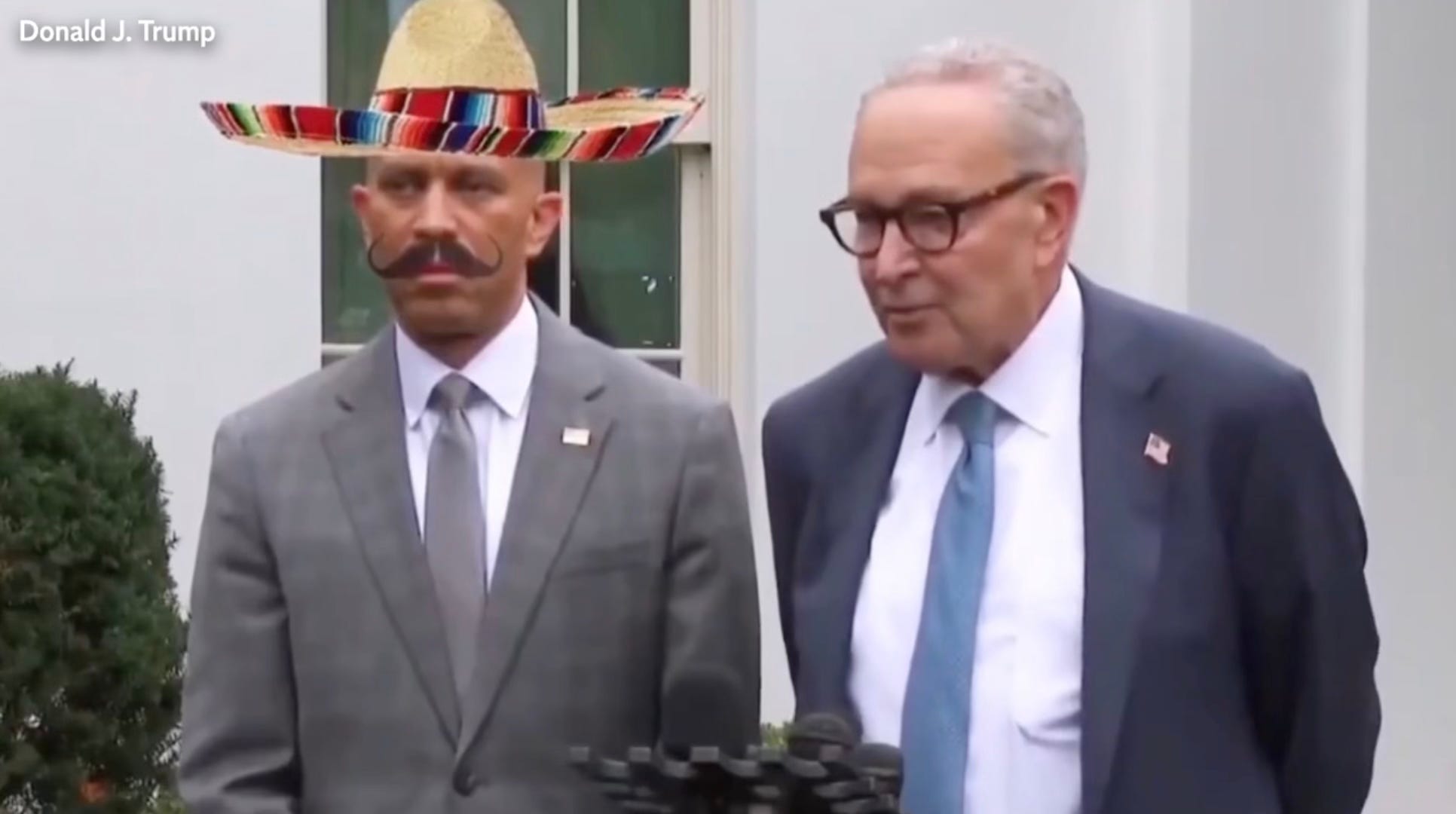
Republicans pounced back, characterizing Dems as putting illegals above Americans. Sombrero memes exploded. Feds got an unpaid vacation. Pressure mounted on both sides of the aisle as the longest shutdown in history persisted (did you even notice?).
Round-and-round they went, with performative posturing and mutual mockery. After six weeks, seven swing-state Democrats crossed the aisle to support a short-term deal in November, ending the shutdown and pushing the next deadline to January 30th. The deal was sold as a cooling-off period to negotiate a serious, bipartisan solution to the subsidy cliff and broader health system failures.
Because bipartisan health care breakthroughs happen a lot.
Oh wait.
No they don’t.
The Hostage Exchange
No deal was reached before the holidays.
I know – you’re shocked.
This brings us to the present, with Washington once again staring down a January 30th shutdown. When that short-term funding deal expires, government funding runs out. Again.
Senators Bernie Moreno and Susan Collins have been leading the dealmaking efforts and have made some progress.
Reportedly, Democrats would get:
An extension of COVID-era subsidies for several more years.
Preservation of current, weak-sauce pro-life protections on subsidy money, rather than stronger Hyde protections (which outright prohibit any taxpayer support for elective abortion).
To get Republican votes, this deal needs a policy pound of flesh, something real that can plausibly be called a compromise.
My bet: ACA subsidies — both COVID-era and baseline — are allowed to flow into health savings accounts (HSAs), instead of being sent directly to big insurance companies. In other words, “School Choice for Health Care,” the policy I described a few weeks ago and which President Trump has repeatedly demanded.
That raises new pro-life concerns. (More on those next week.)
Behold, Budget Reconciliation
The Moreno shutdown deal isn’t the only path to reform this year.
Right before Christmas, Speaker Johnson pushed a largely symbolic health care bill — a nothing-burger of nits and nats — designed to give members something to say they did on health care over the holidays, while COVID subsidies expired.
In exchange, he promised Republicans a real shot at reform using the budget reconciliation process.
Ah, reconciliation! Doesn’t it just have that ring of bipartisan peace and love? In reality, it’s the exact opposite. Reconciliation allows the majority party to pass major policy changes without having to overcome a Senate filibuster or garner a single Democrat vote.
Control both chambers and you can pass the bill by majority vote in the House and then move a bill in the Senate with 51 votes — not the 60 needed to overcome a filibuster on regular legislation — which was exactly how Democrats passed the ACA.
Republicans are no stranger to the process either; the doomed repeal-and-replace bill I described in an earlier post was a reconciliation package, as was last year’s One Big Beautiful Bill.
The ACA: the Sideshow that Washington Treats as the Main Event
For fifteen years, Washington has acted as if the ACA was the health care system.
The bickering and blame-shifting, the hostile committee hearings and fiery floor speeches — if it was about health care, it was usually about the ACA. Politicos treat the exchange plans as if they are the center of American health care rather than a small slice of it.
That is a mistake and both parties have repeatedly made it (though President Trump’s focus on price transparency and drug costs in the first term was the first break in this pattern).
The ACA marketplace covers just over 20 million people. The employer-sponsored and broader commercial markets cover nearly 10x that many. Still, we let the ACA consume all the oxygen, while the real system — the one most Americans actually live in — has imposed crushing financial burdens and terrible health outcomes.
In the broader commercial market, premiums have been skyrocketing. Hospital consolidation has accelerated the monopolies driving up prices. Entire industries of middlemen sprung up that most people have never even heard of. Insured patients have been dying from delayed or denied care and unthinkably high deductibles.
Real Reform Worth Fighting For
Done right, reconciliation could disrupt the commercial market — where employer-sponsored coverage, off-exchange plans, and non-insurance arrangements operate. These reforms would transfer power away from health care special interests and back to the people who pay for care — patients and employers.
Rumor has it the package will likely include:
School choice for health care: employer dollars into worker-owned accounts usable for ACA plans, off-exchange plans, sharing ministries, and direct-pay arrangements.
All-in cash prices: upfront, all-in direct-pay prices equal to or lower than insurers’ best rates.
Site neutrality: no more hospital tax — the extra cost (sometimes three to five times higher) for the same service, just for the privilege of having it done at a building owned by a hospital.
Price transparency on steroids: enshrine Trump first-term rules, beef up their requirements for precision and jack up enforcement to eleven.
PBM fiduciary obligations: require PBMs to treat patients and employers like clients to whom they owe a debt of responsibility.
Health care sharing tax parity: stop discriminating against health care sharing ministry members in the tax code.
These reforms may sound wonky but they’re earth-shattering.
They would burn down the predations of the current system. (More details on why and how here and here.)
There is no free market in health care, but a reconciliation bill containing these provisions would be the jet fuel to the birth one. Which is why you can expect the industry shills to swarm Capitol Hill to try to stop it — there are between four and five health industry lobbyists for every member of Congress.
Again, it’s always dangerous to bet against Congress doing nothing. So, it may not happen, if House Republicans let Speaker Johnson out of his promise because they’ve decided health reform is just too hard, and the premium increases on the exchanges are water under the bridge.
But I’m more hopeful than I’ve been in many years. For the first time in decades, Republicans know what they want, they can describe it in plain, populist language, and the president is on their side: money going straight to the people instead of Big Insurers, and the kind of transparency and fiduciary requirements that help employers actually get an edge on the special interests owned by Wall Street.
For a party that normally fights like hell to do nothing, we have a generational opportunity to swing for the fences. I can almost taste it.
But, wait.
The brutal reality is that none of these important bills will happen — neither the Moreno ACA deal, nor the reconciliation bill on everything else — until Republicans face a question they’ve been avoiding for decades.
I know because we’ve been here before. Many times.
Every time serious health reform gets proposed, it dies at the same intersection: the place where health policy meets pro-life imperatives.
HSA expansion? Dead.
Subsidy reform? Dead.
Tax deductions for innovations? Dead.
The reasons are complicated, rarely explained publicly, and almost entirely misunderstood — even by the legislators voting on them.
You know I advised President Trump on health care. But the other half of my portfolio was pro-life policy, and the guerrilla wars I fought in that crusade are too radioactive to talk about publicly. I care deeply and desperately about both causes, because in my view, they’re actually the same cause.
So next week, I’m calling a Republican family meeting to discuss The Tax Code’s Abortion Problem.
Don’t miss it, subscribe and share. Part 2 drops on Shutdown Day: January 30th.
The reconciliation package you're describing would actually shift power back to patients and employers. It has to happen!
Love the audio! So much better than the AI version. The passion and intentionality really shine through!