


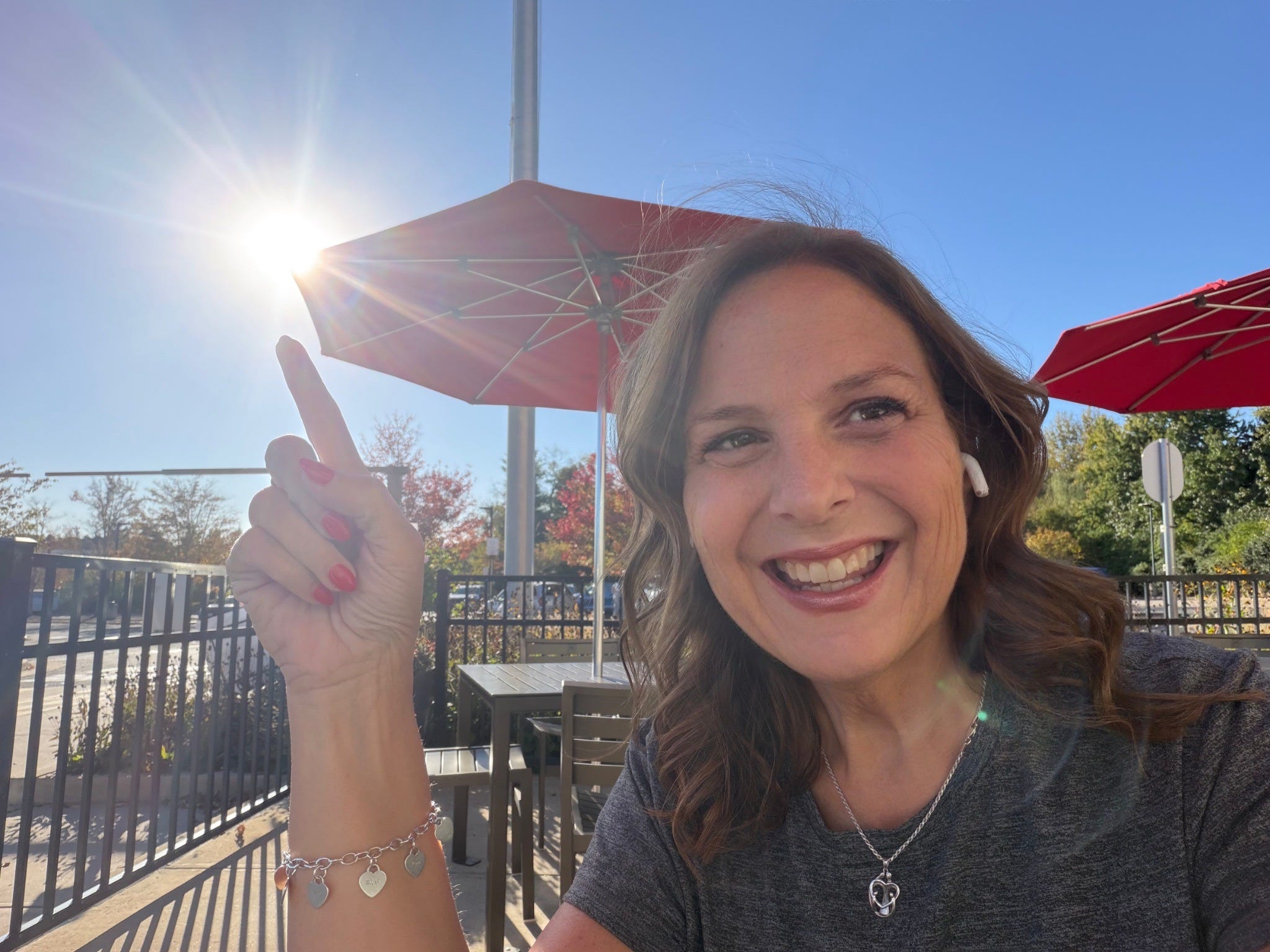
From May through September, your humble correspondent is basically a lizard on a warm rock.
My mornings start on the patio with my dog, bare feet in the grass, face turned toward wherever the sun is climbing over the trees. Then I wander down to my favorite little organic coffee shop for hot tea, eggs and avocado toast, and carry the whole operation back outside. I work on the patio or the front porch for the rest of the day. My clients and colleagues have long stopped asking why my Zoom background is my backyard or a wall of yellow siding. Extension cords snake out the back door, giant fans roar, umbrellas get repositioned every hour to chase the shade.
I love every minute of it, and my body and mind feel fed in a way I can’t fully explain. And then the air turns, as it’s turning right now.
For a few weeks I fight it. I wrap up in a blanket and stubbornly keep my porch office open past its natural expiration date. Eventually I lose that battle and retreat to the rocking chair in my office (regular viewers of my TV hits will recognize it). Eventually the space heater comes out of the closet, and I build myself a cozy little nest.
It’s comfortable. It’s also not the same.
The vitality drains out of me. My energy flattens. My nearsightedness, which I’ve been beating back with an out-of-the-system neuro-optometrist (more about that here), creeps forward a little every winter like clockwork. My vitamin levels and hormones go a bit haywire. By February or March I’m scheming about a beach trip with the urgency of a woman planning a prison break, because if I don’t get some real sun on my face soon, I’m going to lose my mind.
My entire year, if I’m honest, is built around the summer months.
So why not just move somewhere sunny? You already know the answer, because it’s probably your answer too. Aging parents. Kids. Grandkids who still think I’m fun. A husband with a job that isn’t portable. All of it conspires to keep us planted in Virginia and all four of its mostly temperate seasons. And the places where you can live outdoors in the winter have their own problem: by July they turn into pizza ovens, and everyone there hides inside in the air conditioning. Trade-offs everywhere.
For decades, The Authorities have had a name for what happens to me every winter. I think they got it wrong.
The Disorder That Isn’t
In 1984, psychiatrist Norman Rosenthal and colleagues at the National Institute of Mental Health described “seasonal affective disorder.”
They found it through a newspaper survey and were surprised by how many people responded. They also discovered that bright light helped. Today the psychiatric manual files it under major depression “with seasonal pattern.”
Let’s look at who gets it.
Prevalence runs around 1 percent in Florida, roughly 5 percent at the latitude of New York, and about 10 percent up in New Hampshire. Something like 90 percent of people report at least some seasonal shift in their mood or energy.
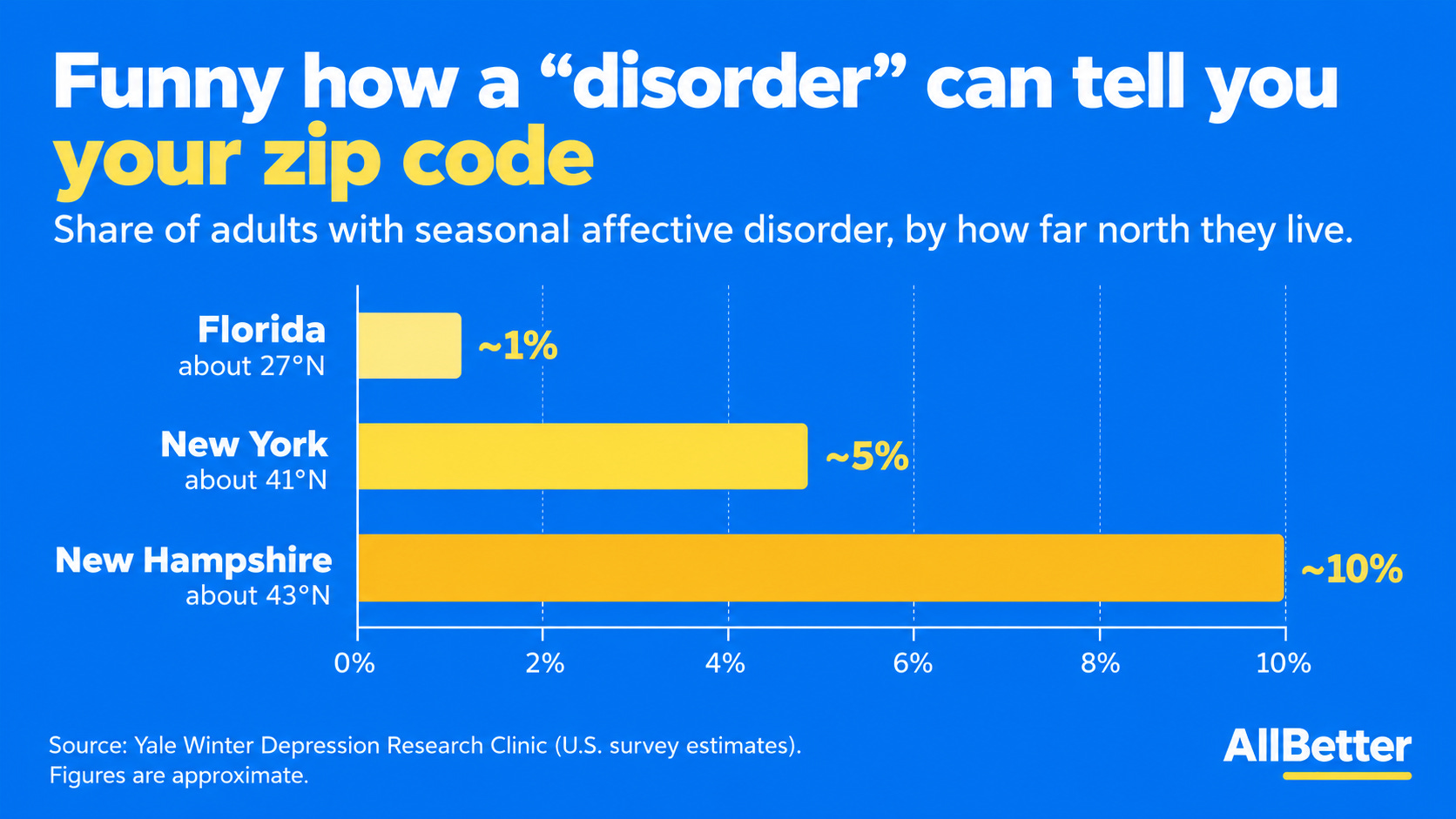
When nine out of ten people feel a thing, and the thing tracks precisely with distance from the equator, I’d call that physiology not pathology.
Our bodies are responding exactly as designed to a dramatic change in inputs. Every fall we pack ourselves into boxes lit by bulbs and filtered through window glass, and our bodies register the change and object. As loyal readers know, I don’t think symptoms are malfunctions. They’re messages, and this one is pretty easy to read.
Americans already spend about 87 percent of our time indoors and another 6 percent in vehicles, according to the EPA’s big national activity survey. But that’s averaged across the year. In the winter it’s worse.
And indoors is dark in a way our brains notice even when our eyes don’t.
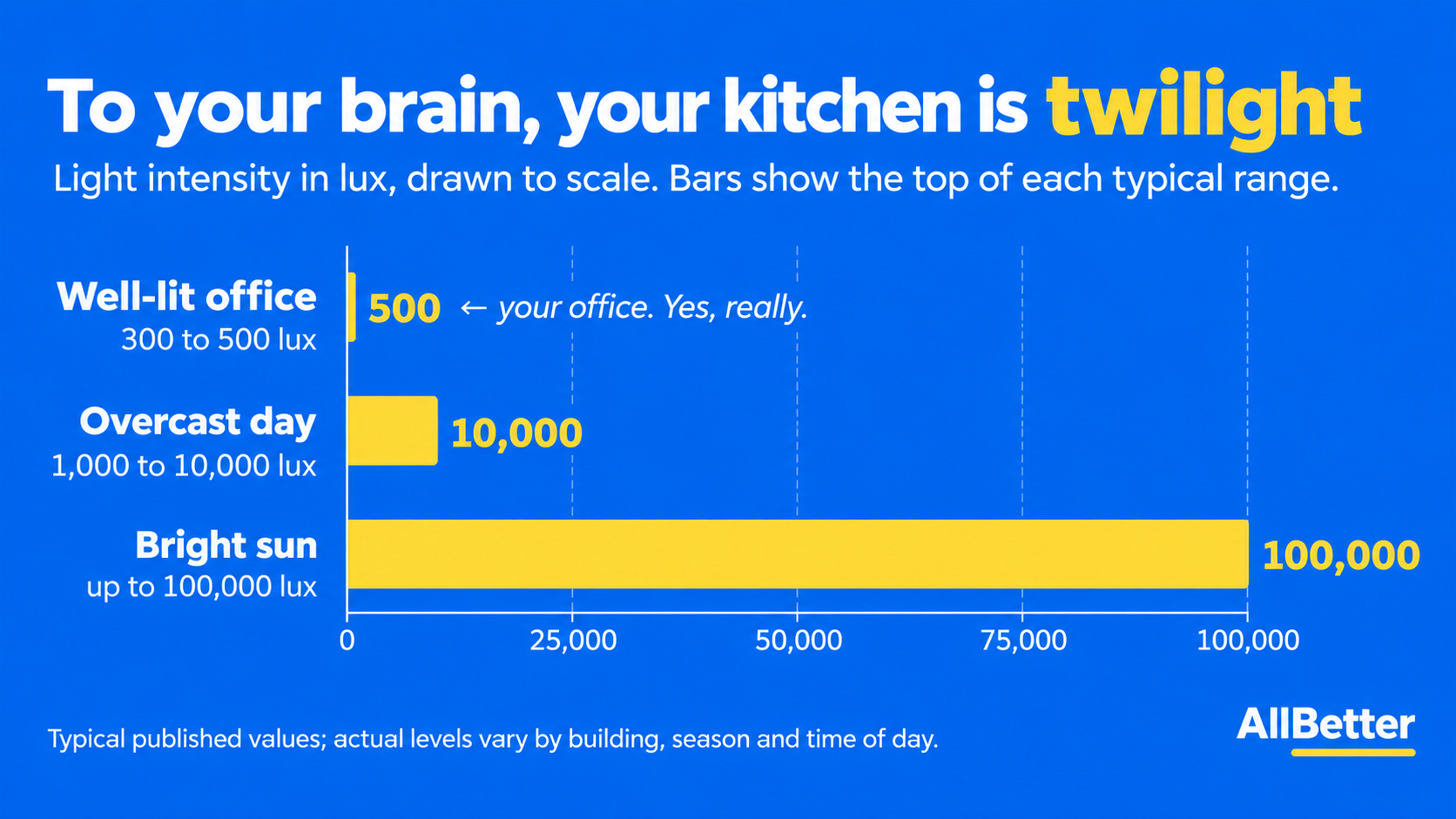
A well-lit office runs around 300 to 500 lux. An overcast day outside delivers thousands of lux, and bright sun can top 100,000. As far as your biology is concerned, your cheerful kitchen is twilight.
Ultra-Processed Light
Which brings me to the article that’s had my head spinning as the temps drop.
Graham Lawton has a feature in New Scientist (yes, that New Scientist, the mainstream science weekly, hardly a crunchy wellness blog) with the delightfully alarmist headline, “[t]he shock revelation that light bulbs are wrecking your metabolism.” It’s an excellent read.
Here’s the short version.
What changed. Starting in the early 2000s, two energy-efficiency technologies took over. LEDs replaced incandescent bulbs, and window glass was engineered to block infrared light so heat stays in or out. Between the two of them, the light we get indoors got stripped of its long wavelengths, the red and near-infrared end of the spectrum. LEDs give off essentially nothing beyond about 750 nanometers. UCL neuroscientist Glen Jeffery estimates we lost roughly 95 percent of the spectrum.
Who cares? For all of human history, those long wavelengths were everywhere. They’re in sunlight, moonlight, campfires, candles, oil lamps and the good old incandescent bulb, whose spectrum is close to the sun’s. Red and infrared light - the only light most humans until recently ever saw after sunset (in a fire) - passes right through your clothes and penetrates deep into your tissues. It bounces around inside you (that red glow when you press your finger over a flashlight) until it gets absorbed. Some of it is absorbed in your mitochondria, the little power plants inside your cells, where it speeds up the electron transport chain that makes ATP, (what The Science claims is) your body’s energy currency. Bob Fosbury, an astrophysicist turned light biologist, calls it photometabolism and sums it up in four words: “Light is a nutrient.” Meanwhile, the blue light pouring off our screens and LEDs appears to slow that same energy machinery down. We took away the good stuff and piled on the bad.
What happens when you’re deprived? Fosbury compares long-wavelength light to a vitamin, and he compares the deprivation to scurvy, the vitamin C deficiency that killed sailors by the tens of thousands. The scurvy comparison works because the damage builds slowly. He and Jeffery think red-light deprivation may be one of the biggest drivers, possibly the biggest, of the obesity, type 2 diabetes, dementia and early-onset cancer we’re drowning in (and, I’d argue, infertility, but more on that below). Scott Zimmerman, a lighting company founder who works with them, likens LED light to ultra-processed food.
Ultra-processed light. The light equivalent of Taco Bell.
Who’s acting on it? After Jeffery’s team found essentially no long-wavelength light in the beautiful new critical care unit at King’s College Hospital in London, the hospital opened a six-bed rooftop ward this spring so patients (and staff!) can get outside. Patients with access to daylight have long been known to go home sooner. Two more London hospitals are considering the same. Readers who remember my rant about hospitals as Soviet-style hellscapes with locked windows will appreciate that somebody’s finally reading the memo.
The epidemiologist in me has to say it: the article itself admits the exact mechanism is still debated and the evidence on red-light therapy is patchy. I’d love to see more than mechanism and expert hunches. But the hunches line up with a pile of other evidence.
The Receipts
Blood sugar. In a small 2024 study from Jeffery’s lab (Journal of Biophotonics, 30 people), 15 minutes of 670 nm red light before a sugar drink cut the rise in blood glucose by about 28 percent and the peak spike by about 7.5 percent. Fifteen minutes of light changed how the body handled glucose.
Eyesight. In 2020, the same lab found that three minutes a day of deep red light for two weeks improved color contrast vision by up to 20 percent in people over 40 (Journals of Gerontology). Older eyes have tired mitochondria. Feed them light and they perk up.
Mood and sleep. A UK Biobank analysis of about 400,000 people (Journal of Affective Disorders, 2021) found that more time in outdoor daylight was associated with fewer depressive symptoms, less antidepressant use, better sleep and less insomnia.
Myopia. A randomized trial in Guangzhou (JAMA, 2015) added 40 minutes of outdoor time to the school day, and three-year myopia rates dropped from 39.5 percent to 30.4 percent. In Denmark, where daylight swings from about 7 hours in winter to 18 in summer, children’s eyes lengthened, and their nearsightedness advanced, faster during the dark half of the year (Ophthalmology, 2013). So my annual winter eyeball creep has company.
Vitamin D. North of roughly 37 degrees latitude, the winter sun sits too low in the sky for your skin to make meaningful vitamin D for months at a stretch. That’s the classic Boston research by Michael Holick’s group. My patio is at about 39 degrees north. No wonder my labs wobble every winter.
Notice something about those first two studies. They used lab lamps. But I am not about to tell you to buy a red-light panel. Some of those gadgets are overpowered enough to cause inflammation, according to the very scientists who study this. The reason those studies matter to me is that they show what happens when you hand a red-light-starved body back a tiny fraction of the wavelengths it evolved on. And God already hung the best full-spectrum lamp ever made right outside your front door - free of charge.
Light, Darkness and the Fifth Vital Sign
Regular readers know where my mind goes next.
If you read “Do You Want the Baby or the Bear?“ you know I think a woman’s reproductive system works like a full-time safety inspector. It stays on the job only when the body believes conditions are good enough to carry a baby. Most of the time I’ve written about the bear as stress: a bad marriage, a grinding job, a bank account with no cushion. But light belongs on that inspection list too. Our hormones evolved on a schedule set by the sun and the moon, and we’ve scrambled both.
Start with the moon. In 2021, chronobiologist Charlotte Helfrich-Förster and colleagues published an unusual dataset in Science Advances: menstrual records that a few dozen women had kept for up to 32 years. For long stretches, many of those cycles lined up with the lunar cycle. The lining up was strongest when the women were younger, and it weakened when the women were exposed to more artificial light at night. The authors put it gently, but the implication is that our light pollution may be drowning out a signal women’s bodies used to keep time by. Our great-great-grandmothers got real darkness most nights, with a full moon a few nights a month to break it up. We live under streetlights and phone screens.
Then there’s darkness itself, which turns out to be a fertility nutrient of its own.
Your brain makes melatonin only in the dark, and melatonin does a lot more than help you sleep. Concentrations in the fluid around a developing egg run higher than in your blood, where it acts as a powerful antioxidant that shields the egg from oxidative damage. Hiroshi Tamura’s group in Japan found that women with more melatonin in that fluid had less oxidative damage. In women with a history of poor egg quality, adding melatonin roughly doubled fertilization rates in IVF (not that you should participate in IVF - please don’t). I’m not telling you to buy melatonin gummies, for the same reason I’m not selling red-light panels. The point is that your body makes this protective hormone for free, as long as you give it real darkness. Light at night shuts production down.
Night-shift workers run that experiment every day. In Harvard’s Nurses’ Health Study II, nurses who’d spent long stretches on rotating night shifts reported more irregular cycles. A 2016 review of the shift-work research found the evidence increasingly points to night work as a risk factor for miscarriage. Men aren’t exempt either. In a 2020 study of 116 men at an Israeli fertility clinic, more evening and bedtime screen use went with lower sperm concentration and motility.
Now add the daytime half of the story. Eggs are among the most mitochondria-packed cells in the human body, and egg quality falls as their mitochondria tire out. If Jeffery and Fosbury are right that our mitochondria are starving for the red and infrared light we stripped out of our homes, I’d love to know what that has done to our eggs. As far as I can find, that study hasn’t been run. I’d bet my last Diet Coke it’s worth running.
So picture the modern woman trying to conceive. She spends her days under LEDs behind infrared-blocking glass, and her nights bathed in blue light from three different screens. Her body gets too little long-wavelength light when the sun is up and too little darkness after it goes down. Then she acts victimized by bad luck and fate when her cycle goes haywire and a specialist hands her a label.
I know that woman, because I was her.
I spent my reproductive years in windowless Senate offices and fluorescent hearing rooms, sleeping four hours a night and scrolling until I passed out. No doctor ever asked me how much daylight I got. None of them suggested turning off the lights at night. They handed me birth control, and later, a diagnosis.
Light isn’t the whole story, but I’m increasingly convinced it’s a big chapter, and one of the easiest to rewrite.
Congress Banned a Nutrient
Now for the Washington twist, because of course there is one.
In 2007, Congress passed an energy law (signed by a Republican president, for those keeping score) that set efficiency standards for light bulbs. In 2022, the Biden Department of Energy finished the job, requiring 45 lumens per watt. Since mid-2023, that’s kept standard household incandescent bulbs off American shelves, and an even stricter standard arrives in 2028. In the name of climate policy, Congress outlawed an essential nutrient.
The plot twist: on September 30, Senate Energy and Natural Resources Chairman Mike Lee advanced his Liberating Incandescent Technology Act (the “LIT Act,” clever, Mike!) out of committee. The Department of Energy testified in support two weeks earlier, asking why the government should centrally plan which lighting technologies people can use. Amen. It still needs 60 votes on the Senate floor, and it has zero Democratic cosponsors, so don’t hold your breath. But for the first time in nearly twenty years, someone in Washington is asking whether the bulb Nazis were wrong.
Of course, now Congress and the President are trying to turn all our mornings into pitch blackness so that the golf courses can stay open later, by making Daylight Savings Time permanent. Our biology would function much better if Standard time were made permanent instead. Last I checked, one stubborn (blessed) Senator was holding the line for sanity. May God continue to buck him up!!
Your Fall Light Diet
You don’t need a gadget, a prescription or a plane ticket (though I’ll get to that last one).
Here’s what I’m doing this fall - feel free to join me!
Take your morning coffee outside. Wrap yourself in a blanket, grab your coffee or tea, and go outside within the first hour you’re up. Stay a few minutes, longer if you can, facing toward the sun. Leave the sunglasses inside. A window doesn’t count, because the glass strips out the exact wavelengths you’re going for. Cloudy days still count; overcast skies deliver many times the light of your living room.
Put your feet on the ground. If you can stand the cold, give your bare feet a few minutes on grass or dirt. The electron transfer from the negatively-charged ground, combined with the light, recharges your internal battery.
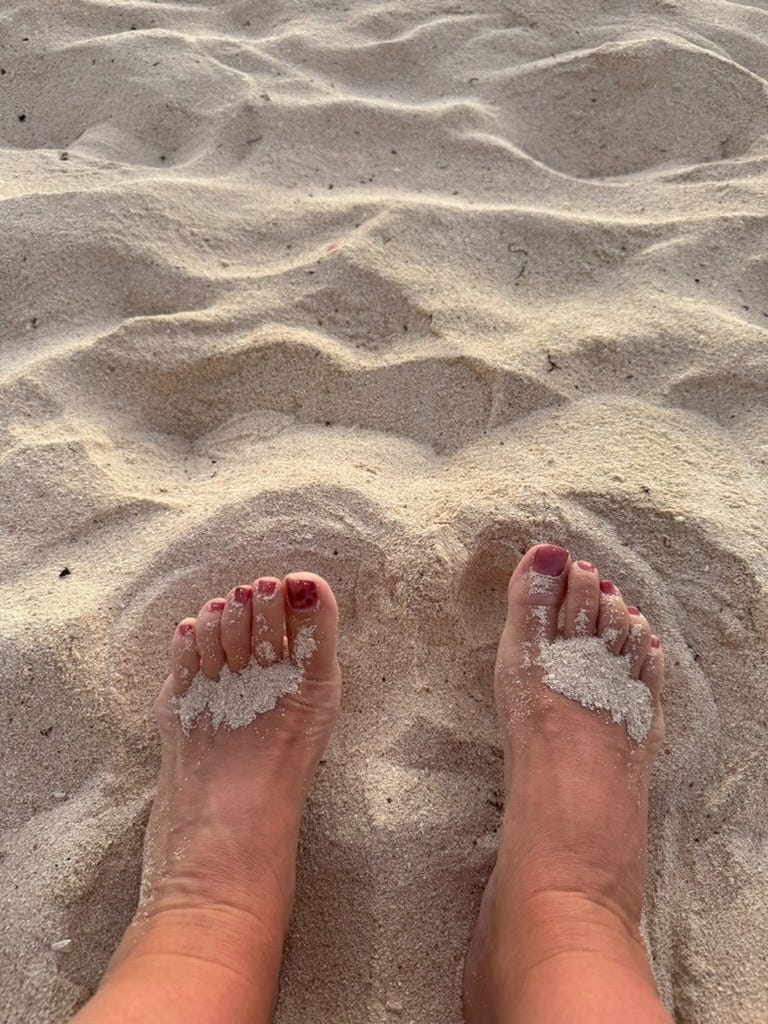
Go back out at midday. Take a walking meeting, eat lunch on the porch, or do your phone calls in the car with the windows down. Ten minutes of real daylight beats eight hours of the office kind.

Dump the LEDs. Swap in incandescent bulbs everywhere you actually spend time, starting with your desk lamp and reading lamp. Jeffery suggests an incandescent on a dimmer: even turned way down, it still pumps out plenty of infrared and draws about as much electricity as an LED. (I’m not that fancy though.) And yes, you can still get incandescents on Amazon. They often look a little smaller or a little odd-shaped (that’s how they squeak past the rules), but they screw into a normal socket and look perfectly ordinary under a lampshade. Stock up before somebody in Washington notices, or until the Senate does its job.
Give your body real darkness. After sunset, light your evenings like your great-grandmother did: candles, the fireplace, dim warm lamps. Put the screens away an hour before bed. Sleep in a truly dark bedroom, with blackout curtains and no glowing chargers. Your eggs (or his sperm) and sanity are counting on that melatonin.
Book your sun before you need it. Plan your February or March escape now, and treat it as the medicine it is.
Every year I’ll mourn the end of porch season, and every year my body will remind me what it needs. This year I’m going to listen to it a little better.
See you on the patio in May. Bring a blanket until then.
If this resonated, share it with the friend who’s already dreading November. And if you want more on how to hack the systems that run your health, join the Revolution and subscribe to AllBetter.
Sources
Lawton, “The shock revelation that light bulbs are wrecking your metabolism,” New Scientist (2026)
Klepeis et al., National Human Activity Pattern Survey (2001)
UCL: Declining eyesight improved by looking at deep red light (2020)
Monash University: UK Biobank daylight study, Journal of Affective Disorders (2021)
Helfrich-Förster et al., women’s cycles and the moon, Science Advances (2021)
Nurses’ Health Study: rotating shift work and menstrual cycles
Fernandez et al., night shift work, fertility and miscarriage (2016)
Green et al., evening screen use and sperm quality, SLEEP (2020)
Inside Lighting: LIT Act advances out of committee (October 2026)
Facilities Dive: DOE supports bringing back incandescent bulbs (September 2026)
This article lit me up! (See what I did there?) SAD is a medicalized way of say, you are a human who notices when you aren't in alignment with living like a human. I bet establishment thinkers have an SSRI for that. Love your tips on how to make winter a little less gloomy.