



Editor’s note: This is Part 1 of a three-part series. Everyone from the White House to your HR department is trying to figure out how to lower health care costs. They’re mostly asking the wrong question. The real answer isn’t about financing mechanisms or which insurance company gets the contract. The way to lower health care costs is to need less health care. Part 1 is about the mindset shift that makes that possible. Part 2 is about what to do when something’s actually wrong - and the system isn’t your first call. Part 3 is about when you genuinely need a hospital, and how to choose one that won’t bankrupt you or make things worse.
It had been the hardest “leg day” with my trainer I’d ever done.
I was proud of myself.
But later that day, the inside of my knee started hurting badly. It was brutal. I couldn’t even bend my knee without sharp pain, even touching it hurt. Knees, it turns out, are load-bearing. Inconvenient. I figured resting and elevating would help. But when it didn’t, of course, I started researching. The symptoms matched the signs of a meniscus tear, and my chiropractor later confirmed he suspected the same.
The usual treatment for this injury is meniscus repair surgery - where the doctor “shaves” the frayed ends of the torn meniscus. But I remembered how often, when surgery for various ailments was put to the most rigorous standard of a randomized controlled trial using “sham surgery” in the control group, outcomes from the placebo effect were often equally effective.
A few weeks later, the 10-year follow up report from the FIDELITY study of long-term outcomes from meniscus repair (the “shaving” procedure) surgery compared to sham surgery controls, would come out in the New England Journal of Medicine, demonstrating that the treatment was no better and probably worse than the sham surgery, both in the short and long term outcomes of interest. At this point, I hadn’t seen that study. I’d only seen enough similar ones to know that my mind was the most powerful healing tool and that it should at least be tried before heading into surgery.
Because of this, I didn’t even want to get an MRI to confirm my diagnosis.
Many MRI studies have shown that “abnormalities” appear in asymptomatic people so frequently that MRIs are not particularly useful in determining the cause of symptoms. However, MRIs are extremely useful at making you think the abnormality is the cause of your symptoms and getting you to pursue high-revenue surgical and other treatments.
In other words, an MRI finding can serve as a “hex” that makes you blame your symptom on some structural defect or injury or degeneration and assume that only an expensive white coat can “fix” it. This is disempowering thinking in the extreme, and unsupported in many cases by the evidence.
I didn’t want my mind polluted with the notion that my body couldn’t heal itself before I’d given it a chance.
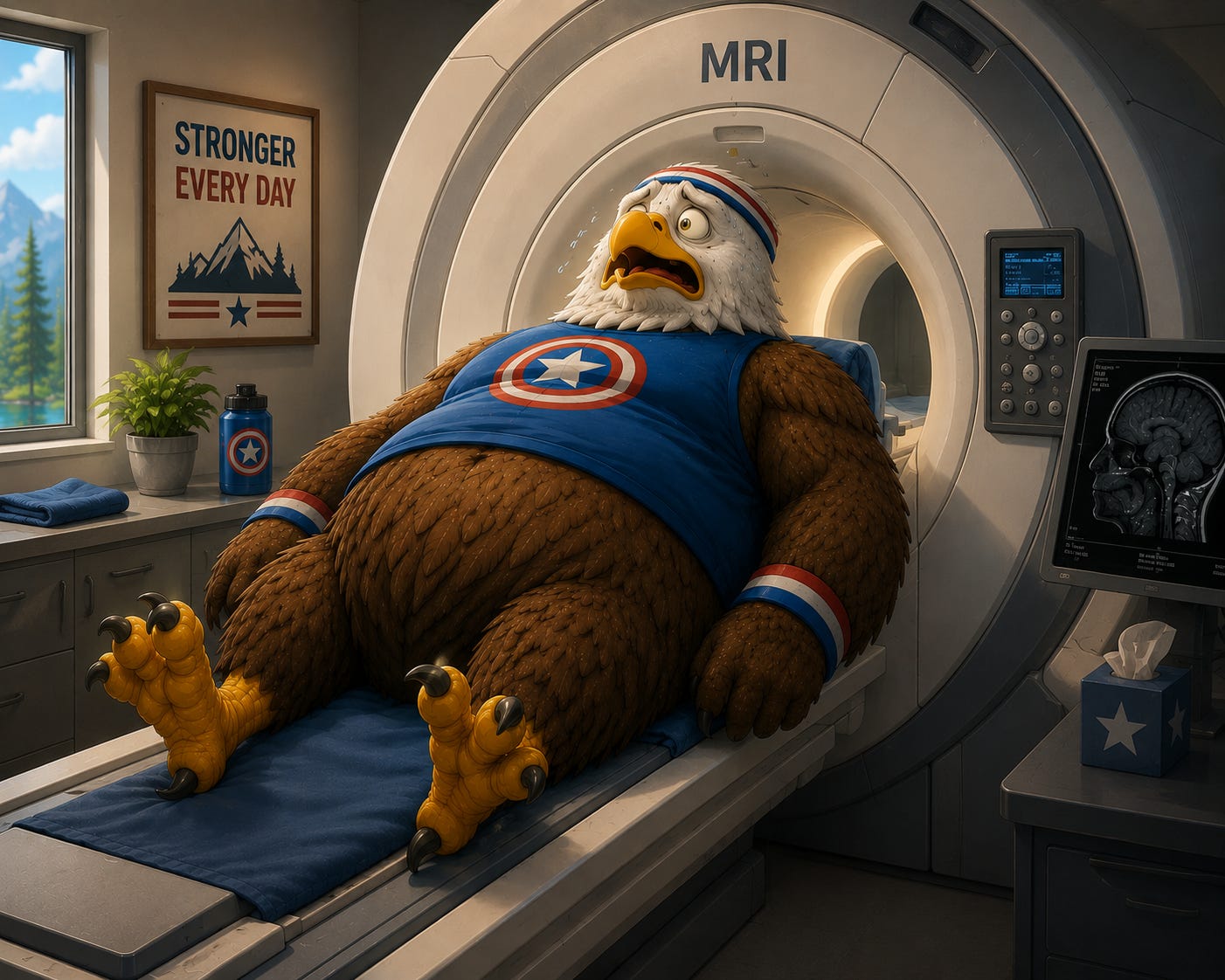
So I rejected the hex.
I went regularly to a chiropractor and an acupuncturist for a few weeks. Their manipulations brought good circulation and energy to the location, followed by symptom relief - often temporary or slow. But after about two months, I was 95% better. Four months later, I could barely feel anything there at all.
My mind is frigging amazing. So is yours.
The Real Answer to the Cost Crisis
Health care costs are eating our economy.
It’s a multi-trillion dollar industry that is nearly a fifth of the GDP. Every business, every state Medicaid director, every family at the kitchen table - we’re all sucking wind from the gut punch of health care bills.
Our solutions are generally in the same genre: financing.
Who pays? How do we shift costs to someone else? Which middlemen can we cut out? These are legitimate questions and I’ve spent most of my career on them (including my current day job as a CEO building ethical health plans for employers). But admittedly, they’re deck chairs.
The ship is sinking because Americans are sicker than we’ve ever been - and getting sicker by the day with chronic disease driving roughly 90 percent of our health care spending. You can’t finance your way out of a demand problem. We can shuffle who writes the check, but when the demand keeps rising, the supply will get more and more expensive.
But what if some fraction of us just needed less care?
The benefits might even go beyond saving the country money. Real agency would invigorate the Don’t-Tread-On-Me American spirit. And it wouldn’t take everyone - a minority could make a huge difference. That kind of shift starts in our mind before it takes effect on our body and our wallet.
So, Back to My Aches and Pains

I’m now dealing with a similar situation with a hip/groin muscle pain.
My hip feels like it constantly needs stretching and that starts to hurt when I’m walking a while. If I don’t rest, it becomes debilitating pretty quickly. I did some acupuncture. But then I discovered something much more effective. Something that sounds so unhinged, I’m slightly embarrassed to type it. If I stop focusing on the pain in the area and instead imagine what it would be like to be completely free from pain, and repeat a certain mantra, I can turn the pain immediately off.
The mantra alone isn’t the trick - it’s choosing to feel the feelings I’d feel if the mantra were true. The mantra is: “my muscles and joints are as limber, flexible and fluid as a child’s.” This isn’t just repeating something I don’t believe. It’s choosing to imagine what it would be like - what it would feel like - if it were really true. When I do this, the pain - literally instantly - disappears. This lets me walk further than I could before, and meanwhile work on the actual root cause - core weakness - by strengthening everything around the area.
I know how this sounds. I’m a health policy type, not a crystal-waving shaman. And yet. I’m not saying this will work in all cases, just that it has been extremely helpful for me.
The Vision Thing
Another thing your mind does - it sees.
My vision was disability-grade for the first part of my life until I got LASIK in both eyes in my 30s. Fifteen years of perfect vision followed and I was super spoiled. Then a few years ago, the nearsightedness started developing again and getting a little worse over time. I refused to give in to this, and I would only wear glasses when it was essential in certain situations.
I also noticed that my vision wasn’t uniformly the same all the time. Better in the sun. Better outside, full stop. Better off screens. Some days, perfect at sunrise; some days, terrible. This was data that challenged the programming I’d absorbed since childhood: stronger prescription every year, nothing you can do, just keep buying new glasses like a good little patient.
I learned about the Bates Method, a series of exercises that helps improve your vision.
And I discovered an alternative, out-of-the-system neuro-optometrist who has put the Bates Method on steroids and, through intensive and consistent exercises that challenge and exhaust my eyes, is beating back the creeping myopia monster that would otherwise be coming for my vision. The philosophy behind the program is that it’s your brain that sees, not your eyeballs. Your eyes are merely the receivers of the signal, it’s your brain that organizes that signal. With practice, your brain can do a better job. Vision happens in the brain and the mind can train it.
I’m beginning to suspect we’re all Jedis in waiting.
I don’t share all these stories to engage in medical exhibitionism or to present myself as some sort of guru who doesn’t understand the agonizing symptoms you’re having. Sometimes the symptoms are so bad that you need some mechanical or pharmaceutical relief while you’re working on your Jedi mind tricks.

This is a work in progress for me too.
I rolled an ankle recently and was in such agonizing pain that I popped two Advils along with my homeopathic Arnica remedy. That ankle healed overnight - literally - and I won’t pretend it was all Arnica and not the Advil. (I have documented at length how dependent I was on Advil in my excruciating pre-menopausal years.)
Now, I’m not suggesting that you should meditate your way out of cancer or Alzheimer’s. Once you’re down the road of a serious illness, it can be difficult or impossible to overcome the system’s programming and take on an illness in a radical way, outside the system.
For most people, the time to swim isn’t when you’re drowning.
The fact is, many of us are deeply committed to dependence on the health care system, despite the evidence that it has failed to reverse the diseases that are actually killing most of us. Most people hit the urgent care or the doctor with every complaint, small or large, and do exactly what that doctor says, take every pill he prescribes, and undergo every procedure he orders. That’s what I did for most of my life.
But what we don’t often stop and consider is that this instant symptom suppression system robs us of the opportunity to let our bodies finish what they’re trying to do - more complete healing. Almost all medical systems older than a few hundred years - such as Ayurvedic, Traditional Chinese and homeopathic frameworks teach insistently that when we suppress symptoms, they burrow down into a deeper organ system than they started, creating more significant illness. Eczema turns into asthma, which turns into an autoimmune condition and similar patterns.
It’s also how we got to a state where half the population are medicated just to get through the day. One in four of us are on three drugs or more. And about a seventh of us are on five or more, according to the CDC. Even more heartbreaking is the impact on children - almost a third of school-aged kids now have a chronic illness.
We spend more on our failing “health care” system than any country in the history of humanity. A report put out by a Johns Hopkins research team (full disclosure, I’m also a co-author) revealed that almost half - HALF - of taxpayer money goes to health care programs.
Now some of us genuinely believe the system is the only thing keeping us alive - a drug cocktail, a surgery, a procedure that’s holding something catastrophic at bay. Those people are not my primary audience here. And they may well be right.
Maybe the drugs, radiation, surgeries, stents, amputations, dialysis and organ transplants really and truly have saved their lives, once the health conditions requiring those responses were well established in the body. Many of them may have a good case to make.
Then there’s another set of people who wrongly credit medical treatments for saving their lives, but their bodies are healing in spite of the system’s interventions. And their minds are just as powerful as all human minds are, which means that their bodies might be responding to all this intervention, in part, because of that belief. (I wrote about that phenomenon here.)
I’m not interested in taking medical treatment away from anyone, nor am I trying to talk people out of what they think is (and what might actually be) critically important medical intervention. No. Instead, the more appropriate time for a radical mindset shift is before the system programming and all its interventions have their clutches too deeply into us. Before we’re totally dependent, either by virtue of reality or perception (or both).
We don’t need everyone’s buy-in to save America from health care insolvency.
If even 10 or 20 percent of Americans chose to opt out of the system whenever possible (like for non-urgent, non-life or limb threatening situations), that might be enough to change the fiscal and clinical trajectory our country is on.

What do I mean by “opt out of the system?”
There’s a continuum of system involvement.
First, let’s stipulate that when you have a life-threatening emergency, you should seek emergency stabilization, of course. But on the other end of the continuum, for most health conditions that arise, you can seek methods for healing outside the system. And in between, there’s the harm reduction approach, where you use the system when necessary - but the least harmful version possible.
Here’s the playbook in three parts:
Prevent illness by living like a human. We have species-specific requirements for food, hydration, sleep, movement, sunlight, contact with nature, tribal connection and spiritual practice. In this way we can minimize the health problems that arise in the first place.
Treat non-emergency health problems outside the conventional system, whenever possible (we will cover alternative options in Part 2 of this series).
When you truly need conventional medical care for non-emergencies, get it anywhere but a hospital system (more on that in Part 3 of this series).
Step One: Live Like a Human
A lot of our health problems arise because we don’t want to invest time, money and energy into our health. We live in a quick-fix, outsourced-authority, comfort-forward culture where if something bad happens in our life, we want some expert to turn it around as quickly and painlessly as possible.
That means that we a) “medicate” our problems away - so we don’t have to feel unpleasant feelings or think unpleasant thoughts. We do this with food, booze, sex, and escapist entertainment such as social media, TV, video games, porn. When the results of this stress suppression come for us, we b) medicate the problems created by our previous “medicating” our problems - we want a pill, a surgery, a life-hack.
But we already know that things that matter the most and that are the most valuable in life require major investments of time, energy and money.

Most of us have already bowed to this reality.
We worked our asses off in school or by paying dues on the job to get to a place where we can reliably pay our bills and achieve financial security. That security is worth the sacrifices we made and continue to make.
Another example is parenting. Having children, while it starts in a pretty fun way, will absolutely destroy you in ways you couldn’t have predicted. And most of us would do it again without blinking, because there is no greater value than children, their success and opportunities and the joy of grandchildren. Also, the bragging rights.
Many of us place a high premium on eternal life too - as well we should - after all, it’s a hell of a lot longer than our earthly life, pun intended. Many of us sacrifice mightily throughout life to pursue spiritual growth and fulfillment - through our time, money, and self-denial.
So why do we think that something as valuable as our health should require less? Part of the answer is that we’ve been gaslit by the white coat religious cult that they are the priests and they are the experts and they have the magical elixirs and that no one else on earth has any wisdom, expertise, or authority over your health except them. This is dangerous voodoo that will get you an early death.
First of all, no doctor cares about you even a fraction of how much you care about yourself.
Second, as we’ve documented extensively in this space, many doctors do a lot of quackery.
“Don’t worry about that myocarditis, sleeves up, mate.”
“Just take hormonal birth control for twenty years and that endometriosis definitely won’t ruin your fertility.”
“Eggs are definitely bad for you.”
“Don’t give your toddler peanut butter or he’ll get peanut allergies.”
“Fetal monitoring definitely is associated with better birth outcomes.”
“This surgery is definitely better than placebo effect.”
And on and on with many other lies, damn lies and other statistics.
And God forbid you end up in a hospital, where very little improves and you’re lucky to escape better off than you came in, if you escape at all. People often ask me, having been lobbied by all the health care special interests during my time in government, who the biggest Bond villains are in health care. It’s the so-called “nonprofit” hospital systems, not even close.
Third, the business model is aligned against our own priorities.
Most doctors and all hospitals are paid only when sick people show up for a visit. While I’m not saying that your doctor is out to get you, the entire health care industry does better when you’re sick, you’re sick for life, and they charge you high prices to do stuff. But you want to be healthy, to get better quickly when you’re sick, and to pay less. So these sets of values are mutually exclusive - only one can win.
The good news is - you have WAY more power than you think to avoid some of the most common illnesses that steal your quality of life.
As I mentioned earlier, we have species-specific requirements for food (real, not fake, found in nature, un-poisoned), hydration (un-poisoned), sleep (7-9 hrs), movement (way more than you are now), sunlight (in abundance starting in the morning, without glass between you), contact with nature (frequent), tribal connection (daily) and spiritual practice (consistent).
These are not optional. They aren’t “wellness tips.” They are the operating requirements of the human animal. Neglect them long enough and you will get sick. Stay sick long enough and you will die early. The medical system will be delighted to help you do both, at great expense to you and your estate.

The MAHA movement, including its policy agenda, is largely focused on this. To be honest, if this were all we all ever focused on, I would still call that a major win.
I’m a work in progress here, so don’t feel judged. I still drink Diet Coke too much - though regular readers will be proud that I no longer keep it in the house. Getting to sleep on time is still a struggle some nights. And well, I like Nutella, Ben and Jerry’s, and pizza way more than I feel comfortable admitting.
But since changing my mindset to take radical agency over my own health, many things have changed in my life. My biggest win has been figuring out how to stay disciplined with workouts - a lifelong struggle until my late 40s. And we now only bring organic food into our house, so our toxic exposure has been dramatically reduced.
You will have your own struggles and your own wins. But the mindset is everything here. Recognizing just how much of our health is in our control and choosing to guard that health as one of life’s greatest duties will change more than just your health - it’ll change your life.
Nota bene: there are so many conflicting and contradictory messages out there about food, hydration, movement, etc, that when you start to try to take control, you will be confused and won’t know exactly which philosophy to adopt. All I can say is to just start with what resonates and makes sense to you. As you experiment and are moving forward, it’s ok if your approach shifts over time - expect it, even.
(If you want help sorting through the noise, that’s what I’m here for!)
Nobody’s coming to save us from Washington, DC. There’s no revolution to be found in your insurance card or your doctor’s office.
The real revolution is the moment you stop assuming your body is broken and start asking what it’s trying to tell you. The future of American health care system depends less on what that system does next than on what each of us does tomorrow morning.
I believe you could live an entire lifetime and never really understand the concept explained in this article. But once you allow yourself to consider it or even try it, you can’t unsee how undeniably true it is. It’s everywhere and it’s amazing.
A lifelong process - the first step is getting back to the basics; whole/real food, water, sun, movement. Refine from there.